
WEEX Exchange Review: A Complete Guide for Beginners



The world of cryptocurrency is always changing, and selecting the appropriate exchange from the numerous options can prove to be quite challenging.
When assessing an exchange, the key factors to consider are security, user-friendliness, liquidity, and the variety of cryptocurrencies available. In a market that is both risky and full of opportunities, having a dependable and easy-to-use platform can be crucial.
WEEX distinguishes itself as a secure, effective, and user-friendly trading platform. In this overview, we will provide you with a thorough introduction to WEEX and all the information you need.
What Is WEEX?
WEEX Exchange, founded in 2018 with a substantial $100 million backing from a leading blockchain investment company, is a robust digital asset trading platform. Positioned as a centralized exchange (CEX), WEEX offers users the opportunity to engage in spot trading, futures trading with leverage up to 400x, over-the-counter (OTC) trading, and copy trading. Supporting a wide range of over 1000 cryptocurrencies, the platform serves a diverse global community of tokens traders.
WEEX places great emphasis on security, boasting a 1,000 user protection fund and implementing advanced security protocols to safeguard user funds and information. This dedication to security, along with an intuitive interface and a wide range of trading tools, has resulted in a devoted and expanding user community at WEEX.

WEEX's affiliate and referral programs are notable for providing commissions of up to 50%, promoting community expansion and boosting user involvement. Whether you are interested in entering the trading realm or diversifying your investment holdings, WEEX integrates innovation, security, and user-focused functionalities to provide a premium cryptocurrency exchange experience.
How To Buy Cryptos On WEEX
Begin by accessing the WEEX website or downloading the app.
If you are currently in possession of a WEEX account, kindly access it by logging in.
Here is a concise manual, tap on this link to access A Step-by-Step Guide for How to Buy/Sell Cryptocurrency on WEEX.
Register and Complete KYC On WEEX
Access the WEEX registration portal or install the application and select [Sign up]. Register by providing the necessary information like email or mobile number. Ensure the accuracy of your email or phone number, and establish a strong and trustworthy password.
Please adhere to our straightforward registration procedure and make sure to input the referral code in the designated field.
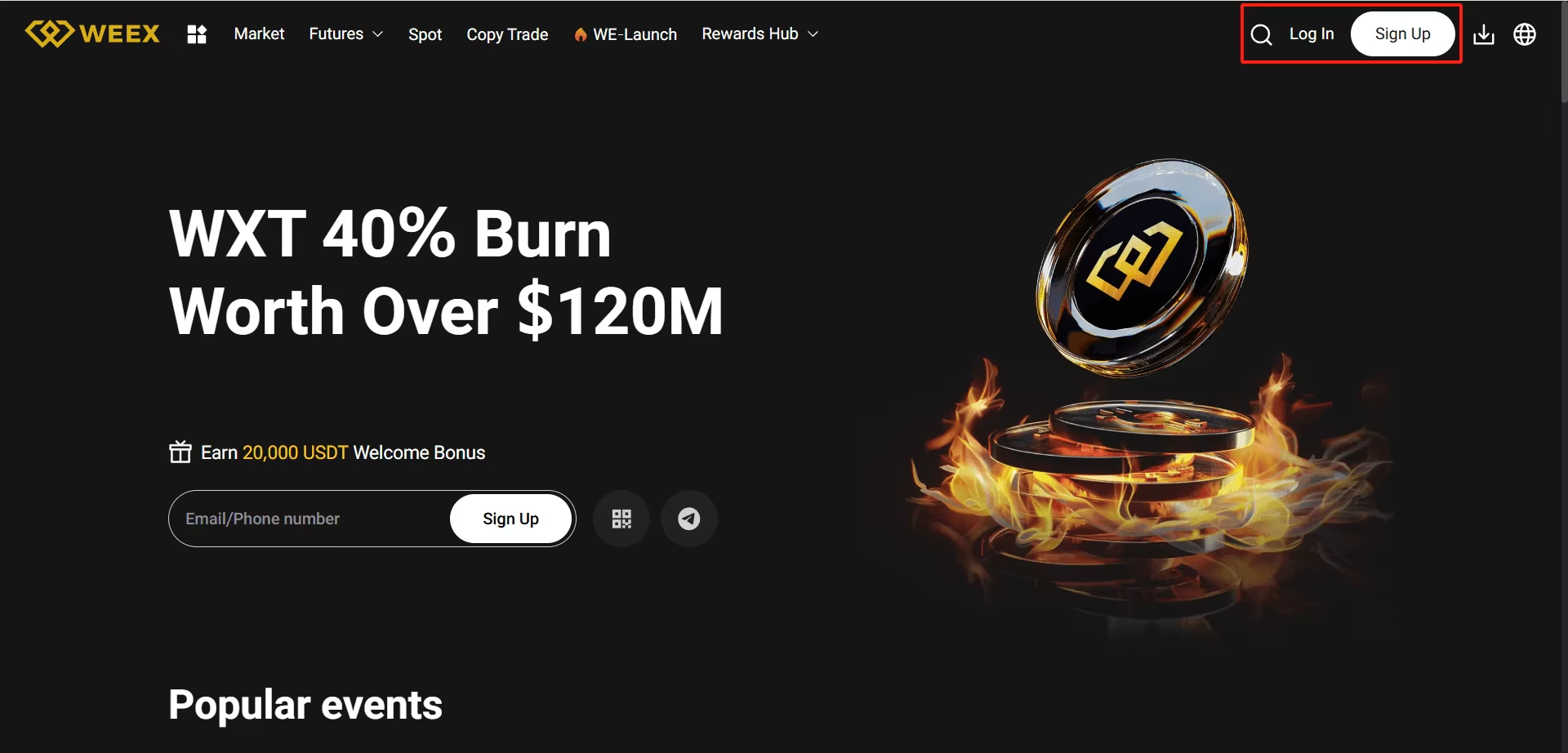
In order to uphold the topmost security protocols, WEEX Exchange will take a proactive approach by mandating users to undergo KYC (Know Your Customer) identity verification according to their user tier.
To complete the KYC identity verification process, simply select the yellow profile icon located at the top left corner of your software's homepage and proceed to upload the required documents within the "Identity Verification" section.
Ensure that you do not input incorrect details, as this may result in the suspension of your account.
Take a look at our tutorial on how to set up an account and complete the WEEX KYC process. Once everything is ready, navigate to the WEEX referral program page to proceed.
Deposit and start trading
Deposits on WEEX are free.
WEEX offers digital wallet services for token deposits. Upon logging into WEEX, you have the option to click [Assets] > click [Deposit] > select the cryptocurrency you own to deposit into the platform, select the desired cryptocurrency for deposit, and proceed to either manually copy the deposit address provided by WEEX or use the QR code scanning feature to initiate the transfer from an external digital wallet.
Explore our detailed instructions for a step-by-step guide on how to deposit on WEEX. By following these steps, you can kickstart your trading experience on WEEX.

Withdraw
Making a withdrawal on WEEX is uncomplicated. If you are utilizing our WEEX application, once you have signed up or logged in, you can proceed by clicking on [Assets], then selecting [Withdraw], followed by choosing the cryptocurrency you wish to withdraw, the network, and entering the desired address and amount. Subsequently, you only need to exercise patience until the withdrawal process is finished.
Explore our guide for how to withdraw on WEEX to gain a better understanding.

Why Choose WEEX?
Strong Security and Trusted Trading:
Security stands as a top priority in the operations of WEEX. The platform upholds a user protection fund of 1,000 BTC, along with transparently providing its address and Proof of Reserves (PoR). Additionally, WEEX implements sophisticated security protocols to safeguard user assets and information, guaranteeing a secure and reliable trading atmosphere.

Diverse Selection of Cryptocurrencies:
Supporting over 1000 cryptocurrencies, WEEX offers a wide range of digital assets for traders to diversify their investment portfolios. This includes popular cryptocurrencies such as BTC USDT, DOGE USDT, ETH USDT, ETC USDT, TRX USDT. By offering this extensive variety, WEEX enables users to capitalize on market trends, trade securely, and easily access their preferred assets.
Versatile Web and Mobile Trading Platform:
WEEX provides a functional trading experience on web as well as mobile apps, catering to traders seeking flexibility and convenience. Whether you are at home or on the go, the WEEX mobile application enables you to engage in cryptocurrency trading, monitor live market data, and manage all account preferences with just a few taps. Both platforms come equipped with advanced trading features, real-time price updates, and customizable charts, empowering users to make prompt and informed decisions. Regardless of your location or device, WEEX guarantees a seamless and effective trading journey.


Skilled Team:
WEEX's team brings together a team of experts hailing from prestigious backgrounds such as Wall Street, Silicon Valley, Citibank, and Google. WEEX has emerged as a prominent player in the global crypto trading sphere, recognized for its cutting-edge solutions and user-centric design. Backed by a proficient technical squad, WEEX delivers a secure, seamless, and effective trading platform on a global scale. Responding to rapid expansion, WEEX has scaled its workforce to over 500 professionals, elevating service standards and fostering continuous product advancement. This strategic expansion enables WEEX to address the varied requirements of its worldwide user base, solidifying its position as a frontrunner in the cryptocurrency trading sector.
Varied Services and Tools:
WEEX functions as a centralized cryptocurrency exchange (CEX) that presents a complete set of trading instruments suitable for novices as well as seasoned traders. The platform delivers a variety of services, such as spot trading, futures trading with leverage of up to 400x, over-the-counter (OTC) trading, and copy trading. Whether one intends to engage in trading at prevailing market rates, leverage positions, or track skilled traders, WEEX furnishes all essential tools essential for achieving success.
Worldwide Presence:
WEEX is proud of its extensive global presence, providing services in various countries including the Japan, Turkey, India, the Philippines, and other nations. This worldwide footprint is supported by robust technical infrastructure, expert services, and a Affiliate Program that offers commission rebates of up to 70%. Since its inception, WEEX has experienced rapid expansion, currently catering to more than 5 million active users in 134 different countries. With a daily trading volume surpassing \$50 billion, WEEX holds a position in the top 12 on CoinMarketCap.
WEEX, with its ongoing growth, continues to be a preferred option for traders looking for a dependable and effective trading platform. The confidence of users around the globe is evidenced by its success. Providing more than 1,000 trading pairs, state-of-the-art security measures, support in multiple languages, and user-friendly features, WEEX ensures an unparalleled trading journey for its international user base.
Multilingual Community Support:
The platform's success is significantly driven by The WEEX community, which caters to distinct segments of users from around the globe. Each group is committed to establishing a space where traders, investors, and cryptocurrency enthusiasts can engage, exchange ideas, and benefit from each other's knowledge. While the global community unites members worldwide, provide region-specific assistance and conversations.

WEEX actively maintains a robust presence on various social media platforms to keep its communities informed and engaged. The community interacts via channels such as Twitter, Facebook, Medium, Telegram, and YouTube. Moreover, Discord and LinkedIn act as interactive platforms for more detailed discussions and professional networking. Whether sharing market updates, promotions, or community events, WEEX's social media engagement ensures that users remain well-connected and informed at all times.
Low Fees:
In normal circumstances, spot trading fees on WEEX are 0.1% for both makers and takers. Futures trading fees are 0.02% for makers and 0.08% for takers.
Yet, hold WXT, you have the opportunity to receive a discount of up to 70% on fees for trading futures, based on your WEEX VIP tier.
Excellent Customer Service
At WEEX, we are committed to delivering outstanding customer service in order to guarantee a fantastic customer experience. Should you come across any difficulties or require clarification, our proficient support staff is on standby to help. You have various options available to contact us effortlessly.
Telegram Support: Get the Telegram app on your device, then join our authorized channels for help:
Customer Support&Business Cooperation: @weikecs
English Assistance: @weexencs
VIP Support: support@weex.com
Artificial Intelligence Support: To receive immediate assistance, just utilize the AI-driven customer service function located at the bottom right of the WEEX site. Should the need arise, you have the option to engage with a live representative for tailored assistance.
Count on dependable and prompt support from WEEX whenever you require it.
WEEX Order Types
For a comprehensive understanding of the different types of orders on WEEX, their functionalities, and strategies for leveraging them effectively, refer to this complete guide to master different types of orders on WEEX.
Market Orders
Market orders are most appropriate for traders who value quick execution and assurance more than exact pricing. By placing a market order, the trade is promptly carried out at the prevailing market price, guaranteeing immediate completion without any delays. Such orders are well-suited for individuals looking to swiftly purchase or sell assets, unconcerned about minor price changes.
If Bitcoin (BTC/USDT) is priced at $96,000, initiating a market buy order guarantees immediate execution at the most favorable available price. This price may slightly differ, for instance $96,005 or $96,010, contingent upon market liquidity during the trade. While this ensures rapid transaction processing, the precise price may experience minor deviations from the listed market value due to market fluctuations and liquidity conditions.
Limit Orders
Limit orders provide traders with increased control over their transactions, enabling them to stipulate the precise price at which they want to purchase or sell an asset. In contrast to market orders, which are executed immediately at the current market price, limit orders are triggered only once the market reaches the designated price point. This precision feature prevents buying above or selling below the intended price, facilitating a more strategic approach to trading.
If Ethereum (ETH/USDT) is trading at $2,500, you have the option to set a buy limit order at $2,488. This particular order will be triggered solely if the market value decreases to $2,488 or less, guaranteeing the acquisition of ETH at your specified price point or a more favorable one.
At WEEX, traders can benefit from using limit orders to capitalize on price changes while retaining authority over their trading decisions. By incorporating limit orders, traders can improve trading flexibility and accuracy, enabling them to optimize their market participation.
Advanced Orders
Experienced traders can take advantage of WEEX's advanced order types, which offer increased flexibility and strategic choices for optimizing trading strategies.
Orders placed with the Good-Till-Canceled (GTC) option will remain active until they are fully executed or manually canceled by the trader, providing the trader with full control over the order's duration.
- A Good-Til-Canceled order for XRP USDT at $2 remains active in the order book until the price matches your condition or you cancel it manually.
Immediate-Or-Cancel (IOC) orders seek to execute the order immediately by filling as much of it as possible, while automatically canceling any portion that remains unfilled. This order type enables partial completion of trades when liquidity conditions allow.
- An Immediate-or-Cancel order for 2 SOL USDT at $135 may fill 1.5 SOL if liquidity allows, with the remaining 0.5 SOL canceled automatically.
Fill-Or-Kill (FOK) is an order type that mandates immediate execution of the entire order. In the event that the full order cannot be filled, it is promptly canceled to prevent any incomplete transactions.
- A Fill-or-Kill order for 3 MASK USDT at $2.1 executes only if all 3 MASK can be bought at that price; otherwise, it’s fully canceled.
By using the Post Only order type, your order will add liquidity to the market when acting as a maker order. If your order would match an existing one, it will be canceled to help you steer clear of taker fees. This approach supports market liquidity and taker fee avoidance, guaranteeing your advantages as a market maker.
- Placing a Post Only order at $92,900 ensures your order adds liquidity to the market, avoiding taker fees and rewarding you as a market maker.
Utilize Take Profit Orders to automatically exit a trade when a predetermined profit target is reached, allowing you to secure profits without constant monitoring. For example, if you bought Bitcoin (BTC) at $50,000 and set a take profit order at $55,000, the position would close automatically when the price reaches $55,000, locking in your gains.
- After buying AAVE USDT at $200, a take profit order set at $95,000 will automatically close your position when the price reaches $95,000, securing your gains.
The enhanced order varieties offered on WEEX enable users to enhance the efficiency of their trading strategies, control risk, and maximize profits in a volatile market setting.
WEEX Trading Types
Spot Trading
What is WEEX Spot Trading?
Spot trading is the most conventional method of trading in the cryptocurrency market, and WEEX Exchange offers a solid platform for traders to participate in these transactions. In spot trading, assets such as cryptocurrencies are purchased or sold immediately at the current market price. Essentially, spot trading involves swapping one cryptocurrency for another, with one coin serving as the pricing unit for acquiring other coins. Orders are matched based on a priority system that considers both price and time, ensuring that each trade is executed at the optimal price. This clear and open approach has made spot trading a favored option among many traders.
Here is a concise overview, access this comprehensive spot trading guide for beginners.

Step-By-Step-Guide
Step 1: Register or Log In
To access your account, select Log in at the top of the page. If you are new to WEEX, choose to sign up and refer to our detailed step-by-step instructions for assistance.

Ensure that you have finished the identity verification process for KYC (Know Your Customer).
STEP 2: Go to Spot Trading
After logging in, simply select the "Spot" button located on the homepage's top section.
Accessing the Spot Trading Section within the WEEX platform.

Step 3: Select a Trading Pair
Explore the trading pairs that are offered and select the specific one you wish to engage in trading with.

STEP 4: Place Your Order
Choose the order type that best suits your needs from the options provided (for example, market or limit).
Select either "Buy" or "Sell" and input the quantity.
Please examine the information carefully before placing your order.

STEP 5: Track Your Orders
Access Open Orders to see all current orders that are still awaiting processing. It is possible to make adjustments or terminate them as necessary.
View Order History: Review all your previous transactions, comprising both fulfilled and revoked orders.
Copy Trading
What is WEEX Copy Trading?
WEEX copy trading enables users to automatically replicate the trades of skilled and accomplished traders on the WEEX platform. By mimicking the strategies of top traders, novices or individuals with less experience can potentially benefit from their expertise. Users have the option to select traders to follow based on their performance, with the system automatically duplicating their trades in real-time. This functionality offers a straightforward entry point into cryptocurrency trading without requiring extensive market understanding, allowing for a hands-off trading experience while gaining insights from seasoned professionals.
What is WEEX Copy Trading Pro?
WEEX has launched the Copy Trading Pro function in order to streamline the process of entering the futures trading market. This feature offers traders and those who copy their trades a clear and easy-to-use platform for trading digital derivatives, with the goal of increasing profits and benefiting all involved parties.
Using WEEX Copy Trading Pro enables individuals to replicate the techniques used by professional traders. This feature allows users to generate income without having to conduct thorough market analysis or actively oversee trades. It is crucial to note that all trades, regardless of their outcomes, will be duplicated by followers. Therefore, it is vital to select traders whose methods are in line with your risk tolerance level.

Why WEEX Copy Trading?
For Copy Traders:
Traders who copy others' strategies can make profits effortlessly without the need to constantly keep an eye on charts all day long.
- Secure and Trustworthy:
WEEX meticulously picks out top traders globally, providing a range of leading strategists for users to select. Transparent and trustworthy trading is ensured through real-time trading data and trackable records of both leading and copied trades.
- Effortless Earnings:
- By simply clicking a button, users can copy multiple traders and sync their opening and closing actions to maximize profitability. Real-time monitoring of profit data from each copied trade allows for adjustments in the copied amount at any given moment. Users also have the flexibility to cease copying or secure profits by closing positions whenever they deem fit.
For Traders:
Traders have the opportunity to leverage the WEEX Traffic Pool, acquiring traffic as well as earning commissions from replicated trades.
- Lucrative Profit Sharing: Traders receive a 10% portion of profits from replicated trades.
- Greater Visibility: Connect with over 10,000 focused futures traders, with platform support to amplify your trading influence and increase your income.
Select this option to join the ranks of an Elite Trader.
Step-By-Step-Guide
STEP 1: Select a Copy Trader
When choosing a top trader to replicate on the Copy Trading Pro platform, take into account various important performance metrics:
- Active Days: Duration counted from the registration date.
- 3-Week Copier Earnings: Total profits earned by copiers in the last three weeks.
- 3-Week PnL: Profit from the past three weeks ÷ the largest single opening position principal in that period.
- 3-Week Win Rate: Profitable orders in the last three weeks ÷ total orders in the same timeframe.
- 3-Week Profit (USDT): Total realized profits over the past three weeks.
- All-Time Copy Trading Profits: Total historical profits generated for copiers.
- Total PnL: Cumulative profits to date ÷ the largest single all-time opening position principal.
- Total Trades: Number of closed orders to date.
- Total Copiers: Number of unique copier accounts following this elite trader to date, counted once per account.
- Current Copiers: Number of users actively copying this elite trader at present.

STEP 2: Configure Copy Trading and Margin Settings
Select a copy trading mode:
- Uniform Mode: Consistent margin settings across all trading pairs.
- Separated Mode: Unique settings tailored for each trading pair.
Next, select your margin setting:
- Position Mode: Replicates your chosen leverage.
- Trader Mode: Adopts the leverage set by the trader.
- Custom Mode: Personalized leverage for individual trades.
Step 3: Set Copy Trade Amount and Customize Advanced Options
Specify the quantity for every trade (either fixed in USDT or based on portfolio ratio). Adjust risk control parameters like stop-loss, take-profit, and slippage ratios, and establish a maximum trading size.
Step 4: Validate and Initiate Copy Trading
Examine all configurations, select "Next" for validation, and verify that there are adequate funds in your futures account for executing the trades.
Futures
Know WEEX Futures Pro
A perpetual futures contract is a type of financial derivative that blends aspects of spot margin trading and futures trading. In contrast to regular futures contracts that have specific delivery dates, perpetual futures are standardized, incorporate margin trading, and settle instantly.

Perpetual futures contracts lack a set expiry date or delivery requirement, permitting traders to maintain their positions without time constraints. To keep the contract price aligned with the spot price, a funding system is implemented. This system involves the exchange of funding rates between long and short positions periodically, which serves to mitigate notable price discrepancies.
The WEEX Futures Pro platform is at the forefront of the cryptocurrency derivatives industry. It caters to seasoned traders seeking a comprehensive and sophisticated trading environment. Users can rely on this platform to manage cryptocurrency derivatives with precision and effectiveness.
WEEX Futures Pro is designed to cater to the requirements of cryptocurrency derivatives traders. It provides opportunities to engage in a wide range of financial products, going beyond the scope of just digital currencies. Users are able to participate in futures contracts trading and make predictions on the value of digital assets without possessing them.
Why WEEX Futures Pro?
The WEEX Futures Pro platform is equipped with a variety of functionalities specifically tailored for experienced traders. It includes sophisticated charting capabilities, live market information, and robust risk control functionalities. Furthermore, users have the option to access a trial edition to become acquainted with futures trading.
Notable characteristics consist of market, limit, and trigger orders, simulated trading, as well as a Futures Pro Calculator for determining PnL, settlement price, and break-even price. Additionally, it enables a maximum leverage of 400x.
Flexible Trading Solutions: Traders can utilize WEEX Futures Pro to conduct trades in different markets without the requirement to uphold margin for numerous positions, thereby enhancing effectiveness.
Broadened Investment Opportunities: Traders can enhance their investment portfolios by spreading their funds across various futures contracts, providing increased flexibility and more effective portfolio supervision.
Strong and Dependable: With smart risk control and a two-tier manual approach, WEEX Futures Pro guarantees safety, empowering traders to establish exact profit-taking and stop-loss levels for trading with security and assurance.
Here is a short overview, access this comprehensive guide for crypto traders on how to trade futures on WEEX.
Step-by-step Guide
After setting up your account and depositing funds, you can start trading futures on WEEX swiftly and effortlessly in three simple steps! Follow these instructions using the BTC Perpetual/USDT illustration:
Step 1: Move Funds to Your Futures Account
Select the Deposit option to transfer cryptocurrency from a different wallet, and proceed to move assets from either your spot or futures account to your Futures Pro account.
Step 2: Profit from a Rising Market by Going Long
If you anticipate an increase in price and wish to initiate a long position, specify the price, quantity, and leverage. Subsequently, select "Open Long (Bullish)" to proceed.
To exit your position, simply select "Close," input the necessary information, and then choose "Close Long."
Step 3: Capitalize on a Falling Market by Going Short
If you anticipate a price decrease and wish to initiate a short position, specify the price, quantity, and leverage. Subsequently, select "Open Short (Bearish)" by clicking on it.
To exit your position, select "Close," input the required information, and then choose "Close Short."

WEEX Leverage
What is Margin?
When initiating a trade, the funds utilized as margin are secured and unavailable for additional trading activities.
Margin serves as a deposit in leveraged trading, enabling the amplification of the order size through the utilization of leverage.
Position Value = Margin x Leverage
This implies that the greater the leverage, the lesser the margin needed.
For instance, when trading Bitcoin using leverage at a market price of approximately 7,000 USDT, you would need to provide a margin of about 200 USDT (excluding fees) on our platform. This allows you to speculate on price fluctuations in both directions and potentially gain profits from them. Any losses incurred will be subtracted from the margin, and once the liquidation price is reached, your position will be automatically liquidated.
Consider the margin as a security deposit for your trade. When you close your position, we will refund the margin to you, adjusting for your profit or loss and any applicable fees. Lower margin usage results in higher leverage, amplifying the risk associated with market fluctuations. Conversely, higher margin utilization decreases leverage, widening the potential profit or loss margin and reducing overall risk. If you are worried about risk, you can choose the isolated position mode.
Margin can be calculated by dividing the product of Contract Quantity, Futures Face Value, and Open Price by Leverage. For instance, if you are trading 100 Dogecoins at an open price of 0.1779 with a leverage of 20x, the margin calculation is: Margin = (100 x 1 x 0.1779) ÷ 20 = 0.8895. For more precise results, utilize the [Calculator] located in the upper right corner of the futures page.
For additional margin details, please refer to the Margin section on the WEEX Futures website.
WEEX Margin Modes:
Cross margin mode
Cross margin functionality on WEEX enables leveraging all funds in a single futures account as margin for active positions. In case a position results in a loss surpassing the available account balance, it will be automatically closed. This feature enhances risk management capabilities, simplifying position management and evaluation. Moreover, the cross margin mode accommodates hedge trading, offering increased versatility in trading approaches.
Isolated margin mode
On WEEX, the isolated margin system assesses risks for short and long trades separately. If liquidation happens, only the margin assigned to that specific trade will be lost. Profits or losses from a closed position are settled into the margin for that trade. In the event of liquidation due to price fluctuations, the user will lose only the margin related to that position, with no impact on other funds in the futures account.
WEEX WE-Launch
What is We-Launch
Users have the opportunity to stake their WXT in pools and receive complimentary tokens from new WEEX WE-Launch premium projects. This platform provides a secure and uncomplicated method to participate in initial cryptocurrency offerings.
In past We-Launch initiatives, numerous well-received tokens like DOGS and TRUMP have taken part.
How to Join in WE-Launch?
In order to join the WEEX We-Launch event, you must register or sign in to your WEEX account and possess WXT tokens to qualify. For further information, refer to a detailed guide on the process.
Step 1: Register or Log In to WEEX
New users can refer to the guide on setting up a WEEX account. Existing users with a WEEX account can proceed to log in.

If you are utilizing a mobile device, kindly install the application in order to register or access your account on WEEX.

Step 2: Hold WXT to be qualified
To qualify, you need to maintain a minimum of 1000 WXT in your spot account for a period of two consecutive days. Below are the steps to purchase WXT on WEEX.
For Web
Engage in trading of WXT USDT on this platform or proceed to the We-Launch category located in the navigation menu and select it.

Press the Purchase button for WXT located on the webpage.

Please input the quantity of WXT you wish to purchase.

For Phone
If you are on a mobile device, select the "WEEX WE-Launch" feature from the WEEX main page and proceed by clicking on the "Purchase WXT" tab.


Input the quantity you wish to purchase, choose your preferred payment option, and assess the current exchange rate prior to finalizing the transaction.

To learn additional information on purchasing WXT, refer to this guide and proceed.
Please note:
- If your WXT balance drops below 1000 WXT for two consecutive days, your account will be suspended.
- Coins that are locked will not count toward the available amount for commitment.
Step 3: Select a Project and Commit WXT
Navigate through the WEEX We-Launch webpage, review the current initiatives, select a project collection, and press the Commit WXT option.


Note:
- If you qualify for a WE-Launch event, ensure you commit WXT during the designated period.
- The committed amount is solely for calculating rewards, and your WXT tokens will remain unfrozen.
Step 4: Monitor and Claim Your Rewards
The airdrop incentive for individual participants is determined following the conclusion of the commitment phase. Nevertheless, you have the ability to verify your precise rewards, anticipated rewards, and legitimate WXT commitment on the dashboard of the project to which you have committed.

WEEX will determine the airdrop quantity by considering the proportion of a user's legitimate WXT commitment (quantity committed × commitment multiplier) in the overall prize pool, and then allocate the airdrops to the user's spot account.
You have the ability to review your reward history at this location:


WEEX Affiliate & Referral Programs
WEEX Affiliate Program
What is the Affiliate Program
The WEEX Affiliate Program targets influencers, content producers, and people with a significant fan base, providing them with an opportunity to generate income through the promotion of WEEX and the recruitment of fresh users to the platform.
How to participate WEEX Affiliate Program
Getting started with the WEEX Affiliate Program is easy and uncomplicated. To learn more, refer to this quick guide that explains the process in detail.
To begin, simply follow these simple instructions:
Step 1: Register or Log In
Explore the WEEX Affiliate Platform or get the app. Simply tap on the "Log In" option located at the top. If you are new, select "Sign Up" and refer to the detailed instructions. Remember to finalize the KYC (Know Your Customer) identity verification process.

Step 2: Complete Your Application
Simply press the "Apply Now" button and complete the application form by including information regarding your platform/channel, followers, members, and personal details. Furnish precise and thorough information to enhance the likelihood of your application being approved.

Step 3: Await Approval
Upon receipt of your application, WEEX will proceed with a review of your submission. This process generally requires 1-2 working days. Upon approval, an email confirmation will be sent to you, and you can expect to be contacted by the WEEX Affiliate team.
Step 4: Explore Your Affiliate Dashboard
After receiving authorization, access your WEEX affiliate dashboard. This platform enables you to oversee your referrals, monitor trading statistics, and review your overall earnings.

Step 5: Share Your Unique Affiliate Links
Create personalized referral links and codes, or obtain the QR code from the dashboard to distribute on your website, blog, social platforms, or advertising efforts.

Step 6: Monitor Your Earnings and Results
Utilize the WEEX dashboard for real-time tracking of your commissions and performance. Evaluate your outcomes and adapt your tactics to optimize your profits.

WEEX Referral Program
What is WEEX Referral Program
The WEEX cryptocurrency exchange provides an affiliate program known as the WEEX referral program. Participants are given a referral code or invite link to share with their acquaintances, or they can opt to share a QR code for scanning. Upon registration by those they refer, the referrer will receive a commission equal to 50% of the fees generated.
For example, if a referral conducts a $120 crypto trade resulting in a $12 fee, the referrer will receive $6. Likewise, if the referral engages in a $2,000 trade incurring a $200 fee, the referrer will earn $100.
How to Participate In WEEX Referral Program
Participating in the WEEX referral program is easy. Just distribute your referral link or code, and when your referral signs up, you will receive a commission. For additional information, refer to this step-by-step guide of the process.
Prepared to begin making money? Simply adhere to these uncomplicated instructions:
Step 1: Register or Log In
- For New Users: Go to the WEEX signup page or download the app and select [Sign Up]. Enter your email or phone number, making sure it’s correct, and create a strong password. Finish the registration steps and input the referral code in the provided field.

- For Existing Users: Sign into your account, hover over your profile, and select "Invite Friends," or go to the official WEEX Referral Program page.

Step 2: Fulfilling KYC Verification (Identity Verification)
In order to uphold the most stringent security protocols, WEEX mandates that users undergo KYC (Know Your Customer) verification corresponding to their level of access.
To complete the verification process, simply select the yellow profile icon located at the upper left corner of the homepage, and proceed to upload the required documents under the section labeled "Identity Verification."
Make sure to input precise data, as providing inaccurate information could lead to the suspension of your account. Refer to our KYC manual for guidance, and after verification, head to the WEEX referral scheme section.
Step 3: Distribute Your Referral Code/Link
You have the option to either copy your unique referral code using the designated button, spread your referral link, or circulate a QR code that serves as your referral identifier through email, social platforms, or instant messaging. The more you distribute, the higher the potential rewards you may receive.

To ensure you receive your commission, it is essential that your referral code is applied by your referee when they register. Failure to do so will result in you not obtaining any bonus.
Step 4: Monitor Referrals & Earnings
To keep track of the rewards and bonuses you've accumulated, you can simply access the WEEX referral program page and navigate to the section labeled "My Performance." Within this area, you will be able to oversee the commissions you have generated and view the total count of users you have referred. This feature enables you to stay informed about your advancements and potential income.

WXT
What Is WXT (WEEX Token)?
WEEX token is a key element of the WEEX ecosystem, aiming to enrich the platform and deliver a range of advantages to users. Following its launch, WXT has experienced a remarkable surge of 384%, hitting a record peak of \$0.03391. Boasting a total token supply of 6 billion, WXT provides perks such as giveaways, reduced fees, and an impressive annual yield of 140%. Additionally, it implements a deflationary approach to enhance its long-term value.
WXT acts as an incentive system for the WEEX community, providing special perks such as access to the launchpad, reduced trading fees, and early access to WEEX events. Through the possession and utilization of WXT, individuals can benefit from potential long-range profits and an enhanced trading environment as the WEEX platform expands further.
Learn how to buy WXT now!

Why Pick WXT?
The WXT token provides a wide array of advantages that enrich your WEEX platform experience. By participating in WXT events on WE-Launch, users can obtain complimentary token airdrops from well-known projects and benefit from a 140% APY by holding WXT. WXT holders receive priority access to WE-Launch events, increased reward multipliers, and the chance to purchase new project tokens at attractive prices.
Moreover, WXT demonstrates increasing on-chain functionality, encompassing its involvement in decentralized finance (DeFi) and NFT markets, along with applications that span across different ecosystems in DEXs and wallets. Moreover, holders of WXT possess the ability to participate in voting processes concerning platform-related decisions, such as the addition of new coins and enhancements to existing features. They are also empowered to put forward governance proposals aimed at shaping the platform's future progression.
Owning WXT also comes with additional advantages, such as reduced trading fees, increased referral rewards, special event incentives, and frequent token distributions. Holding WXT can elevate your VIP status, providing access to varying discount levels, while elite traders who possess WXT receive a greater percentage of profits.

Burn WXT
The deflationary approach of the WXT burn mechanism involves periodically taking out a portion of WXT tokens from circulation, which decreases the overall supply and has the potential to boost the token's value in the long term. This strategy is executed through the purchase and permanent removal of WXT tokens by WEEX from the open market, driven by platform revenues or specific milestones. The advantages include heightened scarcity, sustained rewards for holders, market steadiness, and increased trust within the community. By diminishing the token supply, the burn mechanism establishes scarcity, which in turn elevates the token's value as demand grows. Furthermore, it contributes to the growth of the WEEX ecosystem by attracting investors, improving liquidity, and reinforcing user trust. Through transparent burn processes, WEEX showcases its dedication to creating sustainable value, positioning WXT as a promising asset in the realm of cryptocurrency.
The WXT burns scheduled for the first quarter of 2025 were successfully carried out by WEEX. By utilizing a transparent burn mechanism on January 31, 2025, the platform permanently eliminated 4,000,000,000 WXT (4 billion tokens) from circulation. This deflationary measure is in line with the project's dedication to improving token functionality and maintaining value stability. It represents a significant advancement in the project's updated whitepaper strategy aimed at managing supply-demand dynamics effectively and nurturing sustainable ecosystem development.
Fees On WEEX
Deposits and Withdrawals
Deposits made to WEEX are free.
Weex does not impose any fees on users for cryptocurrency withdrawals; however, users are responsible for covering the network or miners fee, which can fluctuate based on the specific cryptocurrency and network circumstances.
The withdrawal charges for WEEX are available on this page: Rate Standards
When utilizing our WEEX application, simply select the profile icon located at the top left corner and then navigate to [Fee Rates] to access the withdrawal fee rates applicable to all cryptocurrencies.
Click here for access to the full WEEX WXT guide.
Trading Fees
Under usual conditions, both makers and takers are charged a 0.1% fee for spot trading on WEEX. For futures trading, makers pay a fee of 0.02% while takers pay 0.08%.
By holding WXT, you have the opportunity to receive a discount of up to 70% for futures trading fees based on your WEEX vip level. The discount amount increases with the level of your membership. Register or sign in to WEEX today!
To access the regulations and fee structure, simply select the assets icon located in the corner, navigate to [Futures], and choose [Enjoy up to 70% off transaction fees].
Furthermore, occasional trading fee discounts are also provided by WEEX, hence it is advisable to refer to the latest event announcements!
The trading fees for WEEX spot trading and futures trading are available on this page: Rate Standards.
WEEX VIP
The WEEX VIP program is specifically created to provide top-notch assistance and benefits to valued customers. Being a VIP grants you immediate contact with an assigned account manager accessible 24/7 through a dedicated VIP communication channel for resolving any account concerns. This guarantees a tailored, effective service without the usual waiting times or obstacles.
Being a WEEX VIP offers more than just superior customer service. VIPs receive priority treatment for withdrawals, ensuring quick and straightforward transactions without the need for complex verification processes for large sums. Moreover, VIPs are spared from extended lock-up periods and collateral requirements, enhancing transaction efficiency and flexibility. To become eligible, just provide your UID to the customer service team. If you meet the requirements, you will be assigned a dedicated account manager and granted full VIP benefits.
Complete the VIP application form today in order to join the ranks of WEEX VIP members!
WEEX Global Ambassador
Success in football relies on executing accurate maneuvers at the appropriate time, blending speed, precision, and a solid strategy. Similar to the dynamics on the field, triumph in the cryptocurrency market necessitates timely choices, meticulous planning, and a dependable ally to navigate the market fluctuations. This is why the collaboration between Michael Owen and WEEX has been forged---each move pushes WEEX × weex ambassador Owen closer to triumph. By leveraging Owen's strategic acumen and precision alongside WEEX's cutting-edge platform and unwavering commitment to security, this partnership strives to introduce a winning strategy to the realm of cryptocurrency exchange. Just as a cohesive football team operates in harmony, WEEX Owen embodies the strength of teamwork and the determination to excel.

WEEX Vision for 2025
- Enhanced Trading Tools: Continuously developing advanced features to elevate the user experience.
- Worldwide Expansion: Growing its presence to unite traders and communities globally.
- Uncompromising Security: Upholding robust security standards while embracing cutting-edge innovations.
Grateful for the community’s trust and support, WEEX welcomes you to join its mission to redefine cryptocurrency trading. Explore more possibilities by visiting the official WEEX website today.
Conclusion
WEEX stands out as a top cryptocurrency exchange that combines security, innovation, and user-centered design seamlessly. By establishing a 1,000 BTC user protection fund and ensuring transparency through Proof of Reserves, WEEX places a strong emphasis on trust and the safety of assets. Offering a wide range of services including spot trading, 400x leveraged futures, copy trading, and WE-Launch token pools, WEEX caters to traders of all levels, supported by a selection of over 1,500 trading pairs and competitive low fees. The platform's WXT token ecosystem, which is designed to be deflationary, its presence in 134 countries worldwide, and strategic partnerships such as Michael Owen's ambassadorship, all contribute to reinforcing its competitive advantage.
For individuals in the trading world looking for a safe, feature-packed, and community-driven platform, WEEX serves as the entrance to the upcoming trends in cryptocurrency. Gain access to exclusive incentives, reduced fees, and early entry to promising projects by registering today and becoming one of the 5 million users influencing the future of digital finance. Embark on your WEEX journey and explore cutting-edge innovation in trading.
WEEX aims to shape the future of the digital assets industry through the provision of a secure, private, and user-friendly platform. The objective of the WEEX ecosystem is to establish a self-sustaining financial system powered by blockchain technology, offering a range of applications to democratize access to blockchain technology. By connecting cryptocurrency with traditional finance, WEEX is striving to lower entry barriers and introduce cutting-edge products, envisioning a future where digital assets assume a central role in everyday activities.
FAQ (Frequently Asked Questions)
How many cryptocurrencies are available on WEEX?
Supporting more than 1000 cryptocurrencies, WEEX offers a wide variety of digital assets for traders to diversify their portfolios effectively. This selection includes established cryptocurrencies, enabling users to capitalize on market opportunities, trade securely, and conveniently access their preferred assets.
Is WEEX a secure platform?
Affirmative, WEEX is secure. Safety is a key priority for WEEX, demonstrated through various measures including a 1,000 BTC margin pool and dual-layer risk control systems that blend smart technology with manual supervision. In addition, WEEX upholds a safe and confidential setting by utilizing servers located worldwide and employing advanced wallet management verification. Furthermore, WEEX delivers a top-notch futures trading platform offering benefits such as zero charges on tiered liquidations, immediate deposits and withdrawals, and specialized customer service.
How can I add funds to my WEEX account?
Adding funds to WEEX is simple and supports various methods. Refer to the Step-by-Step Guide to finalize your deposit and kickstart your trading or investment experience.
Where can I locate additional FAQs for WEEX?
Explore WEEX wiki to locate the inquiry you seek or navigate through our WEEX support for the solution you require.
You may also like

How to Make Money on Prediction Markets: Beginner Strategies, Risks, and Market Basics
Prediction markets are one of the clearest ways to turn uncertainty into a tradeable number. If you understand how event contracts are priced, how settlement works, and why the market moves, you can use prediction markets to express a view on elections, inflation, Fed decisions, earnings, sports, or other clearly defined outcomes. The smartest way to make money on prediction markets is not to chase every headline, but to focus on events you understand, trade only when the probability looks mispriced, and keep risk small enough to survive being wrong several times in a row.
Wanna Trade Safe & Fast? Join WEEX and Earn!
What Prediction Markets Are and Why They Can Be ProfitablePrediction markets are markets where people buy and sell contracts tied to future events. The CFTC says these products are usually called event contracts and that they have existed in U.S. regulated markets for more than two decades. The basic idea is simple: a contract pays out if a specific event happens, and the market price reflects the crowd’s estimate of that event’s probability. That is why people talk about prediction markets as both a forecasting tool and a trading venue.
This is what makes prediction markets potentially profitable. If a contract is trading at a lower price than the real-world probability of the event, a trader may buy it and profit when the market corrects or when the event resolves in their favor. If the price is too high, a trader may avoid it or, where allowed, take the opposite side. The opportunity comes from mispricing, not from luck alone.
Federal Reserve research released in 2026 adds an important point for beginners: prediction markets can provide high-frequency, continuously updated, distributionally rich benchmark forecasts. That means they are not just “bets.” They can also be used to study how expectations change when new information arrives. For a trader, that matters because market price moves often reveal whether the crowd is overreacting, underreacting, or simply learning faster than you are.
How to Make Money on Prediction MarketsThe main way to make money on prediction markets is to buy contracts when the implied probability is too low and sell or avoid contracts when the implied probability is too high. In simple terms, if a contract implies a 40 percent chance of something happening but you believe the true chance is 60 percent, the trade may have value. That is the same logic behind betting on undervalued odds, except prediction markets are typically structured as regulated financial contracts rather than casual wagers.
Beginners often think the only way to profit is by being “right” about the final outcome. In practice, there are several ways to make money on prediction markets. You can profit from a price move before settlement if the market re-prices your contract. You can profit by holding to expiration when the event resolves in your favor. In some systems, you may also profit by entering a better price than the crowd later accepts. The core skill is spotting a mispriced probability early enough.
A useful mindset is to compare prediction markets with other probability tools. Polls tell you what people say. Prediction markets tell you what people are willing to risk money on. That makes them more reactive to breaking news and policy signals. The Fed’s 2026 paper specifically notes that these markets respond to macroeconomic and financial news, which is exactly why traders watch them around jobs data, inflation releases, and central bank meetings.
Beginner-Friendly Ways to ProfitThe easiest way for a beginner to make money on prediction markets is to trade simple, well-defined events instead of vague or emotional ones. A good event has a clear question, a clear deadline, and a clear settlement source. The CFTC’s own materials emphasize that event contracts can reference things like macroeconomic indicators, corporate earnings, snowfall, or hurricane damage, but the contract design must be specific enough to resolve without confusion.
Here is a practical beginner framework.
MethodHow it makes moneyBest for beginners?Main riskBuying underpriced contractsEvent resolves in your favor or the market price risesYesYou may be wrong on probabilityTrading around new informationPrice moves after news, then you exit before expirationSometimesYou can overreact tooHolding to settlementYou wait for the contract to pay outYes, if the event is clearYou must be right at the endRelative value tradingYou compare closely related outcomes and pick the mispriced oneMore advancedCorrelation can breakHedging a real exposureYou use a contract to offset a business or portfolio riskMore advancedThe hedge may be imperfectThis table is an original synthesis based on the CFTC’s definition of event contracts and the Fed’s 2026 research on prediction market behavior. The key point is that beginners should usually focus on the first and third rows before trying anything more complex.
The Best Types of Prediction Markets to Trade FirstIf you are new, start with markets where the outcome is objective. Election outcomes, Federal Reserve decisions, inflation thresholds, unemployment data, and earnings surprises are easier to understand than highly subjective questions. Reuters has reported that prediction markets are being pushed into institutional finance, which makes macro and policy events even more relevant to traders who want cleaner, data-driven setups.
Why does objectivity matter? Because the more subjective the contract, the more likely the market will be influenced by vague wording, low liquidity, or arguments over what counts as a valid resolution. The CFTC’s event-contract guidance also shows that not every topic is allowed. Certain categories, including terrorism, assassination, war, gaming, and unlawful activity, are prohibited under Regulation 40.11. That means beginners should stay inside clear, ordinary event types rather than chasing exotic contracts they do not fully understand.
A good beginner trade usually has three features: strong public information, a deadline that is close enough to verify soon, and enough trading activity to keep prices meaningful. That combination gives you a better chance of spotting a genuine mispricing rather than an empty market with a misleading price.
How to Read Prices Like a TraderPrediction markets are often priced between 0 and 100 cents. In many cases, a 70 cent contract implies roughly a 70 percent probability, before fees and market frictions. That is why traders speak in terms of “implied probability.” It helps you compare your own view with the crowd’s view in a way that is much easier to act on than a vague opinion.
If the market says an outcome is 30 percent likely and you think it is 55 percent likely, you do not need to predict the future perfectly to make money. You only need the market to be underestimating the chance enough to give you a positive expectation after fees and slippage. That is the heart of profitable prediction markets trading.
The hardest part for beginners is not understanding the number. It is understanding whether that number is actually attractive. A contract priced at 20 cents is not automatically “cheap.” It may be cheap because the event is genuinely unlikely or because the market already knows something you do not. This is where news flow, timing, and discipline matter more than excitement.
What Changed in 2026 and Why It Matters for ProfitIn 2026, the regulatory backdrop became more active. The CFTC withdrew its 2024 event-contract proposal in February, then in March issued a staff advisory saying it wanted to encourage growth and innovation while reminding market participants of their obligations under the Commodity Exchange Act. It also reaffirmed its exclusive jurisdiction over U.S. commodity derivatives markets, including prediction markets, in a February 2026 court filing.
That matters for traders because legal clarity affects liquidity, product design, and market access. If a market is uncertain from a regulatory standpoint, participation can shrink or become fragmented. The CFTC has also continued to update its position through public comments and new proposals in June 2026, showing that prediction markets are still an active policy topic rather than a settled one.
There is also a new enforcement angle. The CFTC’s February 2026 enforcement advisory followed cases involving misuse of nonpublic information and fraud in prediction markets, and the agency has since highlighted additional insider-trading style issues. For beginners, the lesson is simple: profit only from lawful public information. Trying to use private information or influence the outcome is not a clever shortcut; it is a regulatory risk.
Common Strategies People Use to Make Money on Prediction MarketsThe first strategy is event-driven trading. This means you enter before a known catalyst, such as an inflation release, Fed meeting, earnings report, or election debate, and exit when the market reprices. The Fed’s 2026 research notes that prediction market expectations respond to macroeconomic and financial news, which is exactly why these trades can work.
The second strategy is value trading. Here you look for a contract that appears mispriced relative to other public information. For example, if multiple data sources all point in one direction but the market has not moved enough, that may be a value opportunity. The danger is that traders often confuse “I disagree with the market” with “I have an edge.” You need evidence, not just confidence.
The third strategy is holding to settlement on a clean event. This is the simplest form of prediction markets profit. If you understand the contract and the event is straightforward, you buy at a favorable price and wait for the payout. This is often better for beginners than trying to scalp tiny moves all day, because it reduces decision frequency and emotional noise.
The fourth strategy is relative-value trading. That means comparing two linked markets and exploiting the gap between them. This is more advanced because the connection between outcomes is not always stable. Still, it can be powerful when the market is overpricing one side of a closely related pair.
Table: Beginner Strategy GuideStrategyWhat you doSkill levelWhy it can workEvent-driven tradeTrade before a major news releaseBeginner to intermediateMarkets often move sharply after new informationHold-to-settlementBuy a contract and wait for resolutionBeginnerClear events can give a clean payoffValue tradeBuy contracts the crowd seems to underpriceBeginner to intermediateMispricing can close as more information arrivesRelative-value tradeCompare related outcomes and trade the gapIntermediateRelated markets do not always price perfectlyRisk hedgeUse contracts to offset existing exposureIntermediateThe market can reduce losses in another positionThis table is meant to help beginners choose a starting point. The safest path is usually to begin with simple event-driven or hold-to-settlement trades on objective outcomes, then expand only after you understand pricing behavior and settlement rules. That advice lines up with the CFTC’s emphasis on clear event contracts and the Fed’s evidence that these markets can move quickly on new data.
Risk Management Is Where Most Traders Win or LoseThe biggest mistake beginners make is thinking prediction markets are all about being right. They are not. They are about being right often enough, with position sizes small enough that a few wrong trades do not wipe you out. The CFTC’s recent enforcement actions also show that integrity matters. If you do not control your risk and your behavior, the market will eventually punish you.
A practical rule is to treat each trade as a hypothesis, not a certainty. If you buy a contract because you think an event has a 60 percent chance, you should already know what news would invalidate that view. When the market gives you information that contradicts your thesis, the best move is often to cut the trade instead of hoping. Prediction markets reward fast learning.
Liquidity matters too. Reuters has reported that prediction market platforms are pushing toward institutional investors and broader adoption, but that popularity comes with more scrutiny and more suspicious-trade monitoring. Thin markets can look easy to trade, but they can trap beginners with wide spreads and sudden jumps. Always check whether enough participants are actually making the price meaningful.
Why Prediction Markets Are Attracting More AttentionPrediction markets are growing because they sit at the intersection of finance, data, and public curiosity. Reuters reported that platforms are seeking institutional investors, while the CFTC has described prediction markets as a rapidly rising part of the market landscape. At the same time, the CFTC’s research and rulemaking show that regulators now see these markets as too important to ignore.
There is also a product-development angle. Reuters reported in March 2026 that Cboe plans to launch prediction market contracts with partial payouts, moving beyond the traditional all-or-nothing format. That suggests the category is still evolving, which can create new opportunities for traders who understand the structure before the crowd does.
But more attention also means more scrutiny. Reuters reported rising suspicious-trade concerns across prediction platforms in 2026, and the CFTC has repeatedly emphasized fraud, insider information, and manipulation risks. The better the markets get, the more they resemble other serious financial venues: opportunity plus oversight. That is good for long-term credibility, but beginners should still trade carefully.
A Simple Beginner WorkflowHere is the cleanest way to approach prediction markets if you are just starting. First, pick a single event you can understand. Second, read the contract terms and settlement rules very carefully. Third, compare the market price with at least two other public information sources. Fourth, decide in advance how much you can lose. Fifth, enter only if the edge is still there after fees and slippage.
This workflow is important because many beginners skip directly to trading. That usually leads to emotional decisions. Prediction markets are easiest to trade when the event is narrow, the time horizon is short, and the information flow is transparent. The Fed’s 2026 paper supports the idea that these markets update quickly around news, which means your process must be just as fast and disciplined.
If you want to build skill, track your trades. Write down why you entered, what probability you believed was fair, and what happened after new information arrived. Over time, this is how you learn whether you are actually good at prediction markets or just lucky on a few trades.
ConclusionThe best answer to how to make money on prediction markets is surprisingly simple: find mispriced probabilities, trade only clean events you understand, and control risk so a mistake is survivable. Prediction markets are powerful because they convert uncertainty into prices, and that gives traders a way to act on information before the final outcome is known. They can be profitable, but they are not effortless.
For beginners, the safest and most practical path is to start small, focus on objective events, and avoid contracts you cannot fully explain in plain English. The 2026 regulatory environment also makes one thing clear: lawful innovation is welcomed, but misuse of information, manipulation, and reckless speculation are being watched closely. If you decide to trade, do it with a plan, not a guess. That is the difference between smart participation and expensive noise.
FAQ1. Can beginners make money on prediction markets?Yes, but usually only if they focus on simple, well-defined events and size positions carefully. Beginners are more likely to do well by buying mispriced contracts on objective outcomes than by trying advanced trading tactics too early.
2. What is the easiest prediction market strategy for a new trader?The easiest strategy is to trade a clear event with a short timeline and a transparent settlement rule, then hold to resolution if the price looks favorable. That reduces complexity and helps you learn how implied probability works.
3. Are prediction markets legal?Some regulated event contracts are legal in the United States, but the legal framework is still actively evolving. The CFTC has reaffirmed its exclusive jurisdiction, withdrawn an earlier proposal, and continued new rulemaking in 2026.
4. What is the biggest risk when trying to make money on prediction markets?The biggest risk is assuming you have an edge when you do not. Other major risks include unclear contract wording, low liquidity, sudden news moves, and regulatory or compliance issues.
5. Which events are best for prediction markets trading?The best events are objective and easy to verify, such as elections, Fed decisions, inflation data, and earnings outcomes. These are easier to price than vague or subjective questions because the settlement result is usually clearer.
Disclaimer: This article is published for objective research, technological analysis, and educational purposes only. It does not constitute investment advice, financial promotion, or an endorsement/recommendation of any gaming, wagering, or betting activities. Digital asset trading carries inherent market risks. Readers are strictly advised to comply with their local jurisdiction's laws and regulatory frameworks regarding cryptocurrencies and interactive applications before engaging in any on-chain activities.

What Are Prediction Markets: How They Work, Why They Matter, and What to Watch in 2026
Prediction markets are a simple idea with powerful consequences: people put money behind a yes-or-no outcome, and the market price becomes a live crowd estimate of probability. That makes prediction markets useful not only for traders, but also for readers trying to understand elections, inflation, Fed decisions, sports, corporate earnings, and other uncertain events. In 2026, the topic matters even more because U.S. regulators have been actively defining the legal boundaries of event contracts while researchers at the Federal Reserve have highlighted their value as real-time expectations data.
Wanna Trade Safe & Fast? Join WEEX and Earn!
What Are Prediction Markets?Prediction markets are markets where participants buy and sell contracts tied to future events. If the event happens, the contract pays out. If it does not, the contract expires worthless or at a lower payout depending on the contract design. The CFTC describes these products as event contracts and says they are used to forecast, plan for, hedge, and express views about future outcomes. The contracts are often structured as swaps and are commonly yes-no in form, with a fixed payout and expiration.
A practical way to think about prediction markets is this: the market price is the crowd’s estimate of probability. If a contract that pays $1 on “yes” trades at 63 cents, the market is roughly saying the event has a 63 percent chance of happening, after accounting for fees, liquidity, and market frictions. That is why prediction markets are often compared with polls, but they are not the same thing. Polls capture opinions. Prediction markets capture opinions with money attached, which can make them faster to update and harder to ignore.
Prediction markets are not new. The CFTC says event contracts have existed in U.S. regulated markets for more than two decades, and the agency’s February 2026 filing notes that it first officially recognized event contracts in 1992 with the Iowa Electronic Markets. That history matters because it shows prediction markets are not a novelty invented by crypto. They are a long-running financial and information tool that has now moved into a larger mainstream debate.
Why Prediction Markets Matter NowPrediction markets matter now because the conversation has shifted from “What are they?” to “How should they be regulated, and how useful are they?” In March 2026, the CFTC issued a staff advisory saying prediction markets are rapidly increasing in popularity with the American public and can serve as a financial asset class and a source of reliable information. In February 2026, the CFTC also reaffirmed its exclusive jurisdiction over commodity derivatives markets, including event contracts commonly referred to as prediction markets.
The Federal Reserve has also taken notice. A 2026 Fed paper on Kalshi described prediction markets as a new real-time source of financially backed expectations data and said they can provide well-calibrated forecasts for macro variables such as inflation, payrolls, and Fed decisions. That is an important signal because it shows prediction markets are no longer being treated only as a betting novelty. They are being evaluated as a serious forecasting instrument.
This is one reason prediction markets have become a hot keyword in search. People are trying to understand whether these markets are just a form of gambling, a form of derivatives trading, or a better way to measure what the crowd thinks about the future. The answer is that prediction markets can look like all three depending on the product, the jurisdiction, and the underlying contract. That complexity is exactly why the topic gets so much attention.
How Prediction Markets WorkPrediction markets usually start with a simple question: Will a specific event happen by a certain date? Common examples include “Will inflation fall below X?”, “Will a candidate win an election?”, or “Will the Fed cut rates at the next meeting?” A market then lists contracts for “yes” and sometimes “no.” Traders buy the side they think is underpriced. As more participants trade, the contract price moves toward the crowd’s current estimate.
Here is the basic logic behind the pricing:
Contract priceMarket-implied meaningSimple interpretation10 centsLow probabilityThe crowd thinks the event is unlikely50 centsEven chanceThe crowd sees a roughly 50/50 outcome90 centsHigh probabilityThe crowd thinks the event is very likelyThis pricing logic is useful because it turns uncertain future events into something observable in real time. Unlike a survey that may be published weekly or monthly, a prediction market can update minute by minute when new information arrives. That is why the Federal Reserve paper highlights prediction markets as rapidly updating expectations data.
The payout structure is usually straightforward. The CFTC says event contracts often have a fixed payout, commonly $1, and expire either at a set time or when the event concludes naturally. That makes them easy to understand at a surface level, but the important details are always in the settlement rules. The exact wording of the event, the source used to resolve it, and the timing of the resolution can change the economics of the trade.
Prediction Markets vs Polls vs FuturesPeople often confuse prediction markets with polls, sports books, or futures contracts. They overlap, but they are not identical. A poll asks what people think. A sports book sets odds for wagering. A futures contract is usually tied to a commodity or financial asset. A prediction market contract is tied to a future event, and the value depends on whether that event happens.
FeaturePrediction marketsPollsTraditional futuresWhat is measuredEvent outcome probabilityPublic opinionAsset price or commodity valueUpdate speedReal timePeriodicReal timeIncentiveMoney or financial exposureNone or minimalFinancial exposureBest forElections, Fed decisions, inflation, earnings, weatherSentiment and opinionCommodities, rates, indicesMain weaknessLiquidity, legal limits, resolution riskSampling bias, slow updatesLimited to assets and standardized contractsThis comparison matters because prediction markets are strongest when the question is clearly defined and the event can be resolved cleanly. They are weaker when the wording is vague, the resolution source is disputed, or the market is too thin for prices to be meaningful. That is why contract design is almost as important as trading skill.
Where Prediction Markets Are Most UsefulPrediction markets are especially useful in areas where the future is uncertain but measurable. The CFTC specifically notes that event contracts can be based on macroeconomic indicators, corporate earnings, snowfall, hurricane damage, and other event outcomes. The CFTC’s 2026 advisory also points to their value as a reliable source of information for media, sports leagues, financial institutions, and everyday Americans.
In practice, the most active prediction market topics often fall into a few broad categories: elections, central bank decisions, inflation reports, jobs data, sports, weather, and company events. The reason is simple. These are questions where new information arrives in steps, and the market can react immediately. That fast reaction is exactly what makes prediction markets useful for people trying to understand how the crowd interprets breaking news.
That speed also creates value for analysts. When a new jobs report lands, for example, prediction market prices can show whether traders think the result changes the odds of a Fed cut. When a candidate stumbles in a debate, the market can show whether that matters more than the latest polling memo. In both cases, the market becomes a live summary of how new information changes belief.
Latest 2026 Regulation and Legal ContextThe latest legal context is central to understanding prediction markets. The CFTC’s February 2026 filing argued that it has exclusive jurisdiction over commodity derivatives markets, including event contracts commonly called prediction markets. It also warned that state-level attempts to regulate these markets under gambling laws could disrupt U.S. derivatives markets.
In March 2026, the CFTC went further and issued a staff advisory emphasizing that it wants innovation and growth in prediction markets, but within the federal oversight framework set by the Commodity Exchange Act and CFTC rules. At the same time, the CFTC’s contracts and products page makes clear that certain event contracts are prohibited, including those referencing terrorism, assassination, war, gaming, or unlawful activity. That means prediction markets exist inside a legal box, not outside it.
This legal boundary is one reason prediction markets attract so much search interest. People want to know whether they are legal, who regulates them, and where the line sits between financial innovation and gaming. The answer is jurisdiction specific, contract specific, and still evolving. The latest official U.S. posture is not “anything goes.” It is “regulated event contracts are allowed, but the details matter.”
Why Prediction Markets Can Be Surprisingly AccuratePrediction markets can be accurate because they combine information, incentives, and speed. When people have real money on the line, they tend to revise their views quickly when new facts appear. The Fed’s 2026 research on Kalshi found that these markets can yield well-calibrated, rapidly updating density forecasts, and that they respond in real time to macroeconomic and financial news.
That does not mean prediction markets are always right. They can be wrong when liquidity is thin, when traders share the same bias, when the contract wording is unclear, or when outside rules distort behavior. Still, the advantage is that prediction markets reveal a live, tradable probability rather than a static opinion. In fast-moving environments, that difference is huge.
There is also a practical reason people trust them. When a market price moves from 35 cents to 70 cents after a major news event, the shift tells you something useful happened in the collective information set. In other words, prediction markets do not remove uncertainty. They organize it. That is their core value.
Common Risks and LimitationsPrediction markets come with real risks. The first is resolution risk. If the event is not defined clearly, traders may disagree on what counts as a win. The second is liquidity risk. If too few people are trading, the price may not mean much. The third is legal risk. A contract that looks fine in one jurisdiction may be restricted in another. The CFTC’s rules and advisories make this legal dimension impossible to ignore.
There is also the risk of manipulation or abuse. The CFTC has recently issued enforcement material about prediction markets and discussed cases involving potential misuse of material nonpublic information. That matters because any market where money and information meet can be vulnerable if participants try to use inside knowledge or distort prices for their own benefit.
A final limitation is that not every important question can be turned into a clean market. Prediction markets work best when the outcome is observable and the rules are clear. They are less useful when the question is subjective, the settlement source is disputed, or the event depends on a chain of interpretation. For that reason, the design of the market is as important as the crowd’s intelligence.
How Prediction Markets Connect to Modern TradingPrediction markets have become an important part of the broader financial technology landscape because they combine real-time information, market pricing, and user participation. While traditional financial markets focus on assets such as stocks, commodities, currencies, and digital assets, prediction markets focus on future events.
For traders and market observers, prediction markets provide another way to understand sentiment. A price movement does not simply represent buying and selling pressure. It represents how participants collectively evaluate the probability of a future outcome.
This makes prediction markets especially interesting in fast-changing environments. For example, when central banks announce policy decisions, when economic data is released, or when major global events happen, prediction market prices can adjust within minutes as participants update their expectations.
The connection between prediction markets and modern trading is becoming stronger because both rely on the same core principles: information, probability, timing, and risk management. Understanding how markets price uncertainty can help users better analyze broader financial trends.
For people exploring digital asset markets, the same mindset applies. Successful market participation often depends less on guessing and more on understanding probabilities, managing risks, and making decisions based on available information.
A Simple Framework for Reading Prediction MarketsWhen you see a prediction market price, do not stop at the number. Ask four questions. What exactly is the event? How is it resolved? How liquid is the market? And what new information just hit the tape? Those four questions usually explain most of the price movement.
The best way to use prediction markets is not to treat them as magical truth machines. Treat them as probability tools. They are best when combined with judgment, context, and an understanding of the contract rules. That is how analysts, traders, journalists, and policy watchers can use them without overreading every tick.
If you are studying prediction markets for the first time, start with simple event contracts and cleanly defined outcomes. Watch how prices change around news releases. Compare market-implied probabilities with polls or analyst expectations. Over time, you will see that prediction markets are less about guessing the future and more about measuring how the crowd updates its view of the future in real time.
ConclusionPrediction markets are event-driven markets that translate uncertainty into tradable probabilities. They matter because they can be faster than polls, more dynamic than static forecasts, and more informative than casual opinion. In 2026, they also matter because regulators, courts, and researchers are all treating them as a serious part of the financial and informational landscape.
If you understand the contract, the settlement rules, and the regulatory limits, prediction markets can be an excellent lens on the world. They are not perfect. They are not risk free. But they are one of the clearest ways to see what the crowd believes today about what may happen tomorrow. For readers who are exploring the crypto and trading ecosystem, this is the right time to study the mechanics, practice carefully, and trade with discipline rather than impulse.
FAQ1. What are prediction markets?Prediction markets are markets where people trade contracts based on future events. The contract price reflects the crowd’s implied probability of the event happening, which makes them useful for forecasting and real-time belief tracking.
2. Are prediction markets the same as gambling?Not exactly. Some prediction markets can resemble wagering, but regulated U.S. event contracts are treated as derivatives and fall under CFTC oversight. The legal treatment depends on the contract, the venue, and the jurisdiction.
3. Why do people use prediction markets instead of polls?Prediction markets update in real time and put money behind beliefs, which can make them more responsive to new information than polls. The Federal Reserve’s 2026 research found that Kalshi-style markets can provide rapidly updating forecasts for macroeconomic outcomes.
4. What can prediction markets predict?They can be used for elections, inflation, Fed decisions, payrolls, corporate earnings, sports, weather, and many other clearly defined events. The CFTC notes that event contracts can be based on a wide range of outcomes, as long as they fit legal and regulatory rules.
5. Are prediction markets legal in the United States?Some are, but not all. The latest CFTC guidance and litigation posture show that federally regulated event contracts can be legal, while certain categories such as terrorism, assassination, war, gaming, and unlawful activity are prohibited or restricted. Local jurisdiction and contract design matter a great deal.
Disclaimer: This article is published for objective research, technological analysis, and educational purposes only. It does not constitute investment advice, financial promotion, or an endorsement/recommendation of any gaming, wagering, or betting activities. Digital asset trading carries inherent market risks. Readers are strictly advised to comply with their local jurisdiction's laws and regulatory frameworks regarding cryptocurrencies and interactive applications before engaging in any on-chain activities.
SpaceX (SPCX) Price Prediction 2026: Can SPCX Reach $227?
SpaceX just pulled off the largest IPO in history, and the stock is already up nearly 50% from its $135 offering price. But here's the million-dollar question: is SPCX headed to $227 as some analysts predict, or is this a valuation bubble waiting to pop? Let's break down what the numbers, the analysts, and the market structure actually say.
Key TakeawaysSpaceX (SPCX) executed the largest IPO in history on June 12, 2026, raising $75 billion ($85.7 billion with greenshoe) at a $135/share price .The stock trades around $201–$213 as of mid-June, giving it a market cap of roughly $2.6–$3 trillion .Analyst price targets range from a bullish $310 (Zephirin Group) to a bearish $63 (Morningstar), with consensus around $160–$190 .Critical catalysts include: the $60 billion Cursor acquisition, massive cloud leasing deals with Google and Anthropic, the June 30 lockup expiration, and a $20 billion bridge loan maturing in 15 months.With only ~4% of shares available to the public, SPCX is extremely volatile and prone to supply-driven swings .What Is Space Exploration Technologies Corp (SPCX)?SpaceX, trading under the ticker SPCX on Nasdaq, is no longer just a rocket company. It has evolved into a vertically integrated mega-conglomerate spanning three distinct business engines: Launch Services (controlling over 80% of global orbital payload mass), Starlink (10.3 million subscribers generating $11.4 billion in 2025 revenue), and an AI Division combining xAI, the Grok LLM, the social network X, and the newly acquired Cursor coding platform .
The company's market debut on June 12, 2026, was historic by any measure. SpaceX priced 555.5 million Class A shares at $135, raising $75 billion—shattering the previous record held by Saudi Aramco's $25.6 billion IPO in 2019 . Trading opened at $150 and surged to an intraday peak of $225.64 before stabilizing above $200 .
The Financial Reality Behind the HypeWhile the stock price tells a story of euphoria, the underlying financials reveal a more complicated picture. Here's what the numbers actually show:
td {white-space:nowrap;border:0.5pt solid #dee0e3;font-size:10pt;font-style:normal;font-weight:normal;vertical-align:middle;word-break:normal;word-wrap:normal;}MetricValueIPO Price$135Current Price (mid-June)~$201–$213 Market Cap~$2.6–$3 trillion 2025 Revenue$18.7 billion2025 Net Loss-$4.9 billionPrice-to-Sales Ratio~130x–135x Public Float~4% of total shares Starlink Operating Profit (2025)$4.4 billion on $11.4B revenue AI Division Loss (2025)-$6.3 billion on $3.2B revenueStarlink is effectively the cash engine funding everything else . The AI division, while promising, is burning through billions with no clear path to profitability. The $4.9 billion net loss for fiscal 2025 isn't a small detail—it's a structural reality .
Why Is SPCX Trading at Such a High Valuation?Several factors are driving the eye-watering valuation:
The AI Premium. Wall Street isn't valuing SpaceX as an aerospace manufacturer. It's pricing the stock as if it's a combination of Nvidia's AI capabilities, Lockheed Martin's defense contracts, and AT&T's telecommunications network all rolled into one . Oppenheimer analyst Timothy Horan described SpaceX as "the only vertically integrated AI company that combines telecommunications and cloud computing using space-based infrastructure" .Extreme Share Scarcity. Only about 4.3% of total shares are available for public trading . With over 120 funds now holding SPCX (up from just 4 in the first few days), demand is vastly outpacing supply . This scarcity cuts both ways—it pumps the price up, but could also accelerate a crash if sellers suddenly appear.Index Inclusion Expectations. Traders are betting on rapid inclusion in major indices like the Nasdaq-100, which would force passive funds to buy massive quantities of SPCX .SpaceX (SPCX) Price Prediction 2026: Bull vs. BearThe Bull Case: $227+Institutions with buy ratings argue SpaceX should be valued as an infrastructure utility, not a capital-intensive manufacturer :
td {white-space:nowrap;border:0.5pt solid #dee0e3;font-size:10pt;font-style:normal;font-weight:normal;vertical-align:middle;word-break:normal;word-wrap:normal;}InstitutionPrice TargetRationaleZephirin Group$310Extremely bullish on enterprise AI integration and Cursor monetizationTruist Securities$261Expects massive passive index fund buyingOppenheimer$190Constructive on space-based cloud computing moatThe bullish thesis assumes Starlink's 50% subscriber growth continues, the Cursor AI acquisition creates immediate cash flow, and orbital data centers prove economically viable .
The Bear Case: $63The bears point to fundamental disconnects that are hard to ignore:
td {white-space:nowrap;border:0.5pt solid #dee0e3;font-size:10pt;font-style:normal;font-weight:normal;vertical-align:middle;word-break:normal;word-wrap:normal;}InstitutionPrice TargetRationaleMorningstar$63Fair valuation of $780B; warns of capital destruction risksCFRA$115Cites heavy CapEx demands and Starship execution frictionMorningstar's $63 target implies a staggering 70% downside from current levels. Skeptics highlight that outside of Starlink, the core rocket and AI operations remain deeply unprofitable . The price-to-sales ratio of 135x makes Tesla's 15x P/S look cheap by comparison .
Risks to Know Before Investing in SpaceX (SPCX)The $60 Billion Cursor Acquisition. Just four days post-IPO, SpaceX announced an all-stock buyout of Anysphere, the developer of AI coding assistant Cursor, for $60 billion . Paid entirely in premium equity, this dilutes existing shareholders and raises questions about capital allocation discipline.
The June 30 Lockup Expiration. Early private venture backers and employees can liquidate up to 20% of their holdings starting June 30 . This could flood the market with new supply and trigger a significant selloff.
The $20 Billion Bridge Loan. SpaceX carries $30 billion in total debt against $16 billion in cash. A $20 billion bridge loan used to fund AI infrastructure acquisitions matures 15 months post-IPO . Refinancing this under volatile conditions could require additional dilution or debt issuance.
Governance Concentration. Elon Musk retains 85% of voting control through a dual-class equity structure . Minority shareholders have virtually no ability to influence board decisions, capital allocation, or related-party transactions.
How to Trade SPCX on WEEX TradFi: Step by Step GuideFor traders outside the U.S. or those seeking 24/7 exposure, WEEX TradFi offers a USDT-settled SPCX perpetual futures contract that tracks the stock price without requiring a traditional brokerage account .
Step 1: Go to WEEX official website and create your account.Step 2: Fund your account. Transfer USDT to your account or buy crypto directly using fiat or quick buy.Step 3: Navigate to the futures section and search for SPCXUSDT.Step 4: Choose to go long or short.Step 5: Set take profit(TP) or stop loss(SL).Important Note: Trading SPCX futures on WEEX provides price exposure only—you do not own the underlying stock, and you do not receive shareholder rights. This is a derivatives instrument suitable for tactical traders, not long-term investors seeking equity ownership .
Conclusion: Is SPCX a Good Investment?For Short-Term Traders: SPCX offers an ideal arena for high-beta volatility extraction. With only 4% of shares floating, price swings are amplified, creating opportunities for both long and short positions—especially around catalysts like the June 30 lockup expiration, index inclusion announcements, and Starship test flights .
For Long-Term Investors: The fundamentals present a challenging case. Trading at 135x trailing revenue with a $4.9 billion annual loss, SPCX is priced for decades of flawless execution . As one Nasdaq analysis put it, "even if those things happen, the stock would still be overvalued" . Patient investors may find it advantageous to wait for the lockup expirations to clear before deploying large capital allocations.
The consensus view on TipRanks shows a Moderate Buy rating with an average 12-month price target of $160—implying roughly 20% downside risk from current levels .
Ready to trade? Sign up on WEEX Now and Start Trading!
FAQQ: What is SpaceX (SPCX)?
SpaceX (SPCX) is a vertically integrated mega-conglomerate spanning commercial aerospace, satellite telecommunications (Starlink), and artificial intelligence. It executed the largest IPO in history on June 12, 2026, at a $135/share price .
Q: What is the SPCX price prediction for 2026?
Analyst price targets range from $63 (Morningstar) to $310 (Zephirin Group), with consensus around $160–$190. The street-high target is $227 .
Q: Is SPCX a good stock to buy in 2026?
SPCX is a highly polarizing asset. It offers massive upside potential if SpaceX executes its AI and space infrastructure vision, but carries extreme valuation risk. Trading at 135x revenue with significant losses, it's only suitable for investors with high risk tolerance .
Q: Why is SPCX stock so volatile?
With only 4% of total shares available to the public, SPCX has an artificially small float. This means even modest buying or selling pressure can cause dramatic price swings .
Disclaimer: This content is provided for general informational and educational purposes only and should not be considered financial, investment, legal, or tax advice. Nothing in this article constitutes an offer, recommendation, solicitation, or invitation to buy, sell, or trade any crypto asset or use any specific service. Crypto assets are highly volatile and involve risk, including the potential loss of capital. WEEX services may not be available in all regions and are subject to applicable laws, regulations, and user eligibility requirements. Please carefully assess risks and confirm local requirements before making any financial decisions.

Kalshi vs. Polymarket: Which Prediction Market Platform Is Better for You?
If you've been eyeing prediction markets, you've probably heard the two big names: Kalshi and Polymarket. Both let you trade on real-world outcomes—elections, sports, crypto prices, economic data. But they go about it very differently.
One feels like a traditional exchange. The other feels like a crypto-native trading floor. Which one fits your style? That depends on where you are, how you fund your account, and what you actually want to trade.
Let's cut through the noise. Here's a direct comparison of regulation, fees, liquidity, mobile experience, and market depth—so you can decide without the fluff.
Key TakeawaysKalshi is a CFTC-regulated U.S. exchange with USD funding and a simpler onboarding process—best for mainstream U.S. users.Polymarket is a crypto-native platform that recently gained U.S. regulatory approval—better for global event coverage, politics, and crypto markets.Sports dominate Kalshi (88% of volume). Polymarket is more diversified across politics, crypto, and global events.Polymarket offers tighter pricing efficiency and deeper liquidity in most markets—but requires a crypto wallet.Both platforms are now legal in the U.S. (excluding Nevada). Your choice comes down to convenience vs. market breadth.Kalshi vs. Polymarket: Quick Comparison Table td {white-space:nowrap;border:0.5pt solid #dee0e3;font-size:10pt;font-style:normal;font-weight:normal;vertical-align:middle;word-break:normal;word-wrap:normal;}FeatureKalshiPolymarketLegal statusCFTC-regulated U.S. exchangeCFTC-regulated (since Nov 2025); global on-chain accessGeographic availabilityAll U.S. states except NevadaAll U.S. states except NevadaCurrencyUSDUSDC / stablecoinsTrading modelCentralized exchangeBlockchain-based marketFunding methodACH, wire, debit cardCrypto wallet (USDC on Polygon)Crypto wallet required?NoYesBest forSports bettors, casual U.S. usersPolitical traders, crypto natives, global usersRegulation and Legal Status: Where Can You Trade?Here's where the two platforms diverge the most.
Kalshi was built from the ground up as a U.S.-regulated exchange. It's overseen by the CFTC and operates like a traditional derivatives market. If you're in the U.S. (outside Nevada), you can deposit USD, trade event contracts, and withdraw to your bank account. Simple.Polymarket started as a crypto-native platform operating outside U.S. regulatory oversight. That changed in November 2025, when it received a CFTC-amended Order of Designation and relaunched for U.S. users through regulated intermediaries. Today, both platforms are technically legal for U.S. residents—but the user experience couldn't be more different.Bottom line: Kalshi is simpler for Americans. Polymarket is more accessible globally and offers deeper liquidity in politics and crypto markets.
Kalshi vs. Polymarket: Which One is Better on Mobile APP?Kalshi Mobile AppThe users prefer clean, beginner-friendly interface. Easy navigation between markets. Quick deposits and withdrawals. Available through traditional app stores—no wallet setup required.
Advantages: Kalshi feels effortless on mobile. Jump in, place a position, get out. It doesn't overwhelm you with data. Perfect for casual or first-time users.Disadvantages: Fewer advanced trading tools. Limited customization. Market depth feels basic compared to Polymarket.Polymarket Mobile AppThe users prefer real-time price updates, active order books, strong liquidity in popular markets. Fast execution during high-volume events—it feels like a live trading terminal in your pocket.
Advantages: Polymarket is more engaging—you can almost sense price movements in real time. But it demands more attention. You're not just checking odds; you're watching a market evolve.Disadvantages: Steeper learning curve for new users. Crypto wallet setup required. Interface can feel complex.Choose Kalshi for convenience. Choose Polymarket if you want a more dynamic, data-rich trading experience.
What Can You Trade on Kalshi and Polymarket?After using both platforms, one thing becomes clear: Kalshi is sports-first. Polymarket is politics-and-crypto-first.
Sports MarketsKalshi dominates here—sports account for roughly 88% of its weekly trading volume. Deep liquidity on NFL, NBA, MLB, and college football.Polymarket offers broader sports coverage—including niche and fast-moving event markets—but sports make up only about 46% of its volume.PoliticsKalshi covers major U.S. political events, elections, and approval ratings.Polymarket is the undisputed leader here—$507 million in political market volume in a recent week compared to just $16.8 million on Kalshi. Global elections, leadership changes, and geopolitical events are Polymarket's bread and butter.Macro and EconomicsKalshi focuses heavily on economic indicators—inflation, interest rates, weather, and financial events.Polymarket covers some macro events but is generally less economics-focused overall.Crypto-Native EventsKalshi has limited crypto-related coverage.Polymarket is the go-to platform for crypto markets—token prices, regulatory decisions, protocol launches, and industry developments.Bottom line: Sports bettors? Kalshi wins. Political traders? Polymarket by a landslide. Crypto natives? Polymarket is the only real option. Macro traders? Kalshi offers deeper economic data coverage.
Liquidity and Volume: Where Can You Trade Larger Positions?Liquidity matters because prediction markets are peer-to-peer. More liquidity = tighter spreads, faster fills, and less price slippage.
Kalshi: Strong liquidity in major U.S.-focused markets—politics, economics, and headline sports events. But retail position limits cap trades at $25,000.Polymarket: Deeper overall volume across global politics, crypto, and breaking-news markets. Larger positions are better accommodated, and prices tend to stay more stable under pressure.Polymarket leads on liquidity overall. If you're trading larger positions or want tighter spreads, Polymarket is the better choice. Casual traders may not notice the difference in highly active markets.
Final Thoughts on Kalshi and PolymarketThere's no single "best" platform—it depends entirely on what you value more. Choose Kalshi if you're in the U.S., want simple USD deposits, prefer sports betting, and don't want to deal with crypto wallets. For convenience, Kalshi wins, period. Choose Polymarket if you want deeper liquidity, tighter pricing, and global event coverage—and you're already comfortable with crypto. Polymarket offers better market breadth and cost efficiency, but only if you're willing to handle the extra friction of wallets and stablecoins.
The smart move? Many active traders use both. Kalshi for regulated simplicity and U.S. sports. Polymarket for politics, crypto, and global events. They don't really compete—they complement each other. Pick the one that fits your style, or keep both in your toolkit and trade each where they shine.
FAQQ: What's the main difference between Kalshi and Polymarket?
Kalshi is a regulated U.S. exchange with USD funding. Polymarket is a crypto-native platform with broader global markets and USDC-based trading.
Q: Which platform has better sports betting coverage?
Kalshi leads on U.S. sports volume (NFL, NBA, MLB, college football). Polymarket covers more niche international sports.
Q: Is Polymarket legal in the U.S.?
Yes. Polymarket received CFTC regulatory approval in November 2025 and now operates through intermediated access for U.S. users.
Q: Is Kalshi available in all U.S. states?
Kalshi is available in all U.S. states except Nevada.
Disclaimer: This content is provided for general informational and educational purposes only and should not be considered financial, investment, legal, or tax advice. Nothing in this article constitutes an offer, recommendation, solicitation, or invitation to buy, sell, or trade any crypto asset or use any specific service. Crypto assets are highly volatile and involve risk, including the potential loss of capital. WEEX services may not be available in all regions and are subject to applicable laws, regulations, and user eligibility requirements. Please carefully assess risks and confirm local requirements before making any financial decisions.
What Are Prediction Markets? The Complete 2026 Guide
If you've checked the odds of a Fed rate cut or the likelihood of a government shutdown lately, you've probably landed on a prediction market platform like Polymarket or Kalshi. These aren't your average pollsters—they're markets where people put real money on the line.
Here's the thing about prediction markets: they're not some pundit's hot take on TV. They're crowdsourced probability machines. Anyone with a crypto wallet and an opinion can participate. And when money's at stake, people tend to be honest.
This guide covers:
How prediction markets actually workThe biggest platforms and which one fits your styleHow to trade event contracts profitablyThe risks that can wipe you out if you're not carefulKey TakeawaysPrediction markets let you bet on real-world outcomes—elections, crypto prices, economic data—by trading contracts with other participants.Prices reflect crowd-sourced probabilities. A $0.65 contract price means the market sees a 65% chance of that event happening.Polymarket leads the space with $1B+ monthly volume, followed by regulated players like Kalshi.You can profit through information arbitrage, selling hype, statistical edges, or following smart money on-chain.Biggest risks: resolution disputes, insider trading, and low liquidity manipulation.What Are Prediction Markets?Think of prediction markets as financial exchanges for future events. Instead of buying stocks, you're buying contracts on whether something will happen—will the Fed cut rates? Will Bitcoin hit $100K? Will a specific bill pass Congress?
Here's the simple mechanic: you buy a YES contract at a certain price. If the event happens, you get $1 per contract. If not, it expires worthless. The price reflects the market's collective probability estimate.
How it's different from sports betting:
td {white-space:nowrap;border:0.5pt solid #dee0e3;font-size:10pt;font-style:normal;font-weight:normal;vertical-align:middle;word-break:normal;word-wrap:normal;}Sports BettingPrediction MarketsWho sets the odds?The bookmakerThe crowd (supply/demand)Can odds change after you bet?No, locked inYes, updates in real timeCan you exit early?Usually noYes, anytime before resolutionWhy do prediction markets actually work? Because money creates honesty. Polls ask for opinions—people lie. Markets demand real capital—people tell the truth. That's why these platforms often beat professional pollsters at forecasting elections.
Pro tip: Use prediction market odds as a sanity check before big decisions. Planning to buy a house? Check Kalshi's inflation forecasts. Launching a product? See what Polymarket says about regulatory risk.
How Prediction Markets Actually WorkLet's walk through a real example so you can see the mechanics.
Scenario: The 2026 U.S. midterm elections. You want to bet on whether Democrats keep the Senate.
Step 1: Market opensEvent: "Will Democrats control the Senate after the 2026 midterms?"
Two outcomes: YES or NO. Contracts trade between $0.00 and $1.00.
Step 2: Do your homeworkPolls show Democrats up 8 points in key swing states. But historical data says the party in power usually loses midterms. You weigh both.
Step 3: Place your tradeYou buy 1,000 YES contracts at $0.55 ($550 total). If Democrats win, each contract pays $1.00—you get $1,000, netting $450 profit. If they lose, your contracts expire worthless—you lose $550.
Step 4: Market movesA scandal breaks two weeks before the election. YES contracts drop to $0.40. You can sell immediately to cut your loss at $400 (down 27%), or hold and hope for a turnaround.
Step 5: ResolutionElection night. Democrats win. Your 1,000 contracts pay out $1,000. Total profit: $450. ROI: 82% over six months.
The beauty is that you can exit anytime. Prices update constantly as new information flows in—just like crypto trading.
Pro tip: Prediction markets are most profitable when you have information the crowd hasn't priced in yet. If you understand crypto regulation deeply and see a bill passing that others are sleeping on, you have an edge. Trade it.
The Biggest Prediction Market Platforms in 20261. Polymarket – The Crypto LeaderMonthly volume: $1B+Currency: USDC (deposit crypto, trades settle in USDC)Best for: U.S. politics, crypto events, pop culture, celebrity dramaWhy it's #1: No KYC, instant deposits, mobile-friendly. Most new users don't even realize it's a crypto-native DApp.
Most traded events:
Presidential primariesBitcoin price targetsCelebrity scandals2. Kalshi – The Regulated ContenderMonthly volume: $85MCurrency: USD (crypto accepted for deposits)Known for: First legal prediction market in the U.S.Catch: Lower liquidity than Polymarket, fewer event categoriesMost traded events:
Fed interest rate decisionsInflation reportsCongressional bill outcomesWeather events3 Biggest Risks to Know in Prediction Market TradingRisk 1: Resolution DisputesWhat happens when the outcome isn't crystal clear?
Real example: Polymarket hosted "Will Elon Musk step down as Twitter CEO by Dec 31, 2024?" Elon announced Linda Yaccarino as CEO in May 2023—but he stayed on as executive chairman and kept tweeting. Did he "step down"? Traders were split 50/50.
Polymarket resolved it as YES. Some traders lost money on a technicality.
Most markets resolve via oracles (Polymarket uses UMA protocol). Oracles can be gamed or misinterpreted. Always trade markets with clear, unambiguous resolution criteria. Avoid vague events like "Will Bitcoin be widely adopted by 2030?"—what counts as "widely adopted"?
Risk 2: Insider TradingPrediction markets are largely unregulated, which makes insider trading a real threat.
Real example: In 2024, someone bet $700K on "Will Sam Bankman-Fried be convicted?"—YES contracts, 48 hours before the jury verdict. They knew something. They walked away with $1.2M.
What to watch for: Sudden whale bids on low-liquidity markets with no news to justify the move. If "Will FDA approve Drug X?" spikes from $0.30 to $0.80 on $200K volume with zero headlines, someone probably knows something. Do your own research before following.
Risk 3: Low LiquiditySmall markets are easy to manipulate.
Example: Market: "Will Bitcoin hit $100K by June 2026?" Total liquidity: $50K. You buy $30K of YES contracts at $0.55, price spikes to $0.72 because you just ate half the order book. You sell immediately at $0.72, booking a quick 31% gain. Price crashes back to $0.55 after you exit.
You just manipulated the market. Is it illegal? In most regulated jurisdictions, yes—but enforcement is still catching up to the technology.
Final ThoughtsPrediction markets are evolving into serious forecasting tools—not gambling parlors. Use them to gauge probabilities on elections, Fed moves, and crypto outcomes. Treat them as information markets, stick to high-liquidity platforms, and only trade when you have an edge. They won't replace traditional forecasting overnight, but for traders who spot mispriced contracts, the opportunity is real.
Beyond speculation, they also offer a practical hedging function. Heavy on crypto? Hedge regulatory risk with event contracts. In real estate? Inflation markets can serve as a macro hedge. Smart traders use prediction markets not just to bet—but to protect positions and exploit information asymmetries.
FAQQ: Is it illegal to use Polymarket?
Polymarket operates in a legal gray zone that varies heavily by location. Federally in the U.S., it is a legal, licensed derivatives exchange regulated by the Commodity Futures Trading Commission.
Q: What's the difference between prediction markets and sports betting?
Sports betting pits you against the bookmaker, who sets the odds. Prediction markets are peer-to-peer—the crowd sets prices through supply and demand. You can also exit positions early in prediction markets, which sports betting typically doesn't allow.
Q: Can I lose more than I invest?
No. Unlike leveraged trading, your maximum loss is the amount you pay for contracts. If you buy $1,000 worth of YES contracts and the event doesn't happen, you lose $1,000—nothing more.
Q: Are prediction markets legal?
It depends on your jurisdiction. In the U.S., Kalshi is regulated and legal. Polymarket operates in a gray area—it's accessible but not formally regulated. Always check your local laws before participating.
Disclaimer: This content is provided for general informational and educational purposes only and should not be considered financial, investment, legal, or tax advice. Nothing in this article constitutes an offer, recommendation, solicitation, or invitation to buy, sell, or trade any crypto asset or use any specific service. Crypto assets are highly volatile and involve risk, including the potential loss of capital. WEEX services may not be available in all regions and are subject to applicable laws, regulations, and user eligibility requirements. Please carefully assess risks and confirm local requirements before making any financial decisions.

A Deep Dive into the Opportunities Behind NVIDIA’s Strategic Investments

How to Choose the Right Stock Trading Platform for Beginners: Why WEEX Stands Out for Crypto-Native Traders
The platform you trade on matters a lot. Pick the wrong one, and you'll be fighting clumsy interfaces, hidden fees, or worse, missing out on moves because the market's closed. Get it right, and everything flows.
Most traditional brokerages? They come with baggage. Regional locks, endless KYC paperwork, and trading hours that feel stuck in the 20th century. That's where WEEX is doing something different.
Before we get into the nitty-gritty, here's the truth: the "best" platform for your buddy might be totally wrong for you. Know what you actually need before you start comparing. That's the real starting line.
Key TakeawaysYour ideal platform depends on your experience, style, and what you actually trade—not just what's popular.Always compare fees, available markets, usability, and learning resources side by side.Beginners should lean into demo accounts, educational content, and simple interfaces.Seasoned traders? You'll want advanced charts, API hooks, and automation.Regulation matters—but don't overlook on-chain platforms that operate without borders.How to Choose the Right Stock Trading PlatformFees, Features, and What's Actually AvailableRun through these before you hand over any ID or deposit:
Fees and commissions: Some platforms hit you per trade. Others pad spreads or charge subscriptions. "Commission-free" sounds great until you realize they're making money off your order flow. Read the fine print. Always.Available markets: Can you actually buy what you want? Some platforms only give you domestic stocks. Others open up international exchanges. Know the difference.Charting and research: Active traders live on candlesticks, indicators, and screeners. Beginners? They just want clean price data without the noise. Pick accordingly.Order types: Market, limit, stop-loss—that's the bare minimum. If you're serious, look for conditional orders, trailing stops, and OCO. They give you way more control.Mobile vs. desktop: Most people check positions on their phone and execute complex trades on a laptop. Make sure both work well and actually sync.Automation: Planning to run bots or algorithms? Then you need API access or built-in automation tools. Don't assume every platform has this.Regulation and SecurityOnly trade on platforms regulated by real financial authorities in your region. That's not negotiable. Regulation means your funds are segregated and the platform has to meet basic standards.
Also, check for two-factor authentication, account insurance (if they offer it), and clear policies on how they handle your money. None of this eliminates risk, but it does cut down on nasty surprises.
That said, the rules are changing. Fully on-chain platforms operate differently—and for plenty of traders, that's exactly why they're interesting.
Why WEEX Stands Out in Stock Trading PlatformsTraditional brokerages have rules. Lots of them. Market hours, KYC checks, location bans—it's a long list. WEEX flips that script.
Here's the quick version of what makes WEEX different for people who want to trade stocks with USDT:
Trade 24/7 – No waiting for the opening bell. Markets move; you move.Skip the KYC – Start trading without uploading your passport or utility bills.USDT settlement – Use stablecoins instead of fiat. Simple.No location blocks – Access from wherever you are. Seriously.Fully on-chain – Every trade lives on the blockchain. Transparent by design.For crypto-native traders, this removes all the friction that traditional brokerages throw at you. No banking hours. No cross-border headaches. No converting back to fiat just to make a move.
Best Platforms for BeginnersNew to the game? Keep it simple. Here's what actually matters when you're starting out:
Paper trading or demo accounts: Practice with fake money first. It's the safest way to learn how orders work, test strategies, and build confidence without sweating over losses.Educational content: Look for built-in tutorials, explainers, and walkthroughs. If the platform doesn't teach you anything, you're on your own—and that's a rough way to start.Fractional shares: Don't have $500 to buy one expensive stock? Fractional shares let you buy pieces of it with whatever you've got. Huge for beginners with smaller budgets.Clean interface: Too many buttons and flashing numbers = confusion. A simple layout that helps you search, buy, and track is worth more than a hundred fancy features you'll never use.Customer support: When money's on the line, good support matters. Test their chat. Call their number. Check app reviews for complaints. You'll learn a lot about a platform by how they treat their users.Your needs will change as you get more experience. Most traders start basic and graduate to bigger tools as they figure out their style.
What Advanced Traders Look ForOnce you've been around the block, you notice what's missing. Experienced traders usually care about:
Better technical analysis – More indicators, drawing tools, and customizable charts.Automation – API access for bots, custom scripts, and algorithmic strategies.Advanced order types – Conditional orders, trailing stops, and OCO for tighter risk control.Market depth and Level 2 data – Seeing beyond the surface price.If that sounds like you, ask yourself: can your current platform grow with you? If not, maybe it's time to shop around.
Final ThoughtsAt the end of the day, the right stock trading platform comes down to your skill level, your strategy, and what you actually want to accomplish. Beginners need simplicity, education, and a demo account. Experienced traders need power, speed, and flexibility.
But here's something worth thinking about—especially if you're already in crypto. WEEX gives you 24/7 access, no KYC, USDT settlement, and global reach, all on-chain. For anyone tired of traditional brokerages and their endless restrictions, it's a fresh alternative.
Ready to trade? Sign up on WEEX Now and Start Trading!
How Crypto Market Reacts to SpaceX IPO: Prediction Markets, Tokenized Stocks, and RWA Trends Reveal
When SpaceX went public on June 16, 2026, it made Wall Street history—and quietly triggered a crypto market chain reaction. Priced at $135, the stock surged past $173, closing with a $2.1T market cap.
Blockchain platforms saw record activity: Hyperliquid moved $1.2B daily volume on SpaceX perps, while Polymarket traders accurately forecasted the $2T–$2.5T valuation range. Traders without traditional access found faster, 24/7 alternatives to bet on SpaceX.
Instead of draining crypto liquidity, the IPO boosted RWA adoption and tokenized securities. Bitcoin rose 2%, and total crypto market cap climbed 1.7%. The message is clear: blockchain and prediction markets like Polymarket are evolving into serious financial infrastructure—not just speculation.
How SpaceX IPO Changed the GameSpaceX raised roughly $75 billion through its IPO, instantly ranking it among America's largest publicly traded corporations. It now stands alongside Nvidia, Alphabet, Apple, Microsoft, and Amazon in market capitalization.
Institutional demand was staggering. Reports suggest that orders exceeded $350 billion before trading even commenced—a clear signal that investor appetite for space-related assets remains insatiable.
Yet for all the fanfare on Nasdaq, the more intriguing action was unfolding on decentralized exchanges and prediction platforms.
How Crypto Markets Found Their Own Way to Trade SpaceXLong before traditional investors could buy SpaceX shares through their brokers, crypto traders had already been pricing the company using alternative instruments.
Blockchain platforms rolled out several products designed to mirror SpaceX exposure:
Tokenized stocks: digital representations of SpaceX sharesSynthetic assets: derivative products that track stock performanceFutures: contracts with leveragePrediction markets: binary bets on valuation outcomesInstead of waiting for NYSE or Nasdaq opening bells, traders turned to WEEX Exchange, which offers 24/7 trading, no KYC requirements, and USDT-based settlement for tokenized stocks and stock futures.
Perpetual Futures Steal the SpotlightThe standout performer was Hyperliquid, a decentralized derivatives exchange that offered synthetic SpaceX perpetual futures.
Trading volumes were eye-popping:
Over 7 million SpaceX perpetual contracts changed handsDaily volume exceeded $1.2 billionPre-IPO pricing ranged from roughly $153 to $180What made this remarkable was how closely these decentralized prices matched SpaceX's eventual Nasdaq debut. In many ways, blockchain-based derivatives provided price discovery that rivaled traditional exchanges—a milestone that didn't go unnoticed by institutional observers.
For those keeping track of crypto market trends, this was a clear signal that decentralized finance is maturing beyond niche speculation.
Tokenized Stocks: The New FrontierPerpetual futures weren't the only game in town. Tokenized stock offerings drew massive participation from retail and institutional players alike.
Solana-Based Tokenized SharesBackpack Securities and Sunrise introduced SPCX, a tokenized SpaceX stock built on Solana. Eligible holders can eventually convert these digital assets into actual company shares, creating a direct bridge between traditional finance and blockchain infrastructure.
This development speaks directly to the growing RWA trends that are reshaping how investors think about asset ownership. Stocks, bonds, and even real estate are increasingly finding their way onto distributed ledgers.
How Prediction Markets Get Involved in SpaceX IPOThis is where things get particularly interesting for fans of prediction markets and platforms like Polymarket.
Leading up to and during the IPO, Polymarket hosted contracts asking traders to forecast SpaceX's post-debut valuation. The market assigned roughly a 78% probability that the company would close between $2 trillion and $2.5 trillion on its first trading day.
These forecasting platforms added an entirely new layer of price discovery beyond traditional equity analysis. Instead of relying solely on Wall Street analysts, traders could express their views directly through decentralized betting markets.
For anyone following Polymarket activity, the SpaceX IPO offered a textbook case study in how prediction markets can complement—and sometimes even lead—conventional financial forecasting.
RWA Trends: The Bigger PictureFor investors looking beyond the immediate IPO hype, the most significant takeaway may be the accelerating adoption of Real-World Assets on blockchain networks.
RWA refers to traditional financial products—stocks, bonds, treasury bills, real estate, commodities—represented on distributed ledgers. SpaceX has become one of the clearest demonstrations yet that demand for tokenized assets is genuine and growing.
Instead of viewing blockchain only as a cryptocurrency playground, investors increasingly see it as infrastructure capable of modernizing legacy finance.
Many analysts believe future IPOs from companies like OpenAI, Anthropic, or Stripe could generate similar—or even larger—tokenized markets. The infrastructure is now in place, and the appetite is clearly there.
Risks to Know About SpaceX IPOIt would be irresponsible to ignore the challenges. Morningstar estimated a fair value for SpaceX significantly below the IPO price, suggesting that some investors may have paid a premium for hype. Regulatory scrutiny is also intensifying.
Policymakers have raised questions about:
Investor protection mechanisms in tokenized marketsCorporate governance standards for digital securitiesValuation methodology across decentralized platformsOverall market integrity and transparencyTokenized stocks still face regulatory uncertainty across multiple jurisdictions. As adoption grows, clearer rules will likely emerge—but in the meantime, investors should proceed with appropriate caution.
ConclusionThe SpaceX IPO wasn't just a milestone for traditional finance—it became a landmark event for blockchain markets as well. From perpetual futures to tokenized stocks and prediction markets, the IPO showed how decentralized finance is evolving beyond crypto into a broader financial ecosystem. WEEX, with 24/7 trading, no KYC, and USDT-settled tokenized stocks and futures, are lowering barriers and redefining market access.
Rather than weakening digital assets, the IPO strengthened confidence in blockchain infrastructure and reinforced growing RWA trends. As more private tech giants go public, tokenized assets and blockchain trading platforms will play an increasingly vital role in global investing.
Ready to trade? Sign up on WEEX Now and Start Trading!
FAQHow did the SpaceX IPO affect the crypto market?The IPO generated massive interest in blockchain-based investment products, including tokenized stocks, perpetual futures, and prediction markets. Rather than reducing crypto liquidity, it created additional trading opportunities and attracted new participants to the ecosystem.
What role did prediction markets like Polymarket play during the SpaceX IPO?Polymarket hosted valuation prediction contracts that allowed traders to bet on SpaceX's post-debut market cap. The market accurately forecasted a $2 trillion–$2.5 trillion close, demonstrating how prediction markets can complement traditional financial analysis.
Why didn't Bitcoin drop during the SpaceX IPO?Many expected a sell-off as institutions raised capital for the IPO. However, Bitcoin actually gained roughly 2%, suggesting that today's crypto market has deeper liquidity and broader participation than in previous cycles.
What are tokenized stocks and how do they work?Tokenized stocks are blockchain-based digital assets that represent ownership or economic exposure to publicly traded shares. They allow investors to trade traditional stocks on crypto platforms, often with greater flexibility and 24/7 access.
What are RWA trends and why do they matter?Real-World Assets (RWAs) bring traditional financial instruments like stocks, bonds, and real estate onto blockchain networks. This expands crypto's use cases beyond digital currencies and opens new investment opportunities for both retail and institutional investors.
Where can I trade SpaceX-related crypto products?Several platforms offer SpaceX exposure, including Hyperliquid (perpetual futures), Binance (tokenized campaigns), and Backpack Securities (Solana-based SPCX tokens). Always conduct your own research before trading.
What risks should I consider with tokenized stocks?Tokenized stocks face regulatory uncertainty across jurisdictions, potential valuation discrepancies, and governance challenges. Investors should carefully evaluate platform credibility and legal frameworks before participating.
Will future IPOs generate similar crypto market activity?Likely yes. Companies like OpenAI, Anthropic, and Stripe could generate significant tokenized trading activity, especially as blockchain infrastructure and regulatory clarity continue to improve.

Solana SIMD-0550 Proposal Explained: How It Rewrites SOL Inflation and Staking Yields
The Solana SIMD-0550 proposal represents a fundamental shift in the network's tokenomics, aiming to accelerate monetary tightening by doubling the annual disinflation decay rate from 15% to 30%.
If ratified by the community, this modification will compress the time required to reach Solana's permanent terminal inflation floor of 1.5% from the original 5.7 years down to just 2.8 years, achieving the floor by roughly 2029.
Financial projections indicate that this accelerated curve will permanently prevent approximately 18.9 million SOL from entering circulation over a six-year horizon, introducing a multi-billion-dollar supply shock.
While the proposal functions as a major anti-dilution mechanism that favors long-term spot asset holders, it creates substantial revenue compression for network validators who rely heavily on inflationary subsidies to cover intensive hardware costs.
To navigate the impending drop in native protocol rewards, market participants must shift toward advanced trading strategies, liquid staking innovations, and high-efficiency capital allocation tools to sustain yield profiles.
The Solana SIMD-0550 proposal stands as a monumental milestone in the maturation of decentralized economic modeling, altering the programmatic distribution of wealth across one of the world's most prominent blockchain infrastructures. Introduced to address the long-term sustainability of the asset and protect capital allocators from extended token dilution, the proposal seeks to compress the network’s inflationary timeline through an aggressive supply-tightening mechanism. By accelerating the transition to a low, stable issuance floor, SIMD-0550 forces a critical re-evaluation of how validators sustain enterprise-grade operations and how investors maximize capital efficiency. This comprehensive, institutional-grade guide provides an exhaustive breakdown of the architectural shifts introduced by the proposal, the mathematical realities of the new disinflation schedule, the macroeconomic impacts on ecosystem stakeholders, and the strategic adaptations required to thrive in a low-inflation Solana economy.
Wanna Trade Safe & Fast? Join WEEX and Earn!
The Historical Foundations of Solana Monetary PolicyTo fully appreciate the profound structural changes outlined in the Solana SIMD-0550 proposal, one must first explore the foundational monetary policy established at the inception of the Solana mainnet. Unlike alternative layer-one protocols that utilize hard supply caps or strictly fixed block rewards, Solana’s architects designed a dynamic, predictable inflation schedule. This framework was engineered to strike an optimal balance between securing the network via capital bonding and gradually transitioning into a self-sustaining transaction-fee economy. The original macroeconomic model was anchored by three immutable parameters: an initial inflation rate, an annual disinflation decay rate, and a permanent terminal inflation floor.
At the launch of the mainnet, the initial baseline inflation rate was programmatically fixed at 8% per annum. This relatively high yield was a deliberate economic choice designed to solve the cold-start security problem inherent to proof-of-stake networks. By offering substantial initial rewards, the protocol successfully incentivized early capital allocators to bond their tokens to validators, creating a highly secure, censorship-resistant consensus layer. However, maintaining a continuous 8% issuance rate indefinitely would result in severe token dilution, eroding the long-term purchasing power of the asset and discouraging institutional capital from holding native positions.
To mitigate this inflationary pressure, the network incorporated a disinflation decay parameter set at 15% annually. This meant that at the conclusion of each annualized period, the prevailing inflation rate would be multiplied by 85%, resulting in a smooth, predictable reduction in the volume of new tokens injected into liquid circulation year over year. This downward trajectory was programmed to continue uninterrupted until hitting the third core pillar: a permanent terminal inflation floor of 1.5%. Once this 1.5% threshold is reached, the annual disinflation decay halts entirely, and the issuance rate remains flat in perpetuity to provide a baseline security subsidy.
Under this legacy economic blueprint, the multi-year journey from the initial 8% down to the 1.5% terminal floor was mathematically mapped to span approximately 5.7 years, projecting an ultimate arrival date around the first half of 2032. This extended timeline was intended to give the transactional ecosystem ample runway to mature. The underlying hypothesis assumed that as programmatic token subsidies steadily diminished, the organic demand for block space—driven by consumer applications, decentralized finance protocols, and maximum extractable value opportunities—would expand sufficiently to replace inflation as the primary revenue source for network operators.
The Technical Architecture of the SIMD-0550 ProposalIn the current 2026 economic landscape, the assumptions underlying that multi-year runway are being actively re-examined. This re-evaluation culminated in the formal introduction of Solana Improvement Document 0550, universally recognized as the Solana SIMD-0550 proposal. Titled "Double Disinflation," the document was submitted to the Solana governance forum by prominent engineering minds within the core development community. The proposal quickly transformed from a theoretical technical discussion into a central pillar of ecosystem strategy, drawing widespread attention across validator coalitions, institutional funds, and core protocol developers.
Architecturally, the Solana SIMD-0550 proposal is elegant in its simplicity but far-reaching in its systemic impact. Rather than inventing complex algorithmic fee structures, altering burn mechanisms, or introducing variable emissions tied to network congestion, the proposal modifies a single, high-leverage parameter within the protocol's economic engine. It leaves the historical 8% starting inflation rate untouched as a point of origin and maintains the 1.5% terminal floor as an absolute destination. Instead, it proposes an immediate adjustment to the annual disinflation decay rate, doubling it from 15% to 30%.
By accelerating the annual disinflation decay parameter to 30%, each subsequent year's token issuance rate is calculated as 70% of the prior year's rate, rather than the traditional 85%. This adjustment dramatically alters the trajectory of the mathematical curve governing token creation. The core motivation behind this acceleration is to engineer a rapid, decisive contraction in supply expansion. Proponents of the measure argue that Solana's transactional engine and fee-generating capabilities have matured at a pace far exceeding original expectations, rendering the prolonged, decade-long dilution schedule obsolete and unnecessary for maintaining robust network security.
Quantitative Analysis: Modeling the Accelerated CurveThe primary debate surrounding the Solana SIMD-0550 proposal centers on its hard quantitative realities and the stark mathematical divergence between the legacy issuance model and the newly proposed framework. By doubling the disinflation rate to 30%, the timeline required for the network to reach its long-term monetary equilibrium is effectively cut in half. The historical schedule required nearly six years from the current epoch to descend to the 1.5% terminal floor, targeting a transition in 2032. Under the accelerated parameters of SIMD-0550, this journey is compressed into just 2.8 years, pulling the destination forward to the first half of 2029.
To grasp the macroeconomic scale of this parameter shift, it is essential to analyze the cumulative token issuance metrics over a multi-year horizon. Comprehensive financial modeling within the governance documentation highlights the immense volume of capital that will be impacted. Over a six-year tracking window encompassing this structural transition, the implementation of the Solana SIMD-0550 proposal will permanently prevent approximately 18.9 million SOL tokens from ever being minted and distributed into the circulating market supply.
When evaluated at current 2026 market prices, where SOL exhibits sustained trading velocity around the $70 to $75 range, this supply reduction represents an unissued token valuation of approximately $1.51 billion. This capital will simply never exist, shifting the protocol's economic baseline away from structural inflation toward programmatic asset scarcity. The table below outlines a precise comparison of the core macro-economic parameters under both schedules:
Macro-Economic MetricLegacy Solana Inflation ScheduleProposed SIMD-0550 ScheduleInitial Baseline Inflation Rate8.0%8.0%Annual Disinflation Decay Rate15.0%30.0%Expected Time to Terminal FloorApprox. 5.7 Years (Target: 2032)Approx. 2.8 Years (Target: 2029)Permanent Terminal Inflation Floor1.5%1.5%Cumulative Supply Reduction (6 Years)0 SOL (Baseline Reference)Approx. 18.9 Million SOLEstimated Nominal Value of Supply CutNot ApplicableApprox. $1.51 Billion USDMarket Dynamics: Supply Shocks and Capital EfficienciesFor long-term investors, spot asset holders, and institutional allocators, the economic ramifications of the Solana SIMD-0550 proposal are profoundly positive. In both legacy fiat systems and decentralized networks, persistent inflation operates as an invisible, compounding tax on idle capital. When a blockchain protocol continuously mints new tokens to fund its security model, the relative ownership percentage of every non-staking market participant is systematically degraded. Even for those actively participating in native staking, high nominal inflation creates an economic treadmill, requiring constant compounding just to maintain a baseline percentage of the aggregate market capitalization.
By executing a steep, rapid contraction in token emissions, SIMD-0550 introduces a structural supply shock to the liquid marketplace. With nearly 19 million fewer tokens entering the order books over the coming years, the structural selling pressure stemming from programmatic emissions drops precipitously. According to the foundational laws of market economics, if the network's transactional utilization, enterprise adoption, and speculative demand remain constant or expand while the rate of new supply creation is severely restricted, upward pressure on the asset's underlying valuation becomes a mathematical probability. This dynamic has led prominent market analysts to characterize the proposal as an internal corporate restructuring of Solana’s monetary supply, drawing clear parallels to the supply-scarce psychological mechanics that drive major asset halvings.
Beyond the raw mechanics of supply and demand, the Solana SIMD-0550 proposal introduces critical fiscal efficiencies for market participants operating within stringently regulated financial jurisdictions. In many global economies, the taxation of digital assets dictates that the receipt of on-chain staking rewards is categorized as an immediate taxable income event, evaluated at the fair market spot price of the token at the exact minute of distribution. Under a high nominal inflation regime, capital allocators frequently face massive tax liabilities on paper rewards that they have not yet liquidated, occasionally forcing the disruptive sale of principal capital to satisfy seasonal regulatory obligations.
By compressing the nominal inflation rate and reducing the absolute volume of tokens distributed via staking rewards, SIMD-0550 substantially lowers the localized tax friction imposed on long-term ecosystem participants. This transition redefines the token as a highly capital-efficient asset to hold, manage, and deploy within institutional compliance frameworks, shifting the return profile away from taxable inflationary distributions and toward tax-deferred capital appreciation driven by systemic asset scarcity.
The Validator Dilemma: Hardware Demands and Yield FrictionWhile asset holders view the Solana SIMD-0550 proposal with clear optimism, the document has sparked intense, highly localized resistance within Solana's professional infrastructure and validator communities. Solana is widely recognized as one of the most computationally intensive decentralized networks in existence, requiring node operators to secure and maintain exceptionally high-performance hardware configurations. Validators must continuously deploy multi-core enterprise-grade processors, massive amounts of ultra-high-speed random-access memory, institutional solid-state storage arrays, and unmetered synchronous fiber-optic network connections to keep pace with the protocol's unmatched transaction throughput and low latency requirements.
The capital expenditures and recurring operational costs associated with running a top-tier Solana validation node are immense. Under the legacy economic framework, validators successfully mitigate these heavy infrastructural costs through two distinct revenue streams: a customized commission fee harvested from user staking allocations driven by programmatic inflation, and a split of organic transaction fees alongside maximum extractable value bidding rewards. Currently, inflationary rewards serve as the predictable financial backbone for the vast majority of the network's active validator base, providing a reliable buffer against bearish market cycles and volatile transaction volumes.
By doubling the disinflation decay rate, the Solana SIMD-0550 proposal directly compounds the financial strain on these critical operators, accelerating the decline of their primary revenue stream far ahead of schedule. As nominal emissions compress at a 30% annualized clip, the baseline yield distributed to validators contracts at an aggressive pace. This compression creates an immediate economic hazard for smaller, independent, or community-led node operators who lack the massive capital reserves or large-scale venture backing enjoyed by institutional validation conglomerates.
If inflation subsidies decline faster than organic transaction fee revenues can scale up to replace them, independent validators face the very real prospect of operating at a net financial loss. Such an outcome could trigger widespread validator capitulation, forcing smaller operators to take their nodes offline entirely. This structural exit would inevitably centralize the network's consensus architecture into a highly concentrated pool of well-funded corporate entities, potentially undermining Solana's long-term decentralization narrative, increasing systemic vulnerability, and weakening its core censorship-resistance properties.
To visualize the precise trajectory of this yield compression, financial models have mapped out the expected contraction of native on-chain rewards. Assuming a stable network-wide staking participation ratio of approximately 68%, the table below details the definitive downward divergence in annualized yields that stakers and validators will confront if SIMD-0550 reaches full production implementation:
Operational TimelineNative Yield Under 15% DecayProjected Yield Under 30% DecayNet Yield Compression MarginYear 1 Post-ActivationApprox. 4.93% APRApprox. 4.34% APR-0.59% Percentage PointsYear 2 Post-ActivationApprox. 4.19% APRApprox. 3.04% APR-1.15% Percentage PointsYear 3 Post-ActivationApprox. 3.52% APRApprox. 2.25% APR-1.27% Percentage PointsYear 4 Post-ActivationApprox. 3.03% APRApprox. 1.76% APR-1.27% Percentage PointsYear 5 Post-ActivationApprox. 2.54% APRApprox. 1.58% APR-0.96% Percentage PointsThis quantitative mapping demonstrates that by the third year of active deployment, the native on-chain staking yield under the SIMD-0550 schedule will drop to a mere 2.25% APR, a profound contraction from the 3.52% APR guaranteed under the legacy protocol rules. This shift forces capital allocators to recognize a new paradigm where traditional, passive on-chain staking can no longer serve as a high-performance engine for wealth accumulation or asset multiplication.
Ecosystem Adaptation: The Rise of Liquid Staking and MEV OptimizationAs the quantitative reality of the Solana SIMD-0550 proposal shifts native protocol rewards toward historic lows, capital within the ecosystem must naturally migrate toward more efficient and creative financial structures. When protocol-level base returns contract into narrow single-digit percentages, sophisticated market participants cannot afford to leave their capital locked within rigid, slow-moving on-chain mechanisms that yield suboptimal results. This shifting macroeconomic climate demands a transition toward advanced decentralized financial instruments capable of optimizing capital efficiency and squeezing maximum utility out of every unit of risk.
The primary mechanism driving this adaptation is the massive expansion and refinement of Liquid Staking Tokens, commonly referred to as LSTs. In a low-inflation environment, traditional staking carries an unacceptable opportunity cost because it completely immobilizes the underlying asset during the protocol's unbonding periods. Liquid staking protocols resolve this dilemma by accepting user SOL allocations, routing them across a optimized network of high-performance validators, and issuing a liquid derivative token in return. This derivative token continuously appreciates in value relative to the underlying asset as rewards accumulate, while remaining completely liquid and deployable across the wider decentralized finance matrix.
Concurrently, the validator ecosystem must undergo a radical optimization phase focused on maximum extractable value capture to insulate its operational margins from the effects of SIMD-0550. As programmatic block rewards dwindle, validators can no longer treat MEV optimization as an optional, secondary pursuit. Node operators must widely integrate specialized, high-performance third-party client modifications, such as the Jito-Solana architecture, to actively participate in specialized block-space auctions. By executing bundle transactions and collecting tips from sophisticated arbitrageurs and high-frequency traders, validators can establish a highly lucrative, transaction-driven revenue stream that effectively decouples their financial survival from protocol-level inflation subsidies.
Governance, Consensus, and the Implementation RoadmapThe ultimate activation of the Solana SIMD-0550 proposal rests entirely within the complex, multi-layered governance and consensus machinery of the global Solana community. Unlike traditional centralized financial institutions where sweeping monetary changes are decreed by bureaucratic committees, modifications to a decentralized public ledger require a rigorous, transparent process of open source code review, public debate, social alignment, and economic voting. Because this proposal introduces a sharp divergence of financial interests between spot token investors and active infrastructure operators, the path to mainnet deployment is characterized by intense strategic positioning.
The formal process begins with an exhaustive technical review phase within the Solana Foundation’s improvement repositories. Here, core protocol developers, security researchers, and systems engineers rigorously analyze the proposed codebase modifications to ensure that changing the disinflation decay constant introduces no hidden software vulnerabilities, state-transition bugs, or unintended consensus fragmentation. Once the code is validated as stable and secure, the proposal advances to the critical on-chain voting epoch, where community stakeholders cast their ballots.
In the Solana governance model, voting power is explicitly tied to token weight, meaning that entities managing substantial capital allocations possess decisive influence over the network's legislative trajectory. This weight distribution creates a compelling political dynamic: while large-scale investment funds, asset managers, and retail holders are highly incentivized to vote in favor of SIMD-0550 to lock in the multi-billion-dollar anti-dilution benefits, validator cartels and node operators may combine their voting weight to block the measure to preserve their predictable inflation subsidies. If consensus is reached and a passing majority is secured, the parameter shift will be deployed during a scheduled network upgrade, requiring validators worldwide to update their running clients to the new economic epoch.
Thriving in Solana's New Monetary ParadigmAs Solana navigates this profound structural evolution, the absolute worst posture a market participant can adopt is financial complacency. The transition from a highly subsidized, inflationary ecosystem into a lean, supply-scarce transactional powerhouse requires active, disciplined portfolio management and the utilization of premier trading tools. Savvy market participants must proactively position their capital to capture the substantial valuation upside driven by the impending token supply shock, while simultaneously shielding their yield profiles from native reward compression.
To achieve this optimal state of capital efficiency, traders must consolidate their market activities within institutional-grade exchange infrastructure that seamlessly blends lightning-fast execution speeds with state-of-the-art wealth preservation capabilities. By managing portfolios on premier platforms that offer deep liquidity, minimal slippage, and advanced risk management dashboards, investors can instantly pivot between active asset speculation and highly secure yield preservation. This strategic agility ensures that whether the ecosystem enters a phase of heightened volatility or prolonged consolidation following the final governance decision, your digital assets remain continuously productive, fully liquid, and perfectly positioned to capture maximum financial upside.
FAQ1. What is the core mechanism behind the Solana SIMD-0550 proposal?The Solana SIMD-0550 proposal, technically designated as the "Double Disinflation" framework, is a core protocol modification designed to restructure Solana’s monetary policy. The proposal modifies a singular, high-leverage parameter within the network's economic engine by doubling the annual disinflation decay rate from its historical baseline of 15% up to 30%. This change accelerates the reduction of newly minted tokens, pulling forward the timeline to reach the network's long-term economic equilibrium.
2. How exactly does SIMD-0550 alter the network's token inflation schedule?SIMD-0550 leaves the historical 8% initial inflation rate and the 1.5% absolute terminal inflation floor completely intact. Instead, it changes the rate of progression between these two metrics. By increasing the annual decay rate to 30%, the volume of new tokens issued shrinks much faster each year, compressing the time required to hit the permanent 1.5% floor from 5.7 years down to 2.8 years, which permanently removes roughly 18.9 million SOL from future issuance.
3. What is the projected timeline for the implementation of these inflation changes?Following a successful phase of open-source engineering reviews, the proposal must secure a passing majority during an on-chain token-weighted governance vote. If the community ratifies the measure, the parameter updates will be integrated into an upcoming scheduled major feature activation cycle across the global validator set. This accelerated curve would enable the network to reach its permanent 1.5% terminal inflation floor by approximately the first half of 2029, rather than the original 2032 projection.
4. How does the proposal impact independent validators and native stakers?For asset holders, the proposal acts as a powerful anti-dilution shield that enhances structural token scarcity. However, for network infrastructure operators, it introduces severe yield friction. As programmatic token subsidies decline at an accelerated 30% annual rate, native staking rewards are projected to plummet to roughly 2.25% APR by the third year of deployment. This rapid compression poses an immediate financial challenge to smaller, independent validators who rely on these subsidies to offset intensive hardware expenditures.
5. What strategies can market participants use to offset declining on-chain yields?To counteract the yield compression brought about by SIMD-0550, capital allocators must shift away from passive, legacy on-chain staking toward advanced capital efficiency strategies. This includes transitioning capital into high-performance Liquid Staking Tokens (LSTs) that remain deployable within decentralized finance applications, and supporting validators who utilize advanced MEV-capture clients like Jito-Solana to generate transaction-driven revenue streams that decouple operational survival from protocol inflation.
Disclaimer: This article is published for objective research, technological analysis, and educational purposes only. It does not constitute investment advice, financial promotion, or an endorsement/recommendation of any gaming, wagering, or betting activities. Digital asset trading carries inherent market risks. Readers are strictly advised to comply with their local jurisdiction's laws and regulatory frameworks regarding cryptocurrencies and interactive applications before engaging in any on-chain activities.

Best Crypto Trading Strategies 2026: How to Trade Cryptos Like a Pro
Crypto markets move fast—especially when meme coins, smaller altcoins, or hot ecosystems like Solana are in focus. That speed cuts both ways. It creates opportunity, sure. But it also punishes impulse decisions. One emotional trade can wipe out days of gains in minutes.
That is why having a solid trading strategy matters more in 2026 than ever before. Whether you are in and out of positions within hours or building exposure over months, structure beats instinct. A clear plan helps you stay level when prices swing—and keeps you from making decisions you will regret later.
Key TakeawaysCrypto trading strategies for volatile tokens combine technical analysis, risk management, and emotional discipline—not just hype-chasing .Risk management crypto practices (stop-losses, position sizing, diversification) matter more than picking the "right" token .Volatile tokens like Solana ecosystem coins and memecoins offer opportunity—but they can wipe out unprepared traders fast .WEEX offers 24/7 access, up to 400x leverage, and a user-friendly interface for both beginners and pros .Why Volatile Tokens Behave DifferentlyVolatile token trading is a completely different game than traditional investing. Cryptocurrencies can swing 10% or more in a single day—especially lower-cap assets and meme coins .
Several factors drive this behaviour:
Low liquidity: smaller orders move prices moreSocial sentiment: tweets and forums can trigger rapid moves24/7 trading: markets never close, so news hits instantlyLeverage: amplified positions mean amplified swingsNo earnings reports: no traditional fundamentals to anchor expectationsTake Solana ecosystem tokens as an example. They react quickly to network news, exchange listings, influencer posts, or broader market momentum. A strong rally can reverse just as fast.
This is why experienced traders treat volatility as both opportunity and risk. Sharp moves create setups, but they also increase the chance of emotional mistakes. FOMO (fear of missing out) pushes traders into positions after big runs. Panic selling does the opposite during drops.
Recognising these patterns is step one. Step two is building a strategy that works with them, not against them.
Best Crypto Trading Strategies 2026Different traders need different approaches. Not everyone benefits from staring at charts all day.
Momentum trading is the most beginner-friendly. You identify tokens already moving strongly in one direction and trade with the trend—not against it. Simple, but it works.Breakout trading involves watching for tokens breaking through resistance or support levels. When volatility confirms the breakout, you enter. When it does not, you stay out.Range trading suits sideways markets. Buy near support, sell near resistance. Nothing fancy—just discipline.Scalping is for experienced traders only. Many small trades, quick profits, constant attention. High stress, high skill requirement.Dollar-cost averaging (DCA) is the conservative option. Instead of chasing every move, you build positions gradually in stronger cryptocurrencies over time. Less stress, less upside, lower risk.A practical Solana trading guide often combines technical analysis with ecosystem awareness. Monitor volume, sentiment, and network activity—not just price .
Speculative trades should only be a small part of your overall portfolio. Treat them as lottery tickets, not retirement plans .
Risk Management Every Crypto Traders Should KnowLet us be direct: risk management crypto practices matter just as much as picking the right token. You can be right about direction and still lose money if you size poorly or skip your stop-loss.
Position sizing is the first rule. Limit each trade to 1–2% of your total capital. That way, even a string of losses does not blow up your account.Stop-loss orders are non-negotiable. Set them before you enter the trade—not after. Automated exits remove emotion from the equation when prices move against you.Diversification spreads your exposure. Yes, many cryptos move together. But holding large caps, stablecoins, and selected altcoins reduces stress during market-wide drops.Emotional discipline might be the hardest part. Volatile markets trigger panic, greed, and impulsive behaviour. Having a written plan before you trade helps you stick to the rules when things get chaotic .Long-term investors sometimes adopt a HODL approach during uncertain conditions rather than forcing trades. Focus on broader market cycles instead of daily noise.There is no perfect strategy. Success comes from consistency, patience, and knowing your own risk tolerance.
Read More: Risk Management in Crypto Trading 2026: Complete Guide
How to Trade Crypto on WEEX: Step-by-StepIf you are wondering "where to trade crypto," WEEX offers a straightforward platform for both spot and futures trading. Here is how to get started:
Step 1: Go to WEEX official website and create Your WEEX account.Step 2: Deposit USDT from your wallet or buy crypto via fiat or Quick Buy on WEEX.Step 3: Go to Futures section.Step 4: Set Your Leverage. WEEX offers up to 400x leverage.Step 5: Place Your Order. Choose to go long or short.Step 6: Set Stop-Loss or Take-Profit.That is it. Six steps, five minutes, and you are in. No complicated setup. No waiting for approvals. Just you, your USDT, and the crypto market—ready to trade.
ConclusionVolatile crypto markets are not going away in 2026. The question is whether you are prepared for them.
Different crypto trading strategies suit different personalities. Momentum trading, breakout trading, range trading, scalping, and DCA all have their place. But none of them work without strong risk management crypto practices—position sizing, stop-losses, and diversification.
When you are ready to trade, WEEX offers a practical platform with 24/7 access, competitive fees, and the tools you need to execute your strategy.
Ready to trade? Sign up on WEEX Now and Start Trading!
Latest Updates on WEEXIf you want to buy WXT now, you can sign up for a WEEX account.
Welcome Bonus from WEEX — Claim Up to 30,000 USDT! Join Now!
Disclaimer: This content is provided for general informational and educational purposes only and should not be considered financial, investment, legal, or tax advice. Nothing in this article constitutes an offer, recommendation, solicitation, or invitation to buy, sell, or trade any crypto asset or use any specific service. Crypto assets are highly volatile and involve risk, including the potential loss of capital. WEEX services may not be available in all regions and are subject to applicable laws, regulations, and user eligibility requirements. Please carefully assess risks and confirm local requirements before making any financial decisions.
Top New Memecoins to Watch in 2026: Will Memecoins Return in the 2026 Bull Run and Where to Trade Memecoin?
Meme coins might not be dominating headlines like they did in early 2025. But if you have been around crypto long enough, you know these tokens tend to wake up when liquidity starts flowing back into the market. Bitcoin rallies, traders take profits, and some of that money rotates into riskier bets. Meme coins are often the first place that capital lands.
Back in early 2025, we saw this in full force. Political tokens like the Official Trump coin lit up the market. Trading volumes went through the roof. Then the mood soured. The broader market cooled off, and meme coin valuations took a beating.
But here is the thing—these tokens never really die. Internet culture loves a good viral moment. Crypto communities thrive on humor, identity, and the shared thrill of catching a wave early. That is not going away.
The question for 2026 is not whether meme coins will return. It is which ones will lead the charge. And that means paying attention to fresh narratives, not just recycling old ones.
The Narratives That Could Shape Memecoin Trends in 2026If you are hunting for new crypto gems, you have to look past the hype and pay attention to the stories people are buying into.
Solana has become the home base for meme coin activity. The chain is fast, cheap, and easy to launch on. That has made it the go-to network for new projects. But there is a downside—anyone can launch a token. So you get a lot of noise. The trick is separating the projects with real community pull from the ones that will be forgotten in a week.
td {white-space:nowrap;border:0.5pt solid #dee0e3;font-size:10pt;font-style:normal;font-weight:normal;vertical-align:middle;word-break:normal;word-wrap:normal;}NarrativeWhy It MattersPotential RiskSolana meme ecosystemLow fees and fast trading support rapid token launchesOversupply of low-quality projectsAI meme coinsAI-driven content and automation may boost viralityNarrative momentum may fade quicklyPolitiFi tokensPolitical events can trigger short-term attentionExtreme volatility around news cyclesLow-cap community tokensSmaller valuations may create stronger upside potentialHigh risk of sharp price collapsesPolitical tokens could make a comeback. The US midterm elections are right around the corner. That kind of environment tends to fuel attention around politically themed coins. They react fast to headlines, which is both an opportunity and a trap.
Prediction markets are another area worth watching. Platforms like Polymarket have grown a lot over the past couple years. Some people think meme communities will start overlapping with these platforms more. It is still early, but it is a niche that could gain traction if the conditions are right.
Read More: Top 5 Oil-Themed Coins in 2026: Why Oil-Themed Coins Are Trending in 2026
What Makes an Underrated Memecoin Worth Watching?Honestly, finding underrated memecoins is tough. Most new launches do not last long enough to even be called "underrated." They just fade.
Community is everything. A strong community keeps a project alive during downturns. If people are active on X, Telegram, and Discord—and they are not all bots—that is a good sign. Viral engagement often matters more than the actual tech in this corner of crypto.
Liquidity matters too. When liquidity is thin, price moves become exaggerated. That can work in your favor on the way up. But it can also trap you on the way down. Always check the liquidity pool before getting in.
Narrative fit is worth paying attention to. If a project aligns with what is currently capturing attention—AI, Solana, political news—it has a better shot at gaining visibility.
And then there is risk management. Meme coins are about as risky as it gets in crypto. Dropping 80% in a day is not unusual, even for projects that looked strong a week earlier. If you are not prepared for that, this might not be your game.
Where to Trade Memecoins: Why WEEX Stands OutIf you have been asking "where to trade memecoins," WEEX has quietly become a solid option for active traders. Here is what makes it different:
Decent liquidity: when you are trading volatile assets and want to avoid getting wrecked by slippageLeverage options: you can amplify your position up to 400x leverage.24/7 trading: because meme coins do not wait for market hours to moveUSDT-based margin: keeps things simple and lets you move between crypto and other assets easilyFor anyone searching "where to buy memecoin," WEEX offers a clean interface, competitive fees, and fast execution. It is not the only option, but it is one worth considering if you want a platform that actually works with volatile assets.
How to Trade Memecoins on WEEXGetting started on WEEX takes less than 5 minutes. Here is how.
Step 1: Sign up on the official WEEX website.Step 2: Deposit USDT (TRC20, ERC20, or your preferred network).Step 3: Go to Futures section and search for your memecoin.Step 4: Set leverage. WEEX offers up to 400x leverage.Step 5: Place your order. Choose to go long or short.Step 6: Set a stop-loss or take-profit.Five minutes from now, you could be in a live trade. That is how fast WEEX gets you started.
Risk vs Opportunity in Low-Cap Meme Coins td {white-space:nowrap;border:0.5pt solid #dee0e3;font-size:10pt;font-style:normal;font-weight:normal;vertical-align:middle;word-break:normal;word-wrap:normal;}OpportunityRiskStrong upside during bull marketsSharp corrections during market downturnsEarly access to new crypto narrativesHigh failure rate among new launchesFast community growthLiquidity can disappear quicklyViral momentumPrices may depend heavily on sentimentMost experienced traders do not treat meme coins as long-term investments. They treat them as high-risk trades that require good timing, discipline, and a clear exit plan.
Predictions for 2026? Honestly, no one knows. If Bitcoin stays strong and liquidity returns, the sector could come back to life. But the winners will probably look very different from the ones that dominated the conversation last cycle.
ConclusionUnderrated memecoins could absolutely be part of the 2026 bull run. Especially if liquidity improves and traders start rotating back into riskier assets. Solana-based projects, AI-themed communities, prediction market crossovers, and political narratives all have potential.
That said, low-cap tokens are still highly speculative. Do your own research. And if you are going to trade, WEEX offers a straightforward platform with 24/7 access, competitive fees, and fast execution.
Ready to trade memecoins? Sign up on WEEX Now and Start Trading!
Latest Updates on WEEXIf you want to buy WXT now, you can sign up for a WEEX account.
Welcome Bonus from WEEX — Claim Up to 30,000 USDT! Join Now!
Disclaimer: This content is provided for general informational and educational purposes only and should not be considered financial, investment, legal, or tax advice. Nothing in this article constitutes an offer, recommendation, solicitation, or invitation to buy, sell, or trade any crypto asset or use any specific service. Crypto assets are highly volatile and involve risk, including the potential loss of capital. WEEX services may not be available in all regions and are subject to applicable laws, regulations, and user eligibility requirements. Please carefully assess risks and confirm local requirements before making any financial decisions.

How to Trade Gold, Oil & Stocks with USDT on WEEX TradFi? Full Guide 2026
WEEX TradFi is a trading service that connects crypto users to traditional financial markets – including gold, crude oil, US stocks, stock indices, and commodities – using USDT as collateral.
Instead of opening a separate brokerage account, transferring fiat currency, or dealing with regional restrictions, WEEX TradFi lets you trade traditional assets through the same wallet and workflow you already use for crypto futures.
How WEEX TradFi WorksConnect your crypto wallet (no verification, instant access)Fund with USDT (no minimum deposit)Trade gold, oil, stocks, and indices 24/7Close positions anytime – weekends and holidays includedIf you have ever searched "how to trade oil on crypto exchange" or "can I trade US stocks with USDT," WEEX TradFi is the answer.
Why Crypto Traders Are Moving to WEEX TradFiTraditional finance comes with baggage. Brokers require identity verification, bank transfers, fiat settlement, and restrict trading to market hours. WEEX TradFi removes all of it.
The 4 Key Advantages of WEEX TradFi td {white-space:nowrap;border:0.5pt solid #dee0e3;font-size:10pt;font-style:normal;font-weight:normal;vertical-align:middle;word-break:normal;word-wrap:normal;}AdvantageWhat It Means for YouWallet login – no verificationConnect your wallet and trade immediately. No waiting for approval24/7 tradingTrade gold and oil at 2 AM on Sunday. Markets never closeNo regional restrictionsFull chain-based operation. No regional blocksOne account for everythingCrypto futures + traditional assets. No switching platformsFund your WEEX account with USDT, navigate to TradFi products, and open a position – just like crypto futures.
Trade US Stocks on WEEX TradFiOne of the most requested features is stock trading. WEEX TradFi offers selected US stock-related products – letting you gain exposure to major companies and sectors without leaving the crypto ecosystem.
What you can trade:
US stock index products (broad market exposure)Selected single-stock related contractsSector-based indicesHow it differs from traditional stock trading:
td {white-space:nowrap;border:0.5pt solid #dee0e3;font-size:10pt;font-style:normal;font-weight:normal;vertical-align:middle;word-break:normal;word-wrap:normal;}FeatureTraditional BrokerWEEX TradFiAccount openingDays, with verificationWallet login, instantFundingBank transfer (slow)USDT (imediate)Trading hoursMarket hours only7X24Short sellingComplex (borrow shares)One clickGlobal accessRegional restrictionsNo regional limitsThe process is simple: register on WEEX, fund with USDT, and look for stock-related products under the TradFi section. No separate brokerage account needed.
How to Trade SPCX Stocks on WEEX TradFi: Step-by-Step GuideHere is a practical guide using WEEX TradFi.
Step 1: Go to WEEX official website, sign up and enable 2FA.Step 2: Navigate to WEEX TradFi and search for your stock futures pair.Step 3: Set your leverage (up to 100x).Step 4: Set take-profit and stop-loss.Step 5: Place your order. Choose to go long or short.Pro tip: Stock futures are for short-term traders who understand leverage. If that's you, WEEX TradFi gives you 24/7 access. If you're still learning how to trade stock futures, start small.
How to Trade Gold with USDTGold remains one of the most traded commodities globally. WEEX TradFi makes gold trading with USDT simple.
Why trade gold with USDT?
Gold often moves opposite to risk assets like cryptoHedge against inflation and currency uncertainty24/7 trading means you react to macro news immediatelyHow to start:
Fund WEEX account with USDTNavigate to Precious Metals under TradFiSelect Gold or Silver contractsSet leverage (start low – 2x to 5x)Open position – long or shortGold-focused traders may also review PAXG/USDT perpetual futures for additional exposure options.
Supported Markets on WEEX TradFi
td {white-space:nowrap;border:0.5pt solid #dee0e3;font-size:10pt;font-style:normal;font-weight:normal;vertical-align:middle;word-break:normal;word-wrap:normal;}Market CategoryExamplesWhy Traders Watch ItPrecious MetalsGold, SilverInflation hedge, macro uncertaintyEnergyCrude Oil, Natural GasSupply/demand, geopolitical eventsStocksUS stock index productsCompany trends, sector rotationIndicesGlobal market indicesBroad market directionCommoditiesMajor commodity contractsReal-world demand cyclesProduct availability, leverage, fees, and trading rules vary by contract. Always check the live trading page before opening a position.
Trade with USDT on WEEX TradFiUSDT is the backbone of WEEX TradFi. It lets you keep your account value in a stable, crypto-native asset while gaining exposure to traditional markets like gold, oil, and stock indices.
Here is how it works in practice: You hold USDT, trade crypto futures, and when macro conditions shift—say, inflation fears or an oil supply shock—you can instantly pivot part of your strategy into gold or energy contracts. No fiat conversion. No bank transfer. Just seamless movement between asset classes.
This flexibility explains why more crypto traders are adding TradFi products to their toolkit. New to WEEX? Check out WEEX Welcome Rewards—eligible beginners may find platform tasks and bonuses waiting.
Risk Management: What You Need to KnowTradFi products on WEEX are leveraged contracts – not spot purchases. That means leverage amplifies both gains and losses. Price gaps can trigger liquidations instantly. Funding costs apply to open positions. And sudden news—think OPEC announcements or Federal Reserve decisions—moves prices quickly. Unlike buying physical gold or holding an index fund, these contracts carry real-time liquidation risk.
Before trading, follow this checklist every time. Define your position size – 1-2% of your portfolio maximum. Choose leverage carefully; beginners should start with 2x to 5x, not 100x. Set stop-loss orders on every single position. Understand liquidation rules for each contract before you click buy or sell. And never risk funds you cannot afford to lose. Traditional assets may seem more stable than altcoins, but leveraged contracts remain high-risk instruments.
Read More: Risk Management in Crypto Trading 2026: Complete Guide
ConclusionWEEX TradFi gives crypto traders a direct, 24/7 pathway to gold, oil, US stocks, and global markets – using only USDT and a crypto wallet. No traditional broker, no审核 delays, no跨境 restrictions, no market-hour limits.
Ready to trade? Join WEEX, fund with USDT, and access gold, oil, stocks, and indices – all from one platform, 24/7.
FAQQ: What is WEEX TradFi?
A: WEEX TradFi is a service that lets crypto traders access traditional markets (gold, oil, stocks, indices) using USDT as margin. No traditional broker required.
Q: How to trade gold with USDT on WEEX?
A: Fund your WEEX account with USDT, navigate to the TradFi section, select gold contracts, choose leverage, and open a position – long or short.
Q: Can I trade US stocks on WEEX TradFi?
A: Yes. WEEX TradFi offers selected US stock-related products and index contracts. You gain stock market exposure without a separate brokerage account.
Q: How to trade oil on a crypto exchange?
A: On WEEX, fund with USDT, go to TradFi products, search for crude oil or natural gas contracts, set your leverage, and place your trade – 24/7.
Disclaimer: This content is provided for general informational and educational purposes only and should not be considered financial, investment, legal, or tax advice. Nothing in this article constitutes an offer, recommendation, solicitation, or invitation to buy, sell, or trade any crypto asset or use any specific service. Crypto assets are highly volatile and involve risk, including the potential loss of capital. WEEX services may not be available in all regions and are subject to applicable laws, regulations, and user eligibility requirements. Please carefully assess risks and confirm local requirements before making any financial decisions.

WEEX API: The Complete Guide for Quant Traders & Developers (2026)
The WEEX API is a developer interface that connects trading algorithms, bots, and custom applications directly to WEEX exchange's order books and account systems. Launched in 2018, WEEX now serves over 6.2 million users across 130+ countries .
Unlike basic REST-only APIs, WEEX provides:
WebSocket streams for real-time market dataPaper trading environment for strategy validationOfficial Python SDK with synchronous + asynchronous clientsBroker API for institutional integrationsFor quant traders asking "which crypto exchange API is best for automation?" — WEEX competes directly with Binance, OKX, and Bybit, but with a lower learning curve and beginner-friendly documentation .
WEEX API Authentication: REST & WebSocket SetupStep 1: Generate Your API KeyLog into your WEEX accountNavigate to Account → API ManagementClick Create API KeySelect permissions:Read-only – Balance queries, order historyFutures – Contract trading accessSpot – Spot market trading (if available)Set a passphrase (alphanumeric only – no special characters)Save your secret key immediately – it won't be shown againStep 2: Understand the Authentication FlowAll REST requests require:
text
Headers: ACCESS-KEY: your_api_key ACCESS-PASSPHRASE: your_passphrase ACCESS-TIMESTAMP: UTC timestamp (milliseconds) ACCESS-SIGN: Base64(HMAC-SHA256(timestamp + method + path + body))
The signature format follows industry standards – if you've integrated Binance or OKX before, the logic is nearly identical .
Step 3: Test Your ConnectionUse the Get Server Time endpoint to verify credentials:
text
GET /api/spot/v1/public/time
A successful response returns code: "00000".
WEEX API Endpoints: REST & WebSocket Reference
REST API – Core Endpoints
td {white-space:nowrap;border:0.5pt solid #dee0e3;font-size:10pt;font-style:normal;font-weight:normal;vertical-align:middle;word-break:normal;word-wrap:normal;}CategoryEndpoint ExampleDescriptionMarket DataGET /api/spot/v1/market/fillsRecent tradesOrder BookGET /api/spot/v1/market/depthBid/ask levelsAccount InfoGET /capi/v3/account/getAccountsBalance & assetsPlace OrderPOST /capi/v3/orderLimit/market ordersCancel OrderPOST /capi/v3/cancelOrderCancel by order IDBatch OrdersPOST /capi/v3/batchOrderNew in May 2026 Paper Trading with WEEX Demo API: Test Before You Risk CapitalWEEX offers a paper trading environment that mirrors live market conditions – perfect for backtesting strategies without financial risk .
How to Access Paper Trading
No additional registration required – use your existing API keyDemo accounts start with 1,000 USDT test balanceAll standard order types (limit, market, stop-loss) are supportedUse the WEEX Global Hackathon API test flow as a practice guidePro Tip: Run your strategy on paper trading for at least 500 orders before going live. Most profitable strategies look good in backtests but fail in real-time due to slippage and latency.
WEEX vs Binance vs OKX vs Bybit: API Feature Comparison td {white-space:nowrap;border:0.5pt solid #dee0e3;font-size:10pt;font-style:normal;font-weight:normal;vertical-align:middle;word-break:normal;word-wrap:normal;}FeatureWEEXBinanceOKXBybitREST API✅✅✅✅WebSocket✅✅✅✅Paper Trading✅ (1,000 USDT)❌❌❌Python SDK✅ Official✅ Community✅ Official✅ CommunityBatch Orders✅ (May 2026)✅✅✅Binance CompatibilityIn progress N/APartialPartialRate Limits (Orders/min)50~6,000 (weight-based)~300~50FIX API❌✅✅❌Key takeaway: WEEX is not the fastest or the most feature-rich – but it offers the lowest migration friction for teams already using Binance-style APIs, plus a rare paper trading feature that competitors lack .
How to Build an API Trading Bot on WEEX: Step-by-Step Guide
Step 1: Define Your StrategyStart simple. A moving average crossover bot requires only:
Price feed (WebSocket)Order placement logic (REST)Risk management (position size limits)Step 2: Set Up WebSocket for Real-Time DataSubscribe to the 1-minute kline channel for BTC/USDT:
python
def on_kline(data): close_price = data['close'] # Your strategy logic herews_client.subscribe_kline("cmt_btcusdt", "1m", on_kline)
Step 3: Implement Order LogicUse REST endpoints for execution. Always use limit orders – market orders incur slippage.
python
def place_buy_order(price, size): return client.trade.place_order( symbol="cmt_btcusdt", size=str(size), match_price="0", # Limit order price=str(price), type="1" # Open long )
Step 4: Add Error Handling & LoggingCommon errors to catch:
-1052: Insufficient permissions (check API key settings)-1054: Order not found (wrong order ID)HTTP 429: Rate limit exceeded (pause and retry)Step 5: Deploy & MonitorStart with small position sizes (e.g., 0.001 BTC). Monitor your bot for 24 hours before scaling up.
Why Quant Teams Are Choosing WEEX APIBinance API Compatibility Reduces Migration CostsMany quantitative funds built their infrastructure around Binance's API structure. WEEX is actively working toward Binance-compatible endpoints, meaning existing strategies, SDKs, and WebSocket logic can be reused with minimal changes .
"If every platform requires rewriting the adapter layer, the development cost multiplies. Standardized API structures solve this." – Anonymous quant developer, via gkket.com
Paper Trading Saves Real CapitalMost exchanges force you to test live. WEEX's 1,000 USDT demo environment lets you:
Validate WebSocket stabilityTest order routing logicSimulate drawdown scenariosTrain junior developers risk-freeGrowing Ecosystem with Regular UpdatesRecent enhancements (2026):
March 2026: WebSocket V3 (faster, more stable)May 2026: Batch order supportOngoing: Broker API for institutional clientsBeginner-Friendly for New Quant DevelopersUnlike OKX or Bybit, WEEX's interface and API documentation are designed with clear risk reminders and simplified logic – making it a top choice for developers transitioning from manual to automated trading .
Conclusion: Start Trading with WEEX APIThe WEEX API provides a solid foundation for algorithmic traders, from individual developers running Python bots to institutional quant teams. Key advantages include paper trading, Binance-compatible structure, and an official SDK that slashes development time.
When you are ready to start building, WEEX offers a straightforward platform with competitive fees, WebSocket stability, and the security you need for automated strategies.
SPCX Stock vs SPCX Coin: Complete SPCX Trading Guide 2026
SPCX stock represents real equity exposure to Space Exploration Technologies Corp.—the company behind SpaceX, Starlink, Falcon, Dragon, and Starship.
According to public reporting around June 12, 2026, SpaceX priced its IPO at $135 per share, with trading expected through Nasdaq channels under the ticker SPCX.
Real stock ownership typically includes:
Legal equity exposureBrokerage custodyPotential shareholder rights (voting and economic rights, depending on share class)The key distinction: SPCX stock is only real when accessed through a regulated stock exchange, broker, or approved investment channel. A random crypto token with the same ticker is not automatically SpaceX equity.
How to verify real SPCX stock availability: Check directly with your broker, Nasdaq, or official IPO filings. IPO conditions move fast. Final trading details may change during launch day.
What Is SPCX Coin?SPCX coin is a loose label used across crypto markets for SpaceX-themed tokens. This category includes three very different products:
td {white-space:nowrap;border:0.5pt solid #dee0e3;font-size:10pt;font-style:normal;font-weight:normal;vertical-align:middle;word-break:normal;word-wrap:normal;}TypeDescriptionRisk LevelTokenized stock productsStructured exposure tracking SpaceX share priceModerateSynthetic perpetual contractsCash-settled futures with no share ownershipHighMeme coinsUnofficial tokens using SpaceX branding onlyVery highThe problem: public information is often incomplete. Many SPCX coin projects lack clear team details, smart contract audits, or verified liquidity.
SPCX meme coin risk is real. Anyone can create a token with "SPCX" in the name on Solana or Ethereum. Some use IPO language and stock-style marketing to attract buyers before pulling liquidity.
SPCX Stock vs SPCX Coin: What's the DifferenceThe difference comes down to ownership.
SPCX stock gives you exposure to SpaceX as a company through regulated infrastructure. You own a piece of the business—subject to share class terms.
SPCX coin gives you exposure to a token. That token may track SpaceX price movements. Or it may track nothing. Or it may disappear tomorrow.
Is SPCX real SpaceX stock? Only when accessed through official market channels. A crypto token labeled SPCX is not automatically real SpaceX equity.
Tokenized stock vs real stock comparison: Real shares may provide direct equity ownership and legal protections. Tokenized products typically provide price exposure only—no voting rights, no dividend claims, and no formal shareholder status.
How to Buy SPCX Coin on WEEX: Step-by-Step TutorialIf you have verified a specific SPCX coin product and decided to trade, WEEX provides a platform for crypto-based SpaceX exposure. Follow these steps.
Step 1: Go to WEEX official website and create your WEEX account.Step 2: Deposit Funds. Deposit USDT or buy crypto directly on WEEX.Step 3: Go to "Spot" section and search for the trading pair.Step 4: Place Your OrderStep 5: Secure and Monitor. Withdraw to personal wallet if holding long-term—do not leave funds on exchange unnecessarilyImportant: WEEX offers crypto trading products, not direct stock ownership. Buying SPCX coin on WEEX gives you exposure to a token, not SpaceX shares. Read platform terms carefully.
Risks of SPCX Coins That Nobody MentionsMost discussions highlight upside. Here is what can go wrong.
Risk 1: No Shareholder Rights
Even legitimate tokenized products rarely include voting rights or formal equity claims. You hold a derivative, not a share.
Risk 2: Liquidity Illusions
Some SPCX tokens trade on thin order books. A $1,000 sell order can move price 10-15%. Exiting becomes expensive.
Risk 3: Contract Risk
If mint authority remains active, the team can create unlimited new tokens. If freeze authority remains active, they can lock your holdings.
Risk 4: Hype Decay
SpaceX IPO attention will fade. When social media moves to the next narrative, volume leaves. SPCX coin prices often drop faster than the actual stock.
SPCX coin price prediction is unreliable because most tokens lack fundamentals. Price moves on sentiment alone.
SpaceX IPO vs Crypto Token: Which One Fits You?Not a simple "better or worse" question. Depends on your goal.
td {white-space:nowrap;border:0.5pt solid #dee0e3;font-size:10pt;font-style:normal;font-weight:normal;vertical-align:middle;word-break:normal;word-wrap:normal;}SPCX StockSPCX CoinOwnership typeReal equityToken (price exposure only)Shareholder rightsYes (varies by class)NoRegulationSecurities oversightMinimal to noneRisk levelStock market riskExtreme volatility, contract risk, liquidity riskBest forLong-term investorsShort-term speculators who understand crypto risksSpaceX shareholder rights depend on actual share class and where shares are held. Tokenized products provide none.
Choose SPCX stock if you want clearer legal exposure to SpaceX as a company. Choose SPCX coin only if you understand high-risk crypto speculation and have verified the exact product.
ConclusionSPCX stock and SPCX coin are not the same. SPCX stock refers to real SpaceX equity through official market channels. SPCX coin is a broad category that includes tokenized products, synthetic contracts, and meme coins—each with different risks.
Before buying any SPCX token, verify the contract address, issuer, liquidity, and permissions. Treat unverified tokens as high-risk speculation. For those who understand the risks and want crypto-based exposure, WEEX provides a platform to trade verified SPCX coin products.
Do not rush because of IPO hype. Check every detail. And never risk more than you can lose.
Disclaimer: This content is provided for general informational and educational purposes only and should not be considered financial, investment, legal, or tax advice. Nothing in this article constitutes an offer, recommendation, solicitation, or invitation to buy, sell, or trade any crypto asset or use any specific service. Crypto assets are highly volatile and involve risk, including the potential loss of capital. WEEX services may not be available in all regions and are subject to applicable laws, regulations, and user eligibility requirements. Please carefully assess risks and confirm local requirements before making any financial decisions.

Automate Your Crypto Strategy with WEEX API: Full Guide for Beginners
WEEX provides full API trading support through REST and WebSocket endpoints. These connections enable automated market data access, order execution, and account management for traders building bots or quantitative strategies.
Public endpoints stream real-time prices and order books. Private endpoints handle order placement, cancellations, and balance checks. The WEEX API suits developers who need low-latency data feeds or systematic execution. Integration examples cover grid bots, market makers, and analytics dashboards. For developers and traders, the WEEX API event aim to integrate public and private endpoints for bots, quant strategies, and real-time analytics for test automation.
Key TakeawaysWEEX provides both REST and WebSocket APIs for market data access, order execution, and account management.Public endpoints deliver price feeds, order books, and K-line data. Private endpoints handle order placement, cancellations, and balance checks.REST API suits discrete actions like placing orders or pulling historical data. WebSocket API streams real-time updates for low-latency strategies.Does WEEX Support API Trading?Yes. WEEX offers a full API stack for programmatic trading.
Developers can connect via REST for request-response operations or WebSocket for real-time streaming. Public endpoints expose market data—prices, order books, K-lines, trading pairs. Private endpoints, secured by API keys, let you place and cancel orders, check balances, and pull trade history.
How to use WEEX API for automated trading starts with understanding which protocol fits your use case. REST for discrete actions. WebSocket for continuous streams. Most production systems combine both.
What Can You Build with WEEX API?WEEX API trading use cases cover most systematic strategies:
Grid trading bots – Place buy and sell orders at predefined price levelsMarket making – Stream order book updates and submit two-sided quotesMomentum strategies – React to price changes within secondsArbitrage – Compare prices across venues and execute on WEEXCustom dashboards – Pull balances and open orders for real-time risk monitoringHow to build a trading bot with WEEX API follows a clear path. Model your strategy offline using historical candles. Validate signals and risk rules. Move to WebSocket streams for live signal evaluation. Run simulated orders. Finally, enable private API calls with small size.
Is WEEX API Safe?Private endpoints require API keys. Treat them like passwords.
WEEX API security best practices include:
Scoped permissions – Issue keys with minimum required access. No trading? No trade permission.IP whitelisting – Only allow requests from your server IPs.Key rotation – Replace keys on a schedule or after any suspected exposure.Separate environments – Different keys for development, staging, and production.No client-side keys – Never embed API keys in frontend code or public repositories.Is WEEX API safe for automated trading? The protocol itself is secure when users follow basic key hygiene. Most breaches come from leaked keys, not exchange vulnerabilities.
How to Evaluate a Crypto Exchange APIBefore writing a single line of code, assess four areas:
Liquidity and instrument coverage – Does WEEX support the pairs and order types you need?Latency and uptime – Measure round-trip times on REST. Monitor WebSocket message delays during high volatility.Rate limits and retry logic – Review documentation for request limits. Implement exponential backoff on HTTP 429 errors.Documentation and SDKs – Clear endpoint schemas, error codes, and sample code reduce integration time.WEEX API rate limits and documentation are available through the official developer portal. Review them before building.
WEEX API Risk ManagementAutomated trading fails silently when not instrumented properly.
WEEX API risk management requires:
Circuit breakers – Stop trading if slippage exceeds a threshold or spread widens beyond normal rangeOrder frequency limits – Prevent runaway loops from executing hundreds of trades per secondBalance cross-checks – Verify available funds before each order submissionReconnection logic – WebSocket drops happen. Implement sequence gap detection and exponential backoffError logging – Store every API response. Replay failures for post-mortemsCommon API trading mistakes to avoid include ignoring rate limits, using market orders on illiquid pairs, and failing to test cancel/replace workflows. Edge cases define reliability.
ConclusionWEEX supports API trading through both REST and WebSocket endpoints. The stack covers market data access, order execution, and account management—enough to build grid bots, market makers, or momentum strategies.
Security comes down to key hygiene: scoped permissions, IP whitelisting, and regular rotation. Risk controls like circuit breakers and balance cross-checks prevent automated losses from spiraling.
Start small. Paper trade first. Validate latency and error handling. Scale only when your system survives volatile conditions without human intervention.
For traders moving from manual clicks to code, WEEX API provides a solid foundation. The rest depends on your strategy and discipline.
Disclaimer: This content is provided for general informational and educational purposes only and should not be considered financial, investment, legal, or tax advice. Nothing in this article constitutes an offer, recommendation, solicitation, or invitation to buy, sell, or trade any crypto asset or use any specific service. Crypto assets are highly volatile and involve risk, including the potential loss of capital. WEEX services may not be available in all regions and are subject to applicable laws, regulations, and user eligibility requirements. Please carefully assess risks and confirm local requirements before making any financial decisions.
How to Trade Spot Stocks and Stock Futures on WEEX: Best Practices for Beginners
The line between crypto and traditional finance is blurring. More traders now want to trade stock futures directly with USDT – no broker account, no waiting for market hours.
WEEX TradFi offers two ways to get exposure: spot tokenized stocks and stock perpetual futures. They work differently. Pick the wrong one and you could overpay in fees or blow up a leveraged position without understanding the funding rate.
This guide breaks down both products, shows you how to trade stock futures on WEEX, and explains the fee structure so you keep more of your profit.
Spot Stocks vs. Stock futures: Know the DifferenceBefore you learn how to trade stock futures on WEEX, understand what you're actually trading.
Spot stocks:
Buy and sell directly with USDT. Think Tesla, NVIDIA, Apple.Hold long term like regular stocks. No leverage.Lower risk. Simpler to manage.Stock futures (perpetual futures):
USDT-margined. Up to 100x leverage.Trade 24/7 – including when US stock markets are closed.Track tokenized stock indices. Better for short-term or swing traders.Higher leverage = higher risk. Funding rates apply every 8 hours.Quick rule: Want steady long-term exposure? Spot stocks. Want leveraged plays or the ability to hedge? Learn how to trade stock futures on WEEX TradFi.
How to Trade Spot Stocks on WEEX: Step by Step GuideIf you want exposure without leverage, start here.
Step 1: Go to WEEX official website, sign up and complete KYC.Step 2: Deposit USDT. Transfer your funds to account or buy via fiat or WEEX quick buy.Step 3: Go to the spot stocks section and search for trading pair like NVDAUSDT or TSLAUSDT.Step 4: Place an order. Minimum order starts low (around 20 USDT)Step 5: Manage your positionHow to Trade Stock futures on WEEX TradFi: Full TutorialThis is the section you came for. Here's exactly how to trade stock futures on WEEX TradFi.
Step 1: Go to WEEX official website, sign up and complete KYC.Step 2: Navigate to WEEX TradFi and search for your stock futures pair.Step 3: Set your leverage (up to 100x).Step 4: Set take-profit and stop-loss.Step 5: Place your order. Choose to go long or short.Stock futures are for short-term traders who understand leverage. If that's you, WEEX TradFi gives you 24/7 access. If you're still learning how to trade stock futures, start small.
Conclusion: Trade Smarter on WEEX TradFiSpot stocks and stock futures on WEEX TradFi give you a bridge between crypto and US stock-related assets – all with USDT.
Use spot stocks for balanced, long-term portfolio allocation.
Use stock futures if you understand leverage and want 24/7 trading with low fees.
Now you know how to trade stock futures on WEEX. Open the WEEX app, go to the TradFi tab, and place your first order. Start small. Watch your funding rates. And take advantage of that 0% maker fee.
FAQQ: What is the difference between spot stocks and stock futures on WEEX?
Spot stocks are tokenized assets you buy and hold with no leverage. Stock futures are perpetual futures with up to 100x leverage, funding rates every 8 hours, and 24/7 trading. Choose spot for long-term exposure. Choose futures for short-term leveraged plays.
Q: How to trade stock futures on WEEX for the first time?
Go to the TradFi tab, search for your desired stock perp pair (e.g., TSLA-PERP), set leverage (start low), enter position size, set TP/SL, then place your order. The full tutorial is in the article above.
Q: Can I trade stock futures 24/7 on WEEX TradFi?
Yes. Unlike traditional stock markets, WEEX TradFi lets you trade stock futures 24 hours a day, 7 days a week – including weekends and after US market close.
Q: Is it safe to trade stock futures with USDT?
Crypto assets are volatile and carry risk, including potential loss of capital. Stock futures add leverage risk. Only trade with what you can afford to lose. Set stop-losses. WEEX services may not be available in all regions – check local requirements first.

Is GambleFi Legal? Global Regulations Transforming the Crypto Gambling Industry
In practical terms, Is GambleFi Legal? The most accurate answer is that GambleFi can be lawful only inside a layered compliance stack, and that stack is getting heavier everywhere. Europe separates crypto regulation from gambling law. The United States overlays FinCEN money transmission rules and securities analysis on top of local gaming rules. The United Kingdom applies strict promotions and gambling oversight. Offshore jurisdictions such as Curaçao and Malta are also hardening their frameworks. The industry is therefore moving from “can we launch?” to “can we prove licensing, AML, advertising, and consumer protection controls at scale?”
Wanna Trade Safe & Fast? Join WEEX and Earn!
Defining GambleFi Under Modern LawGambleFi is a modern label for crypto enabled wagering, gaming, or entertainment systems that use blockchain rails, smart contracts, or tokens to create deposit, payout, incentive, or access mechanisms. Under modern law, that label is not decisive by itself. Regulators look at function, not branding. If a platform accepts value, transmits value, markets financial or token products, or offers games of chance to consumers, it may trigger gambling law, payment law, crypto asset regulation, consumer law, and AML duties at the same time. That is why Is GambleFi Legal cannot be answered by reading a whitepaper alone. It requires a multi jurisdiction classification exercise.
This legal ambiguity is not accidental. It arises because decentralized smart contracts sit at the intersection of several legal categories that were designed in different eras. A casino license regime may focus on chance, stake, and prize. A crypto asset regime may focus on issuance, custody, transfer, and marketing. An AML regime may focus on transmission, customer due diligence, transaction monitoring, and suspicious reporting. A single GambleFi product can therefore be subject to several regimes at once, and the fact that it is “onchain” does not remove those obligations. Inference: the more a platform resembles a payment intermediary, token issuer, or consumer facing gambling service, the more likely it is to face overlapping compliance burdens rather than a single simple license question.
Europe MiCA and National Gambling LawEurope is the clearest example of why the phrase Global Regulations matters. The European Commission states plainly that there is no sector specific EU legislation for gambling services, and that EU countries are autonomous in how they organize gambling services so long as they comply with EU treaty freedoms and case law. In parallel, the Commission says MiCA creates a comprehensive legislative framework for crypto assets and related services that are not otherwise covered by other Union acts. The legal consequence is that a GambleFi platform in Europe may face two separate tests at once: national gambling law for the gaming activity and MiCA related obligations for any crypto asset activity.
That separation matters for commercial planning. A project that is compliant as a crypto service provider under MiCA may still need a local gambling license in the member state where it targets users. Likewise, a locally permitted gambling operator may still need to examine whether a token sale, custody model, or payment structure brings it into the crypto asset perimeter. This is why European GambleFi legal analysis is rarely about a single approval. It is about mapping the operator’s activities against both the national gambling framework and the crypto asset framework. The result is often a more conservative market access strategy, especially when consumer protection, age gating, responsible gaming, and anti money laundering controls are added to the picture.
The EU is also moving harder on transparency. FATF’s 2025 update to Recommendation 16 seeks more information in cross border payment messages, and the FATF notes that the changes add a safety net to the international payment system by improving transparency and tools against fraud and error. That development matters for GambleFi because the more a platform depends on crypto transfers, the more it must prove traceability in a world where payment transparency has become a regulatory expectation rather than a courtesy.
United States FinCEN SEC and the Fragmented RealityIn the United States, the answer to Is GambleFi Legal often begins with a classification problem. FinCEN’s guidance states that persons accepting and transmitting convertible virtual currency are money transmitters, and as such they are money services businesses subject to registration, AML programs, recordkeeping, monitoring, and reporting requirements, including SARs and CTRs. FinCEN also says those requirements apply equally to domestic and foreign located CVC money transmitters doing business in whole or substantial part in the United States. Inference: a GambleFi platform that moves user value, even if it frames itself as entertainment, can still fall into a transmission category that triggers federal AML obligations.
The securities overlay is equally important. The SEC’s Crypto Task Force says it aims to clarify how the federal securities laws apply to the crypto asset market, distinguish securities from non securities, and provide realistic paths to registration. The SEC’s 2026 interpretation also states that even a crypto asset that is not itself a security may become subject to federal securities laws if it is offered and sold as part of an investment contract. For GambleFi, that means token economics, reward promises, treasury claims, or yield messaging can create a separate legal risk layer beyond gambling law. Inference: if a GambleFi token is marketed as a growth asset or used to raise capital with profit expectations, securities analysis may become unavoidable.
This is why the U.S. market is not a single legality question. It is a stack of questions. Does the product touch money transmission? Does it involve a token that may be a security? Does it target U.S. users in a way that invokes local gaming or consumer protection rules? Does it have an advertising strategy that could draw regulator attention? Because these questions can trigger different agencies and different statutes, GambleFi platforms that operate globally often discover that the U.S. is not a scalable gray zone. It is a high scrutiny jurisdiction where compliance design must be deliberate from the start.
United Kingdom FCA Promotions and Gambling OversightThe United Kingdom is another jurisdiction where legal status depends on more than one rulebook. The FCA states that all cryptoasset firms marketing to UK consumers, including firms based overseas, must comply with the UK financial promotions regime. The same FCA materials explain that the regime applies regardless of what technology is used to make the promotion, which means websites, mobile apps, social channels, and other digital campaigns can all be in scope. For GambleFi, that is a major issue because user acquisition often relies on aggressive performance marketing, referral flows, and social amplification.
At the same time, the Gambling Commission licenses gambling in Great Britain and requires licensees to stay within its rules. Its blockchain and cryptoassets guidance says licensees must inform the Commission about changes in payment arrangements and must review their AML risk assessment when new payment methods are introduced. It also says the Commission is aware of increasing interest in cryptoassets within the licensed gambling industry. In practice, this means a GambleFi operator cannot treat crypto payments as a side channel. Payment design, source of funds controls, and AML escalation are part of the regulatory perimeter.
The UK’s current direction is especially important because it combines promotions law with consumer protection expectations. The FCA’s guidance and enforcement posture show that consumer facing crypto promotion is a regulated activity in substance, not just in name. Inference: for GambleFi brands, a UK audience can create both financial promotion risk and gambling compliance risk, which means marketing teams need legal review before launch rather than after growth. That makes the UK one of the clearest examples of how Global Regulations are reshaping the Crypto Gambling Industry through both licensing and advertising control.
Offshore Hubs Like Curaçao and Malta Are Not StaticCuraçao is a useful example of how the offshore model is being rebuilt rather than abolished. The Curaçao Gaming Authority says that, following the implementation of the National Ordinance on Games of Chance, or LOK, it became responsible for licensing, supervision, and enforcement of the online gaming sector as of 24 December 2024. The authority also describes a phased reform process that began in November 2023 and replaced the older offshore framework. This is a significant shift because it means the jurisdiction is moving away from legacy light touch structures toward a more independent supervisory model.
In other words, the old assumption that an offshore address equals low friction legality is increasingly outdated. Curaçao is still relevant, but it is no longer the same regulatory story it once was. For GambleFi operators, that means the compliance question is not simply “can we get a license?” but “what do current licensing, supervision, and enforcement expectations actually require?” The answer increasingly includes AML controls, internal governance, public accountability, and the ability to demonstrate ongoing compliance.
Malta shows a different but equally important path. The Malta Gaming Authority says it is responsible for monitoring compliance of casino and gaming licensees with the PMLA and the PMLFTR, and for reporting non compliance to the FIAU. It further explains that AML CFT obligations require licensees to apply a risk based approach in applying controls and procedures. The MGA also maintains licensee and enforcement registers, which reinforces the point that licensing is tied to visible supervision and public enforcement. For the Crypto Gambling Industry, Malta remains a sophisticated jurisdiction, but not a casual one.
Privacy Versus Compliance Is the Core ConflictThe hardest legal problem for GambleFi is not licensing in the abstract. It is the privacy versus compliance conflict. Crypto products were built with pseudonymity, self custody, and borderless transfer in mind, while AML systems were built to identify the person, not just the wallet. FATF’s virtual asset standards define virtual assets broadly and require VASPs to implement AML CFT controls, while the FATF Travel Rule update increases expectations around originator and beneficiary information in cross border payment messages. That means a platform cannot rely on technical opacity as a compliance strategy.
For GambleFi, this conflict becomes very concrete. Users may want frictionless participation and privacy friendly wallet behavior. Regulators want KYC AML requirements, sanctions screening, transaction monitoring, record retention, and suspicious activity escalation. Those objectives are not fully incompatible, but they do demand architecture choices that many early crypto products ignored. Inference: a platform that cannot identify users, cannot explain source of funds, cannot map counterparties, and cannot produce audit trails is likely to struggle in jurisdictions that expect financial crime compliance as a baseline.
The lesson is not that privacy disappears. The lesson is that privacy is no longer a free pass. Regulators increasingly expect privacy preserving systems to coexist with controllable identity and traceability at the service layer. That is why modern compliance programs rely on risk based onboarding, sanctions screening, transaction analytics, and escalation pathways rather than a single static KYC event. For the legal status question, that means a GambleFi platform that advertises anonymity without controls is not just taking a product risk. It is taking a legal and reputational risk that can spread quickly across borders.
Jurisdiction or regionRegulatory postureLicensing and promotionsAML KYC expectationsLegal significance for GambleFiEuropeNo sector specific EU gambling law, but MiCA governs crypto assets and related services not otherwise covered by EU law. Member states regulate gambling domestically.Local gambling authorization may still be required even if the crypto side is MiCA compliant.FATF Travel Rule and EU transfer transparency rules increase traceability expectations.Often lawful only with both gambling and crypto compliance mapped separately.United StatesFinCEN treats many CVC transmitters as MSBs, and the SEC continues to clarify when crypto assets may fall under securities laws.Any promotional token or investment framing can draw securities and marketing review.AML programs, SARs, CTRs, and recordkeeping are mandatory for covered businesses.High scrutiny, with legality highly dependent on structure and market access.United KingdomFCA financial promotions rules apply to overseas firms marketing cryptoassets to UK consumers, and the Gambling Commission supervises licensed gambling.Promotions are tightly controlled and gambling payment changes must be disclosed.Licensed operators must review AML risk when payment methods change.A dual risk market where advertising and gaming law both matter.CuraçaoLOK has replaced the older offshore model with a more supervised online gaming framework under the Curaçao Gaming Authority.The old sublicense era has ended and new forms and supervision apply.Reform is explicitly linked to supervision and enforcement.Still relevant, but no longer a loose regulatory shortcut.MaltaMGA monitors licensees under PMLA and PMLFTR and reports non compliance to FIAU.Licensee and enforcement registers support visible supervision.Risk based AML CFT measures are required.Mature and supervised, but far from a no touch environment.Enforcement Is Becoming Cross Border and Infrastructure AwareThe Global Regulations story would be incomplete without enforcement. FATF warns that regulatory failures in one jurisdiction can have global consequences because virtual assets are inherently borderless. That is not a theoretical warning. It is reflected in the increasing coordination between national supervisors, criminal prosecutors, and sanctions authorities. The FATF has also emphasized the risks of offshore VASPs and the use of multiple wallets, chains, and bridges to obscure fund flows.
The United States has already shown how far enforcement can go. The Justice Department has pursued cases against mixer related services and unlicensed money transmitting businesses, including charges tied to Samourai Wallet and earlier laundering services such as Helix and Blender. OFAC has also used sanctions as a tool against infrastructure associated with illicit finance, while later policy changes around Tornado Cash show that sanctions treatment can evolve without changing the underlying regulatory caution. The key point for GambleFi is that authorities are willing to target infrastructure, not just end user scams. If a platform’s payments stack, routing logic, or wallet behavior resembles laundering infrastructure, it will attract attention quickly.
That enforcement model has two important implications. First, compliance by geography is no longer enough if the user base is global and the payment system is borderless. Second, the legal analysis now includes technical design choices such as wallet flow, address screening, chain analytics, and record retention. Inference: the more a GambleFi operator relies on obfuscation or weak identity controls, the more vulnerable it becomes to enforcement that treats the platform as part of a broader illicit finance ecosystem rather than as a niche gaming app.
So Is GambleFi LegalThe best legal answer is conditional. GambleFi may be legal where the operator holds the correct gambling authorization, obeys local advertising rules, implements KYC AML requirements, and avoids securities style token claims or unregistered payment activity. It may be illegal or high risk where the platform targets restricted jurisdictions, markets crypto promotions in breach of financial promotion rules, fails AML obligations, or uses a structure that regulators classify as unlicensed gaming or unregistered money transmission. The broader trend from MiCA compliance to FinCEN guidance to FCA Financial Promotions shows that regulators are not converging on a single global license. They are converging on a shared expectation of control, transparency, and accountability.
That is why the legality question must be asked with jurisdictional precision. A project can be technically sophisticated and still legally fragile. It can be offshore and still exposed. It can be decentralized and still regulated. It can be popular and still non compliant. The winning model in the coming phase of Web3 compliance is not the one that promises the least friction. It is the one that can prove licensing, identity controls, payment transparency, and consumer protection in a way that survives legal scrutiny across borders. That same principle is now shaping the broader crypto trading ecosystem, where users increasingly prefer venues that combine market access with security, compliance, and operational discipline. In a volatile market, top tier platforms such as WEEX stand out not because they avoid regulation, but because serious users want platforms that treat compliance and asset safety as core infrastructure.
FAQ1. Is GambleFi legal in the United StatesIt can be, but only depending on the structure. If the platform is transmitting virtual value, FinCEN may treat it as an MSB with AML obligations, and if the token or product is offered as an investment contract, SEC analysis may also apply.
2. How does MiCA affect GambleFi in EuropeMiCA regulates crypto assets and related services, but gambling remains primarily governed by member state law. That means a GambleFi platform can still need a local gambling license even if its token or crypto service is MiCA aligned.
3. Why does the FCA care about GambleFi promotionsBecause the FCA financial promotions regime applies to firms marketing qualifying cryptoassets to UK consumers, including overseas firms, and aggressive consumer facing promotion can breach those rules even before gambling law is analyzed.
4. What does the FATF Travel Rule mean for crypto gamblingIt means crypto transfers should carry originator and beneficiary information so transactions can be traced and suspicious activity more easily detected. For GambleFi, that increases pressure on wallet flows, payment records, and counterparty verification.
5. Are Curaçao and Malta still strong offshore optionsThey remain important, but they are no longer loose offshore shortcuts. Curaçao has reformed its online gaming regime under LOK, and Malta actively supervises licensees for AML and CFT compliance and publicly records enforcement actions.
Disclaimer: This article is published for objective research, technological analysis, and educational purposes only. It does not constitute investment advice, financial promotion, or an endorsement/recommendation of any gaming, wagering, or betting activities. Digital asset trading carries inherent market risks. Readers are strictly advised to comply with their local jurisdiction's laws and regulatory frameworks regarding cryptocurrencies and interactive applications before engaging in any on-chain activities.
From Web3 to Telegram: The Evolution of Crypto Gambling Mini-Apps
From Web3 to Telegram is the clearest example of how crypto products evolve when distribution, onboarding, and payment infrastructure are redesigned together. Traditional dApps asked users to leave the conversation, install tools, connect wallets, and sign repeatedly. Telegram Mini Apps compress that journey into a chat native experience powered by bots, in app web views, and wallet connection standards on TON. The result is a structural reduction in UX Friction, a shorter Web2 to Web3 Funnel, and a much more natural path for lightweight consumer products that need frequent interaction rather than deep desktop commitment.
Wanna Trade Safe & Fast? Join WEEX and Earn!
The real shift from browser centric Web3 to chat native productsThe earliest Web3 consumer apps were built around a browser first assumption. A user arrived through a website, connected an external wallet, approved permissions, and then repeated the same pattern for every meaningful action. That flow was acceptable for power users, but it created major dropout for mainstream users because the wallet was a separate object with its own mental model, security prompts, and failure modes. Telegram Mini Apps invert that sequence. The user begins in a messaging environment already familiar from daily communication, the app is launched through a bot, and the interface appears inside Telegram as a web app rather than as a detached browser destination. Telegram’s official documentation describes Mini Apps as web apps launched inside Telegram that can support seamless authorization, integrated payments, and push notifications.
That difference may sound cosmetic, but in product terms it is foundational. Every extra step in a funnel is a tax on completion. When a user has to leave a social environment, open a browser, locate a wallet, approve a connection, wait for a signature prompt, and then return to the original context, the system leaks attention at every seam. From Web3 to Telegram, the primary innovation is not a new game mechanic. It is a new context architecture. The application moves to the user instead of forcing the user to move to the application. This is why Telegram Mini Apps are often described as a replacement for websites in interactive consumer use cases.
Zero onboarding friction as a product strategyZero onboarding friction is the central economic promise of Telegram Mini Apps. Telegram Login explicitly advertises higher conversion, lower verification costs, and direct communication channels, and those properties matter because onboarding is where most user acquisition budgets get wasted. If a user can sign in with a few taps rather than setting up a new account system from scratch, the platform immediately reduces abandonment. If the platform can reach that user again inside Telegram, it gains a low cost reactivation channel that classic Web3 dApps rarely enjoy. Those are product advantages first, and crypto advantages second.
In practice, many teams layer wallet abstraction on top of this experience. TON Connect is the most important primitive here because it provides a standard wallet connection protocol that links a dApp to a user wallet through an end to end encrypted session without ever touching the user’s keys. That design lets developers separate identity, authorization, and signing without exposing secret material to the app layer. TON also provides a self custodial web wallet that does not require installation, which shows how the ecosystem is moving toward smoother access even when custody remains user controlled. Together, these pieces create an experience that feels embedded even when the underlying keys are not embedded in the app itself.
This is the practical meaning of Web3 Onboarding inside Telegram. The user does not need to understand the deeper mechanics before they can engage. They can start with a familiar account, see a familiar chat environment, and only encounter wallet logic when a transaction or signature is actually required. That sequencing is critical because it defers complexity until the moment it becomes necessary. In a consumer funnel, deferring complexity usually increases activation. In crypto, it also lowers the probability that a first time user will abandon the process after the first confusing prompt.
Why Telegram is a distribution layer, not just a frontendThe viral logic of Telegram Mini Apps comes from the social graph. Telegram is a messaging environment, so the product is already embedded in a network of direct conversations, group chats, channels, and bot interactions. The platform documentation emphasizes that developers can use Telegram messages as an interface through the Bot API, which means apps can be discovered, launched, and re engaged through the same medium users already use to talk. Push style notification support and account level device registration further strengthen that loop because the application can maintain presence after the first visit. In a pure Web3 browser flow, the distribution layer is usually external. In Telegram, distribution is native to the environment.
That is why Telegram Mini Apps are so effective for high frequency products. A product that asks users to come back often benefits from a channel that already specializes in repeated attention. Social sharing also becomes much easier when the launch point is inside a chat thread rather than hidden behind a browser bookmark. The result is not automatic virality, but a much lower friction path for referral loops, community participation, and prompt based reentry. That is a major reason the Web2 to Web3 Funnel can outperform classic desktop dApp onboarding when the use case depends on repetition, freshness, and social momentum.
This logic does not only apply to gaming style experiences. Any lightweight consumer dApp that depends on fast repeated actions, simple payments, or social triggers can benefit from the same architecture. The case study matters because Crypto Gambling Mini Apps are a concentrated example of a broader trend: the migration of crypto interactions from isolated browser sessions into messaging based super app environments. Once that migration happens, the product no longer competes only on cryptographic novelty. It competes on accessibility, habit formation, and retention design.
Telegram Mini Apps versus classic Web3 dAppsThe contrast below captures the architectural difference that drives adoption.
DimensionTraditional Web3 dAppTelegram Mini AppWhy it mattersEntry pointExternal website or appLaunches inside Telegram through a botFewer context switches and lower abandonmentIdentity flowWallet first, then appTelegram first, then wallet connection when neededBetter Web3 Onboarding and less early frictionInterface layerBrowser tabs and extension promptsIn app HTML5 interfaceMore native mobile feel and faster task completionPaymentsExternal wallet signing or third party checkoutTON Pay and wallet connection flowsUnified payment plumbing for bots, web apps, and Mini AppsRe engagementEmail or push from separate appTelegram messages and notificationsStronger direct communication channelDistributionSearch, ads, external communitiesChats, groups, bots, and channel based sharingNative viral distribution inside an existing social graphWallet handlingUsually external and user managedCan be abstracted through TON Connect or wallet layersLower UX Friction while preserving key securityThe table shows the central product thesis. Classic dApps are often optimized for decentralization first and usability second. Telegram Mini Apps are optimized for discoverability, instant access, and recurrent engagement while still being able to plug into crypto rails. That does not make them inherently superior for every use case, but it explains why they have become such a powerful bridge between Web2 behavior and Web3 functionality.
TON Ecosystem as the settlement and application layerThe TON Ecosystem is important because it gives Telegram Mini Apps a coherent payment and wallet stack rather than forcing every developer to assemble infrastructure from scratch. TON’s official documentation frames the ecosystem around mini apps, bots, wallets, and payments, and its toolset includes open source SDKs for smart contracts, application integration, wallet connectivity, payment flows, and even agent integration. TON Connect provides the wallet connection protocol, TON Pay handles payment abstraction, and AppKit gives developers an application layer for React and JavaScript or TypeScript based integrations. That stack reduces the amount of bespoke crypto plumbing required to launch an interactive product.
For high frequency entertainment products, this matters because payment latency and interaction overhead are part of the experience. Telegram Mini Apps are not trying to behave like slow, heavyweight financial interfaces. They are trying to feel immediate. TON Pay’s documentation explicitly says it supports web applications, Telegram Mini Apps, backend services, and bots, and its goal is to abstract blockchain specific logic from the application developer. That kind of abstraction is exactly what a lightweight consumer product needs when it must process many small interactions without making the user think about chain layers every time.
There is also a structural advantage in the way TON organizes wallet and app connectivity. TON Connect is end to end encrypted and designed to keep keys on the wallet side, which means an app can request signatures and transactions without custodying user secrets. In a mobile first product, that is the right tradeoff. Users get a smoother path, developers get a standard interface, and the security model remains closer to self custody than to classic account based Web2 systems. That balance is one reason TON Ecosystem tooling has become so central to the evolution of Telegram Mini Apps.
Mobile first is not a design trend. It is the new operating assumptionThe move From Web3 to Telegram is also a move from desktop assumptions to mobile assumptions. Telegram Mini Apps have been updated to support more native like behaviors, including full screen operation, portrait and landscape layouts, expanded gestures, home screen style access, and richer device integration. The Verge reported on Telegram’s 2.0 mini app update in late 2024, which emphasized that mini apps could run full screen, be added to the home screen, and support more app like interfaces. That matters because mobile users expect immediacy and continuity, not a fragile browser flow that feels like a website trapped inside a messenger.
The mobile first shift also changes what kinds of products can succeed. On desktop, users may tolerate slower flows if the application is complex or high value. On mobile, especially inside messaging, the winning products are usually those that can complete a meaningful action in seconds. That is why Crypto Gambling Mini Apps, social games, micro reward loops, and instant payment use cases fit the environment so well. The product does not need a long education cycle. It needs to feel instantly accessible, repeatable, and simple enough to fit into a chat driven attention pattern.
One subtle but important point is that mobile first does not automatically mean low sophistication. It means the sophistication is hidden behind a cleaner interface. The app can still use smart contracts, wallet signatures, payment SDKs, and bot logic. The user just sees a lighter surface area. That is a hallmark of good product evolution in crypto: the infrastructure becomes more complex so the user experience can become less complex.
The technical stack behind the trendUnder the hood, Telegram Mini Apps are enabled by a straightforward but powerful stack. Telegram’s Bot API is an HTTP based interface for developers, and the Mini App layer provides HTML5 style web apps that can be launched inside Telegram. The app communicates through bot infrastructure, the front end is built with standard web technologies, and the wallet or payment layer is connected through TON standards. That combination is attractive because it keeps the development model familiar to web teams while shifting distribution and onboarding into the messenger environment.
This stack explains why Telegram Mini Apps have become a bridge technology rather than a niche feature. Web teams can reuse much of their existing frontend skill set. Crypto teams can reuse wallet protocols and smart contract logic. Growth teams can operate within Telegram’s social graph. The result is an integrated product pattern where acquisition, activation, and retention are all native to the same environment. That is a more efficient funnel than the older model of sending users from social media to a website to a wallet to a chain explorer and then back again.
There is also an important infrastructure implication. Telegram’s official blockchain guidelines indicate that Mini Apps operating on other blockchains must transition to TON by February 2025, which reinforces the ecosystem’s move toward tighter integration rather than loose multichain experimentation. Whether one views that as strategic alignment or ecosystem consolidation, the technical message is clear: Telegram wants Mini Apps to share a common blockchain layer rather than fragment across incompatible settlement paths. For developers, that means clearer standards. For users, that means less confusion about which wallet, chain, or payment flow to use.
Why this architecture is especially strong for high frequency consumer loopsHigh frequency products live or die on friction. If a user performs an action once a week, the app can survive a slower flow. If the user performs an action many times per day, every extra step becomes expensive. That is why the category often associated with Crypto Gambling Mini Apps has become such a visible case study. The real lesson is not the gambling use case itself, but the fit between short attention windows, instant access, social sharing, and tiny repeatable interactions. Telegram Mini Apps compress the cycle enough that the product can stay inside the user’s communication rhythm rather than fighting against it.
The same architecture can support many other lightweight services. Payments, loyalty systems, micro commerce, community rewards, and onchain consumer utilities all benefit from a low drag interface and a built in distribution layer. TON Pay’s support for web apps, bots, backend services, and Telegram Mini Apps makes that possible without requiring every developer to reinvent the settlement stack. This is why the broader trend matters more than one category. Telegram is becoming a transactional surface, not just a chat surface.
That shift also changes what users come to expect from crypto products. They expect an application to be instantly reachable, not installed and forgotten. They expect a familiar login path, not a new account system every time. They expect payments to work in context, not in a separate financial ritual. And they expect the interface to feel like a native mobile experience, even if the engine is still blockchain native. Those expectations are now shaping product strategy across the entire ecosystem.
The broader strategic lesson for crypto product buildersFrom Web3 to Telegram is not merely a migration of UI. It is a migration of product philosophy. The winning model is no longer the one that exposes the most blockchain detail to the user. It is the one that hides unnecessary complexity, surfaces only the actions that matter, and uses standards like TON Connect and TON Pay to preserve ownership and settlement control in the background. That is what UX Friction reduction means in a mature crypto product. The fewer times a user has to stop and wonder what to do next, the more likely the product is to retain them.
It also means the marketplace will increasingly reward products that understand distribution as deeply as they understand code. Bots, channels, shared sessions, push updates, and wallet connection prompts are no longer secondary concerns. They are core product primitives. In that world, a successful mini app is one that can move from first touch to meaningful action with almost no user education, while still preserving secure wallet flows and transparent payment logic. That is a hard design problem, and Telegram Mini Apps are one of the clearest answers to it so far.
The final takeaway is simple. The future of consumer crypto is not only chain based. It is context based. Products that live where users already talk, decide, and share will have an enormous advantage over products that require users to leave their social environment and assemble a new one. For that reason, Telegram Mini Apps and the TON Ecosystem are likely to remain a central reference point for anyone studying Web3 onboarding, mobile first interaction design, and the evolution of lightweight onchain entertainment and commerce.
FAQ1. What triggered the evolution from Web3 dApps to Telegram mini appsThe main trigger was UX Friction. Traditional dApps required separate websites, wallet extensions, and repeated signatures, while Telegram Mini Apps launched inside a familiar chat environment with seamless authorization and better re engagement paths.
2. How does TON Ecosystem support Telegram Mini AppsTON provides the wallet connection layer through TON Connect, payment abstraction through TON Pay, and broader app tooling through AppKit and other SDKs, which reduces the amount of custom crypto infrastructure developers need to build.
3. Why are Telegram Mini Apps considered mobile firstBecause they run inside Telegram, can support full screen app like behavior, and are designed to feel instantly accessible without installation or redirects, which aligns well with mobile usage patterns.
4. What role does Web3 Onboarding play in this trendWeb3 Onboarding is the process of making crypto interaction understandable and low friction for new users. Telegram Login, TON Connect, and in app web experiences all reduce the number of steps required before a user can complete a meaningful action.
5. Are Telegram Mini Apps only useful for gaming style productsNo. They are useful for any lightweight consumer workflow that benefits from social distribution, fast payments, repeated engagement, and in chat access, including commerce, loyalty, payments, and community utilities.
Disclaimer: This article is published for objective research, technological analysis, and educational purposes only. It does not constitute investment advice, financial promotion, or an endorsement/recommendation of any gaming, wagering, or betting activities. Digital asset trading carries inherent market risks. Readers are strictly advised to comply with their local jurisdiction's laws and regulatory frameworks regarding cryptocurrencies and interactive applications before engaging in any on-chain activities.
How to Make Money on Prediction Markets: Beginner Strategies, Risks, and Market Basics
Prediction markets are one of the clearest ways to turn uncertainty into a tradeable number. If you understand how event contracts are priced, how settlement works, and why the market moves, you can use prediction markets to express a view on elections, inflation, Fed decisions, earnings, sports, or other clearly defined outcomes. The smartest way to make money on prediction markets is not to chase every headline, but to focus on events you understand, trade only when the probability looks mispriced, and keep risk small enough to survive being wrong several times in a row.
Wanna Trade Safe & Fast? Join WEEX and Earn!
What Prediction Markets Are and Why They Can Be ProfitablePrediction markets are markets where people buy and sell contracts tied to future events. The CFTC says these products are usually called event contracts and that they have existed in U.S. regulated markets for more than two decades. The basic idea is simple: a contract pays out if a specific event happens, and the market price reflects the crowd’s estimate of that event’s probability. That is why people talk about prediction markets as both a forecasting tool and a trading venue.
This is what makes prediction markets potentially profitable. If a contract is trading at a lower price than the real-world probability of the event, a trader may buy it and profit when the market corrects or when the event resolves in their favor. If the price is too high, a trader may avoid it or, where allowed, take the opposite side. The opportunity comes from mispricing, not from luck alone.
Federal Reserve research released in 2026 adds an important point for beginners: prediction markets can provide high-frequency, continuously updated, distributionally rich benchmark forecasts. That means they are not just “bets.” They can also be used to study how expectations change when new information arrives. For a trader, that matters because market price moves often reveal whether the crowd is overreacting, underreacting, or simply learning faster than you are.
How to Make Money on Prediction MarketsThe main way to make money on prediction markets is to buy contracts when the implied probability is too low and sell or avoid contracts when the implied probability is too high. In simple terms, if a contract implies a 40 percent chance of something happening but you believe the true chance is 60 percent, the trade may have value. That is the same logic behind betting on undervalued odds, except prediction markets are typically structured as regulated financial contracts rather than casual wagers.
Beginners often think the only way to profit is by being “right” about the final outcome. In practice, there are several ways to make money on prediction markets. You can profit from a price move before settlement if the market re-prices your contract. You can profit by holding to expiration when the event resolves in your favor. In some systems, you may also profit by entering a better price than the crowd later accepts. The core skill is spotting a mispriced probability early enough.
A useful mindset is to compare prediction markets with other probability tools. Polls tell you what people say. Prediction markets tell you what people are willing to risk money on. That makes them more reactive to breaking news and policy signals. The Fed’s 2026 paper specifically notes that these markets respond to macroeconomic and financial news, which is exactly why traders watch them around jobs data, inflation releases, and central bank meetings.
Beginner-Friendly Ways to ProfitThe easiest way for a beginner to make money on prediction markets is to trade simple, well-defined events instead of vague or emotional ones. A good event has a clear question, a clear deadline, and a clear settlement source. The CFTC’s own materials emphasize that event contracts can reference things like macroeconomic indicators, corporate earnings, snowfall, or hurricane damage, but the contract design must be specific enough to resolve without confusion.
Here is a practical beginner framework.
MethodHow it makes moneyBest for beginners?Main riskBuying underpriced contractsEvent resolves in your favor or the market price risesYesYou may be wrong on probabilityTrading around new informationPrice moves after news, then you exit before expirationSometimesYou can overreact tooHolding to settlementYou wait for the contract to pay outYes, if the event is clearYou must be right at the endRelative value tradingYou compare closely related outcomes and pick the mispriced oneMore advancedCorrelation can breakHedging a real exposureYou use a contract to offset a business or portfolio riskMore advancedThe hedge may be imperfectThis table is an original synthesis based on the CFTC’s definition of event contracts and the Fed’s 2026 research on prediction market behavior. The key point is that beginners should usually focus on the first and third rows before trying anything more complex.
The Best Types of Prediction Markets to Trade FirstIf you are new, start with markets where the outcome is objective. Election outcomes, Federal Reserve decisions, inflation thresholds, unemployment data, and earnings surprises are easier to understand than highly subjective questions. Reuters has reported that prediction markets are being pushed into institutional finance, which makes macro and policy events even more relevant to traders who want cleaner, data-driven setups.
Why does objectivity matter? Because the more subjective the contract, the more likely the market will be influenced by vague wording, low liquidity, or arguments over what counts as a valid resolution. The CFTC’s event-contract guidance also shows that not every topic is allowed. Certain categories, including terrorism, assassination, war, gaming, and unlawful activity, are prohibited under Regulation 40.11. That means beginners should stay inside clear, ordinary event types rather than chasing exotic contracts they do not fully understand.
A good beginner trade usually has three features: strong public information, a deadline that is close enough to verify soon, and enough trading activity to keep prices meaningful. That combination gives you a better chance of spotting a genuine mispricing rather than an empty market with a misleading price.
How to Read Prices Like a TraderPrediction markets are often priced between 0 and 100 cents. In many cases, a 70 cent contract implies roughly a 70 percent probability, before fees and market frictions. That is why traders speak in terms of “implied probability.” It helps you compare your own view with the crowd’s view in a way that is much easier to act on than a vague opinion.
If the market says an outcome is 30 percent likely and you think it is 55 percent likely, you do not need to predict the future perfectly to make money. You only need the market to be underestimating the chance enough to give you a positive expectation after fees and slippage. That is the heart of profitable prediction markets trading.
The hardest part for beginners is not understanding the number. It is understanding whether that number is actually attractive. A contract priced at 20 cents is not automatically “cheap.” It may be cheap because the event is genuinely unlikely or because the market already knows something you do not. This is where news flow, timing, and discipline matter more than excitement.
What Changed in 2026 and Why It Matters for ProfitIn 2026, the regulatory backdrop became more active. The CFTC withdrew its 2024 event-contract proposal in February, then in March issued a staff advisory saying it wanted to encourage growth and innovation while reminding market participants of their obligations under the Commodity Exchange Act. It also reaffirmed its exclusive jurisdiction over U.S. commodity derivatives markets, including prediction markets, in a February 2026 court filing.
That matters for traders because legal clarity affects liquidity, product design, and market access. If a market is uncertain from a regulatory standpoint, participation can shrink or become fragmented. The CFTC has also continued to update its position through public comments and new proposals in June 2026, showing that prediction markets are still an active policy topic rather than a settled one.
There is also a new enforcement angle. The CFTC’s February 2026 enforcement advisory followed cases involving misuse of nonpublic information and fraud in prediction markets, and the agency has since highlighted additional insider-trading style issues. For beginners, the lesson is simple: profit only from lawful public information. Trying to use private information or influence the outcome is not a clever shortcut; it is a regulatory risk.
Common Strategies People Use to Make Money on Prediction MarketsThe first strategy is event-driven trading. This means you enter before a known catalyst, such as an inflation release, Fed meeting, earnings report, or election debate, and exit when the market reprices. The Fed’s 2026 research notes that prediction market expectations respond to macroeconomic and financial news, which is exactly why these trades can work.
The second strategy is value trading. Here you look for a contract that appears mispriced relative to other public information. For example, if multiple data sources all point in one direction but the market has not moved enough, that may be a value opportunity. The danger is that traders often confuse “I disagree with the market” with “I have an edge.” You need evidence, not just confidence.
The third strategy is holding to settlement on a clean event. This is the simplest form of prediction markets profit. If you understand the contract and the event is straightforward, you buy at a favorable price and wait for the payout. This is often better for beginners than trying to scalp tiny moves all day, because it reduces decision frequency and emotional noise.
The fourth strategy is relative-value trading. That means comparing two linked markets and exploiting the gap between them. This is more advanced because the connection between outcomes is not always stable. Still, it can be powerful when the market is overpricing one side of a closely related pair.
Table: Beginner Strategy GuideStrategyWhat you doSkill levelWhy it can workEvent-driven tradeTrade before a major news releaseBeginner to intermediateMarkets often move sharply after new informationHold-to-settlementBuy a contract and wait for resolutionBeginnerClear events can give a clean payoffValue tradeBuy contracts the crowd seems to underpriceBeginner to intermediateMispricing can close as more information arrivesRelative-value tradeCompare related outcomes and trade the gapIntermediateRelated markets do not always price perfectlyRisk hedgeUse contracts to offset existing exposureIntermediateThe market can reduce losses in another positionThis table is meant to help beginners choose a starting point. The safest path is usually to begin with simple event-driven or hold-to-settlement trades on objective outcomes, then expand only after you understand pricing behavior and settlement rules. That advice lines up with the CFTC’s emphasis on clear event contracts and the Fed’s evidence that these markets can move quickly on new data.
Risk Management Is Where Most Traders Win or LoseThe biggest mistake beginners make is thinking prediction markets are all about being right. They are not. They are about being right often enough, with position sizes small enough that a few wrong trades do not wipe you out. The CFTC’s recent enforcement actions also show that integrity matters. If you do not control your risk and your behavior, the market will eventually punish you.
A practical rule is to treat each trade as a hypothesis, not a certainty. If you buy a contract because you think an event has a 60 percent chance, you should already know what news would invalidate that view. When the market gives you information that contradicts your thesis, the best move is often to cut the trade instead of hoping. Prediction markets reward fast learning.
Liquidity matters too. Reuters has reported that prediction market platforms are pushing toward institutional investors and broader adoption, but that popularity comes with more scrutiny and more suspicious-trade monitoring. Thin markets can look easy to trade, but they can trap beginners with wide spreads and sudden jumps. Always check whether enough participants are actually making the price meaningful.
Why Prediction Markets Are Attracting More AttentionPrediction markets are growing because they sit at the intersection of finance, data, and public curiosity. Reuters reported that platforms are seeking institutional investors, while the CFTC has described prediction markets as a rapidly rising part of the market landscape. At the same time, the CFTC’s research and rulemaking show that regulators now see these markets as too important to ignore.
There is also a product-development angle. Reuters reported in March 2026 that Cboe plans to launch prediction market contracts with partial payouts, moving beyond the traditional all-or-nothing format. That suggests the category is still evolving, which can create new opportunities for traders who understand the structure before the crowd does.
But more attention also means more scrutiny. Reuters reported rising suspicious-trade concerns across prediction platforms in 2026, and the CFTC has repeatedly emphasized fraud, insider information, and manipulation risks. The better the markets get, the more they resemble other serious financial venues: opportunity plus oversight. That is good for long-term credibility, but beginners should still trade carefully.
A Simple Beginner WorkflowHere is the cleanest way to approach prediction markets if you are just starting. First, pick a single event you can understand. Second, read the contract terms and settlement rules very carefully. Third, compare the market price with at least two other public information sources. Fourth, decide in advance how much you can lose. Fifth, enter only if the edge is still there after fees and slippage.
This workflow is important because many beginners skip directly to trading. That usually leads to emotional decisions. Prediction markets are easiest to trade when the event is narrow, the time horizon is short, and the information flow is transparent. The Fed’s 2026 paper supports the idea that these markets update quickly around news, which means your process must be just as fast and disciplined.
If you want to build skill, track your trades. Write down why you entered, what probability you believed was fair, and what happened after new information arrived. Over time, this is how you learn whether you are actually good at prediction markets or just lucky on a few trades.
ConclusionThe best answer to how to make money on prediction markets is surprisingly simple: find mispriced probabilities, trade only clean events you understand, and control risk so a mistake is survivable. Prediction markets are powerful because they convert uncertainty into prices, and that gives traders a way to act on information before the final outcome is known. They can be profitable, but they are not effortless.
For beginners, the safest and most practical path is to start small, focus on objective events, and avoid contracts you cannot fully explain in plain English. The 2026 regulatory environment also makes one thing clear: lawful innovation is welcomed, but misuse of information, manipulation, and reckless speculation are being watched closely. If you decide to trade, do it with a plan, not a guess. That is the difference between smart participation and expensive noise.
FAQ1. Can beginners make money on prediction markets?Yes, but usually only if they focus on simple, well-defined events and size positions carefully. Beginners are more likely to do well by buying mispriced contracts on objective outcomes than by trying advanced trading tactics too early.
2. What is the easiest prediction market strategy for a new trader?The easiest strategy is to trade a clear event with a short timeline and a transparent settlement rule, then hold to resolution if the price looks favorable. That reduces complexity and helps you learn how implied probability works.
3. Are prediction markets legal?Some regulated event contracts are legal in the United States, but the legal framework is still actively evolving. The CFTC has reaffirmed its exclusive jurisdiction, withdrawn an earlier proposal, and continued new rulemaking in 2026.
4. What is the biggest risk when trying to make money on prediction markets?The biggest risk is assuming you have an edge when you do not. Other major risks include unclear contract wording, low liquidity, sudden news moves, and regulatory or compliance issues.
5. Which events are best for prediction markets trading?The best events are objective and easy to verify, such as elections, Fed decisions, inflation data, and earnings outcomes. These are easier to price than vague or subjective questions because the settlement result is usually clearer.
Disclaimer: This article is published for objective research, technological analysis, and educational purposes only. It does not constitute investment advice, financial promotion, or an endorsement/recommendation of any gaming, wagering, or betting activities. Digital asset trading carries inherent market risks. Readers are strictly advised to comply with their local jurisdiction's laws and regulatory frameworks regarding cryptocurrencies and interactive applications before engaging in any on-chain activities.
What Are Prediction Markets: How They Work, Why They Matter, and What to Watch in 2026
Prediction markets are a simple idea with powerful consequences: people put money behind a yes-or-no outcome, and the market price becomes a live crowd estimate of probability. That makes prediction markets useful not only for traders, but also for readers trying to understand elections, inflation, Fed decisions, sports, corporate earnings, and other uncertain events. In 2026, the topic matters even more because U.S. regulators have been actively defining the legal boundaries of event contracts while researchers at the Federal Reserve have highlighted their value as real-time expectations data.
Wanna Trade Safe & Fast? Join WEEX and Earn!
What Are Prediction Markets?Prediction markets are markets where participants buy and sell contracts tied to future events. If the event happens, the contract pays out. If it does not, the contract expires worthless or at a lower payout depending on the contract design. The CFTC describes these products as event contracts and says they are used to forecast, plan for, hedge, and express views about future outcomes. The contracts are often structured as swaps and are commonly yes-no in form, with a fixed payout and expiration.
A practical way to think about prediction markets is this: the market price is the crowd’s estimate of probability. If a contract that pays $1 on “yes” trades at 63 cents, the market is roughly saying the event has a 63 percent chance of happening, after accounting for fees, liquidity, and market frictions. That is why prediction markets are often compared with polls, but they are not the same thing. Polls capture opinions. Prediction markets capture opinions with money attached, which can make them faster to update and harder to ignore.
Prediction markets are not new. The CFTC says event contracts have existed in U.S. regulated markets for more than two decades, and the agency’s February 2026 filing notes that it first officially recognized event contracts in 1992 with the Iowa Electronic Markets. That history matters because it shows prediction markets are not a novelty invented by crypto. They are a long-running financial and information tool that has now moved into a larger mainstream debate.
Why Prediction Markets Matter NowPrediction markets matter now because the conversation has shifted from “What are they?” to “How should they be regulated, and how useful are they?” In March 2026, the CFTC issued a staff advisory saying prediction markets are rapidly increasing in popularity with the American public and can serve as a financial asset class and a source of reliable information. In February 2026, the CFTC also reaffirmed its exclusive jurisdiction over commodity derivatives markets, including event contracts commonly referred to as prediction markets.
The Federal Reserve has also taken notice. A 2026 Fed paper on Kalshi described prediction markets as a new real-time source of financially backed expectations data and said they can provide well-calibrated forecasts for macro variables such as inflation, payrolls, and Fed decisions. That is an important signal because it shows prediction markets are no longer being treated only as a betting novelty. They are being evaluated as a serious forecasting instrument.
This is one reason prediction markets have become a hot keyword in search. People are trying to understand whether these markets are just a form of gambling, a form of derivatives trading, or a better way to measure what the crowd thinks about the future. The answer is that prediction markets can look like all three depending on the product, the jurisdiction, and the underlying contract. That complexity is exactly why the topic gets so much attention.
How Prediction Markets WorkPrediction markets usually start with a simple question: Will a specific event happen by a certain date? Common examples include “Will inflation fall below X?”, “Will a candidate win an election?”, or “Will the Fed cut rates at the next meeting?” A market then lists contracts for “yes” and sometimes “no.” Traders buy the side they think is underpriced. As more participants trade, the contract price moves toward the crowd’s current estimate.
Here is the basic logic behind the pricing:
Contract priceMarket-implied meaningSimple interpretation10 centsLow probabilityThe crowd thinks the event is unlikely50 centsEven chanceThe crowd sees a roughly 50/50 outcome90 centsHigh probabilityThe crowd thinks the event is very likelyThis pricing logic is useful because it turns uncertain future events into something observable in real time. Unlike a survey that may be published weekly or monthly, a prediction market can update minute by minute when new information arrives. That is why the Federal Reserve paper highlights prediction markets as rapidly updating expectations data.
The payout structure is usually straightforward. The CFTC says event contracts often have a fixed payout, commonly $1, and expire either at a set time or when the event concludes naturally. That makes them easy to understand at a surface level, but the important details are always in the settlement rules. The exact wording of the event, the source used to resolve it, and the timing of the resolution can change the economics of the trade.
Prediction Markets vs Polls vs FuturesPeople often confuse prediction markets with polls, sports books, or futures contracts. They overlap, but they are not identical. A poll asks what people think. A sports book sets odds for wagering. A futures contract is usually tied to a commodity or financial asset. A prediction market contract is tied to a future event, and the value depends on whether that event happens.
FeaturePrediction marketsPollsTraditional futuresWhat is measuredEvent outcome probabilityPublic opinionAsset price or commodity valueUpdate speedReal timePeriodicReal timeIncentiveMoney or financial exposureNone or minimalFinancial exposureBest forElections, Fed decisions, inflation, earnings, weatherSentiment and opinionCommodities, rates, indicesMain weaknessLiquidity, legal limits, resolution riskSampling bias, slow updatesLimited to assets and standardized contractsThis comparison matters because prediction markets are strongest when the question is clearly defined and the event can be resolved cleanly. They are weaker when the wording is vague, the resolution source is disputed, or the market is too thin for prices to be meaningful. That is why contract design is almost as important as trading skill.
Where Prediction Markets Are Most UsefulPrediction markets are especially useful in areas where the future is uncertain but measurable. The CFTC specifically notes that event contracts can be based on macroeconomic indicators, corporate earnings, snowfall, hurricane damage, and other event outcomes. The CFTC’s 2026 advisory also points to their value as a reliable source of information for media, sports leagues, financial institutions, and everyday Americans.
In practice, the most active prediction market topics often fall into a few broad categories: elections, central bank decisions, inflation reports, jobs data, sports, weather, and company events. The reason is simple. These are questions where new information arrives in steps, and the market can react immediately. That fast reaction is exactly what makes prediction markets useful for people trying to understand how the crowd interprets breaking news.
That speed also creates value for analysts. When a new jobs report lands, for example, prediction market prices can show whether traders think the result changes the odds of a Fed cut. When a candidate stumbles in a debate, the market can show whether that matters more than the latest polling memo. In both cases, the market becomes a live summary of how new information changes belief.
Latest 2026 Regulation and Legal ContextThe latest legal context is central to understanding prediction markets. The CFTC’s February 2026 filing argued that it has exclusive jurisdiction over commodity derivatives markets, including event contracts commonly called prediction markets. It also warned that state-level attempts to regulate these markets under gambling laws could disrupt U.S. derivatives markets.
In March 2026, the CFTC went further and issued a staff advisory emphasizing that it wants innovation and growth in prediction markets, but within the federal oversight framework set by the Commodity Exchange Act and CFTC rules. At the same time, the CFTC’s contracts and products page makes clear that certain event contracts are prohibited, including those referencing terrorism, assassination, war, gaming, or unlawful activity. That means prediction markets exist inside a legal box, not outside it.
This legal boundary is one reason prediction markets attract so much search interest. People want to know whether they are legal, who regulates them, and where the line sits between financial innovation and gaming. The answer is jurisdiction specific, contract specific, and still evolving. The latest official U.S. posture is not “anything goes.” It is “regulated event contracts are allowed, but the details matter.”
Why Prediction Markets Can Be Surprisingly AccuratePrediction markets can be accurate because they combine information, incentives, and speed. When people have real money on the line, they tend to revise their views quickly when new facts appear. The Fed’s 2026 research on Kalshi found that these markets can yield well-calibrated, rapidly updating density forecasts, and that they respond in real time to macroeconomic and financial news.
That does not mean prediction markets are always right. They can be wrong when liquidity is thin, when traders share the same bias, when the contract wording is unclear, or when outside rules distort behavior. Still, the advantage is that prediction markets reveal a live, tradable probability rather than a static opinion. In fast-moving environments, that difference is huge.
There is also a practical reason people trust them. When a market price moves from 35 cents to 70 cents after a major news event, the shift tells you something useful happened in the collective information set. In other words, prediction markets do not remove uncertainty. They organize it. That is their core value.
Common Risks and LimitationsPrediction markets come with real risks. The first is resolution risk. If the event is not defined clearly, traders may disagree on what counts as a win. The second is liquidity risk. If too few people are trading, the price may not mean much. The third is legal risk. A contract that looks fine in one jurisdiction may be restricted in another. The CFTC’s rules and advisories make this legal dimension impossible to ignore.
There is also the risk of manipulation or abuse. The CFTC has recently issued enforcement material about prediction markets and discussed cases involving potential misuse of material nonpublic information. That matters because any market where money and information meet can be vulnerable if participants try to use inside knowledge or distort prices for their own benefit.
A final limitation is that not every important question can be turned into a clean market. Prediction markets work best when the outcome is observable and the rules are clear. They are less useful when the question is subjective, the settlement source is disputed, or the event depends on a chain of interpretation. For that reason, the design of the market is as important as the crowd’s intelligence.
How Prediction Markets Connect to Modern TradingPrediction markets have become an important part of the broader financial technology landscape because they combine real-time information, market pricing, and user participation. While traditional financial markets focus on assets such as stocks, commodities, currencies, and digital assets, prediction markets focus on future events.
For traders and market observers, prediction markets provide another way to understand sentiment. A price movement does not simply represent buying and selling pressure. It represents how participants collectively evaluate the probability of a future outcome.
This makes prediction markets especially interesting in fast-changing environments. For example, when central banks announce policy decisions, when economic data is released, or when major global events happen, prediction market prices can adjust within minutes as participants update their expectations.
The connection between prediction markets and modern trading is becoming stronger because both rely on the same core principles: information, probability, timing, and risk management. Understanding how markets price uncertainty can help users better analyze broader financial trends.
For people exploring digital asset markets, the same mindset applies. Successful market participation often depends less on guessing and more on understanding probabilities, managing risks, and making decisions based on available information.
A Simple Framework for Reading Prediction MarketsWhen you see a prediction market price, do not stop at the number. Ask four questions. What exactly is the event? How is it resolved? How liquid is the market? And what new information just hit the tape? Those four questions usually explain most of the price movement.
The best way to use prediction markets is not to treat them as magical truth machines. Treat them as probability tools. They are best when combined with judgment, context, and an understanding of the contract rules. That is how analysts, traders, journalists, and policy watchers can use them without overreading every tick.
If you are studying prediction markets for the first time, start with simple event contracts and cleanly defined outcomes. Watch how prices change around news releases. Compare market-implied probabilities with polls or analyst expectations. Over time, you will see that prediction markets are less about guessing the future and more about measuring how the crowd updates its view of the future in real time.
ConclusionPrediction markets are event-driven markets that translate uncertainty into tradable probabilities. They matter because they can be faster than polls, more dynamic than static forecasts, and more informative than casual opinion. In 2026, they also matter because regulators, courts, and researchers are all treating them as a serious part of the financial and informational landscape.
If you understand the contract, the settlement rules, and the regulatory limits, prediction markets can be an excellent lens on the world. They are not perfect. They are not risk free. But they are one of the clearest ways to see what the crowd believes today about what may happen tomorrow. For readers who are exploring the crypto and trading ecosystem, this is the right time to study the mechanics, practice carefully, and trade with discipline rather than impulse.
FAQ1. What are prediction markets?Prediction markets are markets where people trade contracts based on future events. The contract price reflects the crowd’s implied probability of the event happening, which makes them useful for forecasting and real-time belief tracking.
2. Are prediction markets the same as gambling?Not exactly. Some prediction markets can resemble wagering, but regulated U.S. event contracts are treated as derivatives and fall under CFTC oversight. The legal treatment depends on the contract, the venue, and the jurisdiction.
3. Why do people use prediction markets instead of polls?Prediction markets update in real time and put money behind beliefs, which can make them more responsive to new information than polls. The Federal Reserve’s 2026 research found that Kalshi-style markets can provide rapidly updating forecasts for macroeconomic outcomes.
4. What can prediction markets predict?They can be used for elections, inflation, Fed decisions, payrolls, corporate earnings, sports, weather, and many other clearly defined events. The CFTC notes that event contracts can be based on a wide range of outcomes, as long as they fit legal and regulatory rules.
5. Are prediction markets legal in the United States?Some are, but not all. The latest CFTC guidance and litigation posture show that federally regulated event contracts can be legal, while certain categories such as terrorism, assassination, war, gaming, and unlawful activity are prohibited or restricted. Local jurisdiction and contract design matter a great deal.
Disclaimer: This article is published for objective research, technological analysis, and educational purposes only. It does not constitute investment advice, financial promotion, or an endorsement/recommendation of any gaming, wagering, or betting activities. Digital asset trading carries inherent market risks. Readers are strictly advised to comply with their local jurisdiction's laws and regulatory frameworks regarding cryptocurrencies and interactive applications before engaging in any on-chain activities.
SpaceX (SPCX) Price Prediction 2026: Can SPCX Reach $227?
SpaceX just pulled off the largest IPO in history, and the stock is already up nearly 50% from its $135 offering price. But here's the million-dollar question: is SPCX headed to $227 as some analysts predict, or is this a valuation bubble waiting to pop? Let's break down what the numbers, the analysts, and the market structure actually say.
Key TakeawaysSpaceX (SPCX) executed the largest IPO in history on June 12, 2026, raising $75 billion ($85.7 billion with greenshoe) at a $135/share price .The stock trades around $201–$213 as of mid-June, giving it a market cap of roughly $2.6–$3 trillion .Analyst price targets range from a bullish $310 (Zephirin Group) to a bearish $63 (Morningstar), with consensus around $160–$190 .Critical catalysts include: the $60 billion Cursor acquisition, massive cloud leasing deals with Google and Anthropic, the June 30 lockup expiration, and a $20 billion bridge loan maturing in 15 months.With only ~4% of shares available to the public, SPCX is extremely volatile and prone to supply-driven swings .What Is Space Exploration Technologies Corp (SPCX)?SpaceX, trading under the ticker SPCX on Nasdaq, is no longer just a rocket company. It has evolved into a vertically integrated mega-conglomerate spanning three distinct business engines: Launch Services (controlling over 80% of global orbital payload mass), Starlink (10.3 million subscribers generating $11.4 billion in 2025 revenue), and an AI Division combining xAI, the Grok LLM, the social network X, and the newly acquired Cursor coding platform .
The company's market debut on June 12, 2026, was historic by any measure. SpaceX priced 555.5 million Class A shares at $135, raising $75 billion—shattering the previous record held by Saudi Aramco's $25.6 billion IPO in 2019 . Trading opened at $150 and surged to an intraday peak of $225.64 before stabilizing above $200 .
The Financial Reality Behind the HypeWhile the stock price tells a story of euphoria, the underlying financials reveal a more complicated picture. Here's what the numbers actually show:
td {white-space:nowrap;border:0.5pt solid #dee0e3;font-size:10pt;font-style:normal;font-weight:normal;vertical-align:middle;word-break:normal;word-wrap:normal;}MetricValueIPO Price$135Current Price (mid-June)~$201–$213 Market Cap~$2.6–$3 trillion 2025 Revenue$18.7 billion2025 Net Loss-$4.9 billionPrice-to-Sales Ratio~130x–135x Public Float~4% of total shares Starlink Operating Profit (2025)$4.4 billion on $11.4B revenue AI Division Loss (2025)-$6.3 billion on $3.2B revenueStarlink is effectively the cash engine funding everything else . The AI division, while promising, is burning through billions with no clear path to profitability. The $4.9 billion net loss for fiscal 2025 isn't a small detail—it's a structural reality .
Why Is SPCX Trading at Such a High Valuation?Several factors are driving the eye-watering valuation:
The AI Premium. Wall Street isn't valuing SpaceX as an aerospace manufacturer. It's pricing the stock as if it's a combination of Nvidia's AI capabilities, Lockheed Martin's defense contracts, and AT&T's telecommunications network all rolled into one . Oppenheimer analyst Timothy Horan described SpaceX as "the only vertically integrated AI company that combines telecommunications and cloud computing using space-based infrastructure" .Extreme Share Scarcity. Only about 4.3% of total shares are available for public trading . With over 120 funds now holding SPCX (up from just 4 in the first few days), demand is vastly outpacing supply . This scarcity cuts both ways—it pumps the price up, but could also accelerate a crash if sellers suddenly appear.Index Inclusion Expectations. Traders are betting on rapid inclusion in major indices like the Nasdaq-100, which would force passive funds to buy massive quantities of SPCX .SpaceX (SPCX) Price Prediction 2026: Bull vs. BearThe Bull Case: $227+Institutions with buy ratings argue SpaceX should be valued as an infrastructure utility, not a capital-intensive manufacturer :
td {white-space:nowrap;border:0.5pt solid #dee0e3;font-size:10pt;font-style:normal;font-weight:normal;vertical-align:middle;word-break:normal;word-wrap:normal;}InstitutionPrice TargetRationaleZephirin Group$310Extremely bullish on enterprise AI integration and Cursor monetizationTruist Securities$261Expects massive passive index fund buyingOppenheimer$190Constructive on space-based cloud computing moatThe bullish thesis assumes Starlink's 50% subscriber growth continues, the Cursor AI acquisition creates immediate cash flow, and orbital data centers prove economically viable .
The Bear Case: $63The bears point to fundamental disconnects that are hard to ignore:
td {white-space:nowrap;border:0.5pt solid #dee0e3;font-size:10pt;font-style:normal;font-weight:normal;vertical-align:middle;word-break:normal;word-wrap:normal;}InstitutionPrice TargetRationaleMorningstar$63Fair valuation of $780B; warns of capital destruction risksCFRA$115Cites heavy CapEx demands and Starship execution frictionMorningstar's $63 target implies a staggering 70% downside from current levels. Skeptics highlight that outside of Starlink, the core rocket and AI operations remain deeply unprofitable . The price-to-sales ratio of 135x makes Tesla's 15x P/S look cheap by comparison .
Risks to Know Before Investing in SpaceX (SPCX)The $60 Billion Cursor Acquisition. Just four days post-IPO, SpaceX announced an all-stock buyout of Anysphere, the developer of AI coding assistant Cursor, for $60 billion . Paid entirely in premium equity, this dilutes existing shareholders and raises questions about capital allocation discipline.
The June 30 Lockup Expiration. Early private venture backers and employees can liquidate up to 20% of their holdings starting June 30 . This could flood the market with new supply and trigger a significant selloff.
The $20 Billion Bridge Loan. SpaceX carries $30 billion in total debt against $16 billion in cash. A $20 billion bridge loan used to fund AI infrastructure acquisitions matures 15 months post-IPO . Refinancing this under volatile conditions could require additional dilution or debt issuance.
Governance Concentration. Elon Musk retains 85% of voting control through a dual-class equity structure . Minority shareholders have virtually no ability to influence board decisions, capital allocation, or related-party transactions.
How to Trade SPCX on WEEX TradFi: Step by Step GuideFor traders outside the U.S. or those seeking 24/7 exposure, WEEX TradFi offers a USDT-settled SPCX perpetual futures contract that tracks the stock price without requiring a traditional brokerage account .
Step 1: Go to WEEX official website and create your account.Step 2: Fund your account. Transfer USDT to your account or buy crypto directly using fiat or quick buy.Step 3: Navigate to the futures section and search for SPCXUSDT.Step 4: Choose to go long or short.Step 5: Set take profit(TP) or stop loss(SL).Important Note: Trading SPCX futures on WEEX provides price exposure only—you do not own the underlying stock, and you do not receive shareholder rights. This is a derivatives instrument suitable for tactical traders, not long-term investors seeking equity ownership .
Conclusion: Is SPCX a Good Investment?For Short-Term Traders: SPCX offers an ideal arena for high-beta volatility extraction. With only 4% of shares floating, price swings are amplified, creating opportunities for both long and short positions—especially around catalysts like the June 30 lockup expiration, index inclusion announcements, and Starship test flights .
For Long-Term Investors: The fundamentals present a challenging case. Trading at 135x trailing revenue with a $4.9 billion annual loss, SPCX is priced for decades of flawless execution . As one Nasdaq analysis put it, "even if those things happen, the stock would still be overvalued" . Patient investors may find it advantageous to wait for the lockup expirations to clear before deploying large capital allocations.
The consensus view on TipRanks shows a Moderate Buy rating with an average 12-month price target of $160—implying roughly 20% downside risk from current levels .
Ready to trade? Sign up on WEEX Now and Start Trading!
FAQQ: What is SpaceX (SPCX)?
SpaceX (SPCX) is a vertically integrated mega-conglomerate spanning commercial aerospace, satellite telecommunications (Starlink), and artificial intelligence. It executed the largest IPO in history on June 12, 2026, at a $135/share price .
Q: What is the SPCX price prediction for 2026?
Analyst price targets range from $63 (Morningstar) to $310 (Zephirin Group), with consensus around $160–$190. The street-high target is $227 .
Q: Is SPCX a good stock to buy in 2026?
SPCX is a highly polarizing asset. It offers massive upside potential if SpaceX executes its AI and space infrastructure vision, but carries extreme valuation risk. Trading at 135x revenue with significant losses, it's only suitable for investors with high risk tolerance .
Q: Why is SPCX stock so volatile?
With only 4% of total shares available to the public, SPCX has an artificially small float. This means even modest buying or selling pressure can cause dramatic price swings .
Disclaimer: This content is provided for general informational and educational purposes only and should not be considered financial, investment, legal, or tax advice. Nothing in this article constitutes an offer, recommendation, solicitation, or invitation to buy, sell, or trade any crypto asset or use any specific service. Crypto assets are highly volatile and involve risk, including the potential loss of capital. WEEX services may not be available in all regions and are subject to applicable laws, regulations, and user eligibility requirements. Please carefully assess risks and confirm local requirements before making any financial decisions.
Kalshi vs. Polymarket: Which Prediction Market Platform Is Better for You?
If you've been eyeing prediction markets, you've probably heard the two big names: Kalshi and Polymarket. Both let you trade on real-world outcomes—elections, sports, crypto prices, economic data. But they go about it very differently.
One feels like a traditional exchange. The other feels like a crypto-native trading floor. Which one fits your style? That depends on where you are, how you fund your account, and what you actually want to trade.
Let's cut through the noise. Here's a direct comparison of regulation, fees, liquidity, mobile experience, and market depth—so you can decide without the fluff.
Key TakeawaysKalshi is a CFTC-regulated U.S. exchange with USD funding and a simpler onboarding process—best for mainstream U.S. users.Polymarket is a crypto-native platform that recently gained U.S. regulatory approval—better for global event coverage, politics, and crypto markets.Sports dominate Kalshi (88% of volume). Polymarket is more diversified across politics, crypto, and global events.Polymarket offers tighter pricing efficiency and deeper liquidity in most markets—but requires a crypto wallet.Both platforms are now legal in the U.S. (excluding Nevada). Your choice comes down to convenience vs. market breadth.Kalshi vs. Polymarket: Quick Comparison Table td {white-space:nowrap;border:0.5pt solid #dee0e3;font-size:10pt;font-style:normal;font-weight:normal;vertical-align:middle;word-break:normal;word-wrap:normal;}FeatureKalshiPolymarketLegal statusCFTC-regulated U.S. exchangeCFTC-regulated (since Nov 2025); global on-chain accessGeographic availabilityAll U.S. states except NevadaAll U.S. states except NevadaCurrencyUSDUSDC / stablecoinsTrading modelCentralized exchangeBlockchain-based marketFunding methodACH, wire, debit cardCrypto wallet (USDC on Polygon)Crypto wallet required?NoYesBest forSports bettors, casual U.S. usersPolitical traders, crypto natives, global usersRegulation and Legal Status: Where Can You Trade?Here's where the two platforms diverge the most.
Kalshi was built from the ground up as a U.S.-regulated exchange. It's overseen by the CFTC and operates like a traditional derivatives market. If you're in the U.S. (outside Nevada), you can deposit USD, trade event contracts, and withdraw to your bank account. Simple.Polymarket started as a crypto-native platform operating outside U.S. regulatory oversight. That changed in November 2025, when it received a CFTC-amended Order of Designation and relaunched for U.S. users through regulated intermediaries. Today, both platforms are technically legal for U.S. residents—but the user experience couldn't be more different.Bottom line: Kalshi is simpler for Americans. Polymarket is more accessible globally and offers deeper liquidity in politics and crypto markets.
Kalshi vs. Polymarket: Which One is Better on Mobile APP?Kalshi Mobile AppThe users prefer clean, beginner-friendly interface. Easy navigation between markets. Quick deposits and withdrawals. Available through traditional app stores—no wallet setup required.
Advantages: Kalshi feels effortless on mobile. Jump in, place a position, get out. It doesn't overwhelm you with data. Perfect for casual or first-time users.Disadvantages: Fewer advanced trading tools. Limited customization. Market depth feels basic compared to Polymarket.Polymarket Mobile AppThe users prefer real-time price updates, active order books, strong liquidity in popular markets. Fast execution during high-volume events—it feels like a live trading terminal in your pocket.
Advantages: Polymarket is more engaging—you can almost sense price movements in real time. But it demands more attention. You're not just checking odds; you're watching a market evolve.Disadvantages: Steeper learning curve for new users. Crypto wallet setup required. Interface can feel complex.Choose Kalshi for convenience. Choose Polymarket if you want a more dynamic, data-rich trading experience.
What Can You Trade on Kalshi and Polymarket?After using both platforms, one thing becomes clear: Kalshi is sports-first. Polymarket is politics-and-crypto-first.
Sports MarketsKalshi dominates here—sports account for roughly 88% of its weekly trading volume. Deep liquidity on NFL, NBA, MLB, and college football.Polymarket offers broader sports coverage—including niche and fast-moving event markets—but sports make up only about 46% of its volume.PoliticsKalshi covers major U.S. political events, elections, and approval ratings.Polymarket is the undisputed leader here—$507 million in political market volume in a recent week compared to just $16.8 million on Kalshi. Global elections, leadership changes, and geopolitical events are Polymarket's bread and butter.Macro and EconomicsKalshi focuses heavily on economic indicators—inflation, interest rates, weather, and financial events.Polymarket covers some macro events but is generally less economics-focused overall.Crypto-Native EventsKalshi has limited crypto-related coverage.Polymarket is the go-to platform for crypto markets—token prices, regulatory decisions, protocol launches, and industry developments.Bottom line: Sports bettors? Kalshi wins. Political traders? Polymarket by a landslide. Crypto natives? Polymarket is the only real option. Macro traders? Kalshi offers deeper economic data coverage.
Liquidity and Volume: Where Can You Trade Larger Positions?Liquidity matters because prediction markets are peer-to-peer. More liquidity = tighter spreads, faster fills, and less price slippage.
Kalshi: Strong liquidity in major U.S.-focused markets—politics, economics, and headline sports events. But retail position limits cap trades at $25,000.Polymarket: Deeper overall volume across global politics, crypto, and breaking-news markets. Larger positions are better accommodated, and prices tend to stay more stable under pressure.Polymarket leads on liquidity overall. If you're trading larger positions or want tighter spreads, Polymarket is the better choice. Casual traders may not notice the difference in highly active markets.
Final Thoughts on Kalshi and PolymarketThere's no single "best" platform—it depends entirely on what you value more. Choose Kalshi if you're in the U.S., want simple USD deposits, prefer sports betting, and don't want to deal with crypto wallets. For convenience, Kalshi wins, period. Choose Polymarket if you want deeper liquidity, tighter pricing, and global event coverage—and you're already comfortable with crypto. Polymarket offers better market breadth and cost efficiency, but only if you're willing to handle the extra friction of wallets and stablecoins.
The smart move? Many active traders use both. Kalshi for regulated simplicity and U.S. sports. Polymarket for politics, crypto, and global events. They don't really compete—they complement each other. Pick the one that fits your style, or keep both in your toolkit and trade each where they shine.
FAQQ: What's the main difference between Kalshi and Polymarket?
Kalshi is a regulated U.S. exchange with USD funding. Polymarket is a crypto-native platform with broader global markets and USDC-based trading.
Q: Which platform has better sports betting coverage?
Kalshi leads on U.S. sports volume (NFL, NBA, MLB, college football). Polymarket covers more niche international sports.
Q: Is Polymarket legal in the U.S.?
Yes. Polymarket received CFTC regulatory approval in November 2025 and now operates through intermediated access for U.S. users.
Q: Is Kalshi available in all U.S. states?
Kalshi is available in all U.S. states except Nevada.
Disclaimer: This content is provided for general informational and educational purposes only and should not be considered financial, investment, legal, or tax advice. Nothing in this article constitutes an offer, recommendation, solicitation, or invitation to buy, sell, or trade any crypto asset or use any specific service. Crypto assets are highly volatile and involve risk, including the potential loss of capital. WEEX services may not be available in all regions and are subject to applicable laws, regulations, and user eligibility requirements. Please carefully assess risks and confirm local requirements before making any financial decisions.
What Are Prediction Markets? The Complete 2026 Guide
If you've checked the odds of a Fed rate cut or the likelihood of a government shutdown lately, you've probably landed on a prediction market platform like Polymarket or Kalshi. These aren't your average pollsters—they're markets where people put real money on the line.
Here's the thing about prediction markets: they're not some pundit's hot take on TV. They're crowdsourced probability machines. Anyone with a crypto wallet and an opinion can participate. And when money's at stake, people tend to be honest.
This guide covers:
How prediction markets actually workThe biggest platforms and which one fits your styleHow to trade event contracts profitablyThe risks that can wipe you out if you're not carefulKey TakeawaysPrediction markets let you bet on real-world outcomes—elections, crypto prices, economic data—by trading contracts with other participants.Prices reflect crowd-sourced probabilities. A $0.65 contract price means the market sees a 65% chance of that event happening.Polymarket leads the space with $1B+ monthly volume, followed by regulated players like Kalshi.You can profit through information arbitrage, selling hype, statistical edges, or following smart money on-chain.Biggest risks: resolution disputes, insider trading, and low liquidity manipulation.What Are Prediction Markets?Think of prediction markets as financial exchanges for future events. Instead of buying stocks, you're buying contracts on whether something will happen—will the Fed cut rates? Will Bitcoin hit $100K? Will a specific bill pass Congress?
Here's the simple mechanic: you buy a YES contract at a certain price. If the event happens, you get $1 per contract. If not, it expires worthless. The price reflects the market's collective probability estimate.
How it's different from sports betting:
td {white-space:nowrap;border:0.5pt solid #dee0e3;font-size:10pt;font-style:normal;font-weight:normal;vertical-align:middle;word-break:normal;word-wrap:normal;}Sports BettingPrediction MarketsWho sets the odds?The bookmakerThe crowd (supply/demand)Can odds change after you bet?No, locked inYes, updates in real timeCan you exit early?Usually noYes, anytime before resolutionWhy do prediction markets actually work? Because money creates honesty. Polls ask for opinions—people lie. Markets demand real capital—people tell the truth. That's why these platforms often beat professional pollsters at forecasting elections.
Pro tip: Use prediction market odds as a sanity check before big decisions. Planning to buy a house? Check Kalshi's inflation forecasts. Launching a product? See what Polymarket says about regulatory risk.
How Prediction Markets Actually WorkLet's walk through a real example so you can see the mechanics.
Scenario: The 2026 U.S. midterm elections. You want to bet on whether Democrats keep the Senate.
Step 1: Market opensEvent: "Will Democrats control the Senate after the 2026 midterms?"
Two outcomes: YES or NO. Contracts trade between $0.00 and $1.00.
Step 2: Do your homeworkPolls show Democrats up 8 points in key swing states. But historical data says the party in power usually loses midterms. You weigh both.
Step 3: Place your tradeYou buy 1,000 YES contracts at $0.55 ($550 total). If Democrats win, each contract pays $1.00—you get $1,000, netting $450 profit. If they lose, your contracts expire worthless—you lose $550.
Step 4: Market movesA scandal breaks two weeks before the election. YES contracts drop to $0.40. You can sell immediately to cut your loss at $400 (down 27%), or hold and hope for a turnaround.
Step 5: ResolutionElection night. Democrats win. Your 1,000 contracts pay out $1,000. Total profit: $450. ROI: 82% over six months.
The beauty is that you can exit anytime. Prices update constantly as new information flows in—just like crypto trading.
Pro tip: Prediction markets are most profitable when you have information the crowd hasn't priced in yet. If you understand crypto regulation deeply and see a bill passing that others are sleeping on, you have an edge. Trade it.
The Biggest Prediction Market Platforms in 20261. Polymarket – The Crypto LeaderMonthly volume: $1B+Currency: USDC (deposit crypto, trades settle in USDC)Best for: U.S. politics, crypto events, pop culture, celebrity dramaWhy it's #1: No KYC, instant deposits, mobile-friendly. Most new users don't even realize it's a crypto-native DApp.
Most traded events:
Presidential primariesBitcoin price targetsCelebrity scandals2. Kalshi – The Regulated ContenderMonthly volume: $85MCurrency: USD (crypto accepted for deposits)Known for: First legal prediction market in the U.S.Catch: Lower liquidity than Polymarket, fewer event categoriesMost traded events:
Fed interest rate decisionsInflation reportsCongressional bill outcomesWeather events3 Biggest Risks to Know in Prediction Market TradingRisk 1: Resolution DisputesWhat happens when the outcome isn't crystal clear?
Real example: Polymarket hosted "Will Elon Musk step down as Twitter CEO by Dec 31, 2024?" Elon announced Linda Yaccarino as CEO in May 2023—but he stayed on as executive chairman and kept tweeting. Did he "step down"? Traders were split 50/50.
Polymarket resolved it as YES. Some traders lost money on a technicality.
Most markets resolve via oracles (Polymarket uses UMA protocol). Oracles can be gamed or misinterpreted. Always trade markets with clear, unambiguous resolution criteria. Avoid vague events like "Will Bitcoin be widely adopted by 2030?"—what counts as "widely adopted"?
Risk 2: Insider TradingPrediction markets are largely unregulated, which makes insider trading a real threat.
Real example: In 2024, someone bet $700K on "Will Sam Bankman-Fried be convicted?"—YES contracts, 48 hours before the jury verdict. They knew something. They walked away with $1.2M.
What to watch for: Sudden whale bids on low-liquidity markets with no news to justify the move. If "Will FDA approve Drug X?" spikes from $0.30 to $0.80 on $200K volume with zero headlines, someone probably knows something. Do your own research before following.
Risk 3: Low LiquiditySmall markets are easy to manipulate.
Example: Market: "Will Bitcoin hit $100K by June 2026?" Total liquidity: $50K. You buy $30K of YES contracts at $0.55, price spikes to $0.72 because you just ate half the order book. You sell immediately at $0.72, booking a quick 31% gain. Price crashes back to $0.55 after you exit.
You just manipulated the market. Is it illegal? In most regulated jurisdictions, yes—but enforcement is still catching up to the technology.
Final ThoughtsPrediction markets are evolving into serious forecasting tools—not gambling parlors. Use them to gauge probabilities on elections, Fed moves, and crypto outcomes. Treat them as information markets, stick to high-liquidity platforms, and only trade when you have an edge. They won't replace traditional forecasting overnight, but for traders who spot mispriced contracts, the opportunity is real.
Beyond speculation, they also offer a practical hedging function. Heavy on crypto? Hedge regulatory risk with event contracts. In real estate? Inflation markets can serve as a macro hedge. Smart traders use prediction markets not just to bet—but to protect positions and exploit information asymmetries.
FAQQ: Is it illegal to use Polymarket?
Polymarket operates in a legal gray zone that varies heavily by location. Federally in the U.S., it is a legal, licensed derivatives exchange regulated by the Commodity Futures Trading Commission.
Q: What's the difference between prediction markets and sports betting?
Sports betting pits you against the bookmaker, who sets the odds. Prediction markets are peer-to-peer—the crowd sets prices through supply and demand. You can also exit positions early in prediction markets, which sports betting typically doesn't allow.
Q: Can I lose more than I invest?
No. Unlike leveraged trading, your maximum loss is the amount you pay for contracts. If you buy $1,000 worth of YES contracts and the event doesn't happen, you lose $1,000—nothing more.
Q: Are prediction markets legal?
It depends on your jurisdiction. In the U.S., Kalshi is regulated and legal. Polymarket operates in a gray area—it's accessible but not formally regulated. Always check your local laws before participating.
Disclaimer: This content is provided for general informational and educational purposes only and should not be considered financial, investment, legal, or tax advice. Nothing in this article constitutes an offer, recommendation, solicitation, or invitation to buy, sell, or trade any crypto asset or use any specific service. Crypto assets are highly volatile and involve risk, including the potential loss of capital. WEEX services may not be available in all regions and are subject to applicable laws, regulations, and user eligibility requirements. Please carefully assess risks and confirm local requirements before making any financial decisions.
A Deep Dive into the Opportunities Behind NVIDIA’s Strategic Investments
Contents
Popular coins


