
A Quick Guide to Understanding the Highlights of SVM Rising Star Fogo



As Solana makes its way back to the peak, the SVM track has become exceptionally lively, with Eclipse and Sonic in the lead and SOON and Fogo following closely behind, all backed by reputable teams and backers. Fogo, which recently announced the completion of two funding rounds, already has more than 3000 angel investors on its list.
What is Fogo?
Fogo is a new SVM chain in development that aims to enable on-chain "institutional-grade" financial services by combining traditional finance performance with decentralized infrastructure.
Currently in the developer network (devnet) phase, Fogo is said to have achieved over 54,000 transactions per second. The testnet is expected to launch in the first quarter of this year, with the mainnet projected for the second quarter.
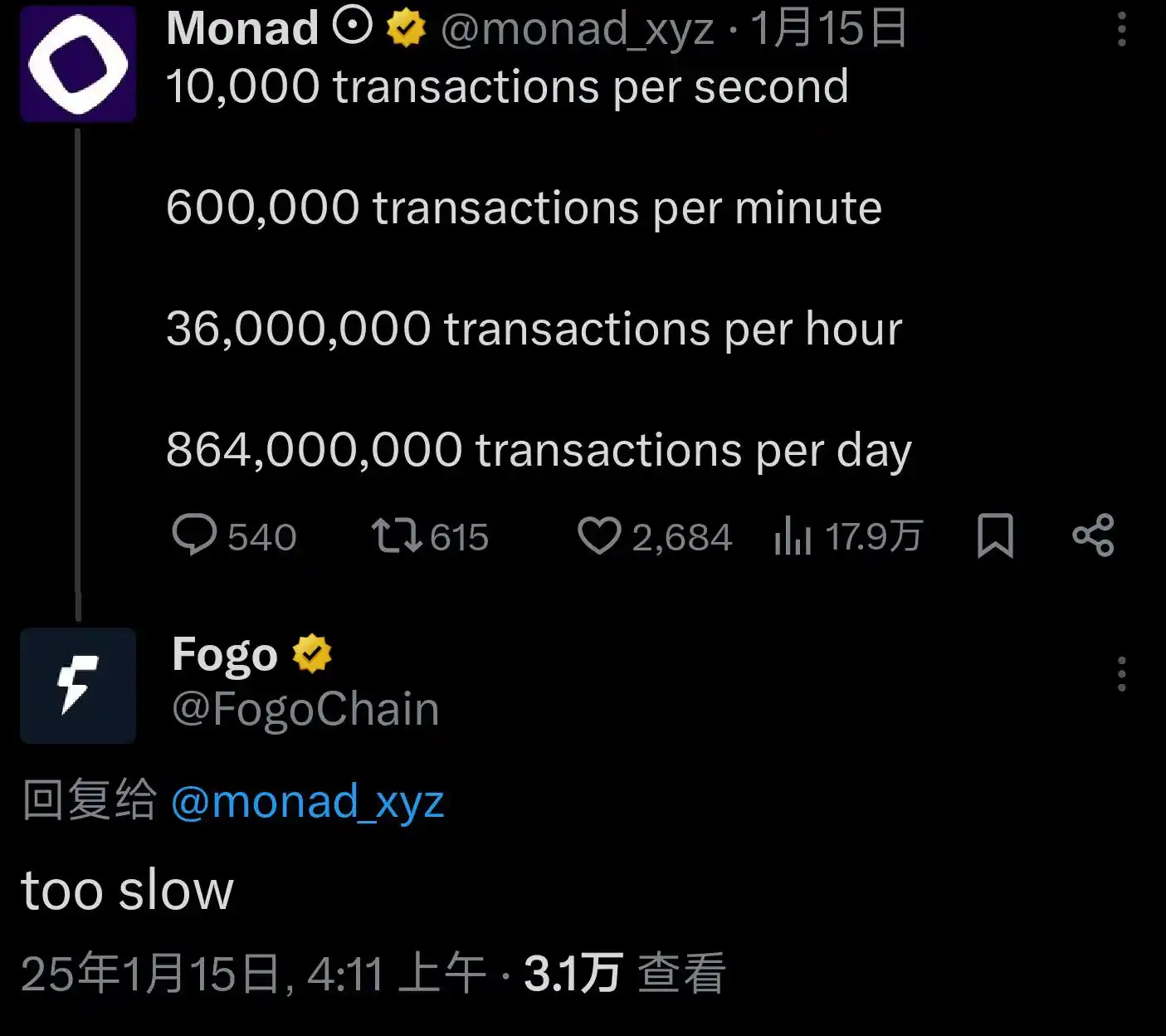
Furthermore, Fogo has already started taunting the new public chain Monad, calling it "too slow." According to the whitepaper, Fogo has three main features:
1. Unified client implementation based on Firedancer: Through a high-performance client implemented purely in Firedancer, Fogo can achieve a level of performance that other networks (including Solana) cannot reach.
Firedancer is Jump Crypto's high-performance Solana-compatible client implementation, demonstrating higher transaction processing throughput than current validator clients through optimized parallel processing, memory management, and SIMD instructions.
There are two versions of Firedancer: "Frankendancer," a hybrid version that uses Firedancer's processing engine and Rust validator's network stack, and a full Firedancer implementation with a complete C network stack rewrite, currently in late-stage development. Both versions maintain compatibility with the Solana protocol. Fogo will initially launch the network based on Frankendancer and then transition gradually to a pure Firedancer implementation.
2. Multi-local consensus and dynamic co-location: This allows validators to coordinate their physical locations at different times while maintaining distinct cryptographic identities for different regions, enabling Fogo to achieve block times and latencies far below those of other mainstream blockchains.
The inspiration for multi-local consensus comes from the "follow the sun" trading model in traditional financial markets. In this model, market-making and liquidity provision migrate between major financial centers as the trading day progresses, facilitating continuous market operation while maintaining concentrated liquidity in specific geographic regions.
III. Selected Validator Set: Through a carefully chosen validator set, FOGO incentivizes high-performance operation and prevents predatory behavior at the validator level.
During the initial stage, the validation node set will be screened through Proof-of-Authority and later transitioned to be directly managed by the validator set. By handing over the screening authority to the validator set, FOGO can impose social layer penalties on abusive behavior without increasing centralization.
Transacting Without SOL? Fogo's Future Expansion
In Fogo's whitepaper, there is a section dedicated to Fogo's future development plans. To expand network access and improve user experience, FOGO may introduce a fee_payer_unsigned transaction type, allowing transactions to be executed without SOL in the initiating account. This feature, combined with on-chain fee payment procedures, enables users to pay transaction fees using SPL tokens (such as TRUMP, MELANIA, or BARRON), while maintaining protocol security and validator compensation.
Users construct transactions that include their intended operations and SPL token payments to compensate the ultimate fee payer. These transactions can be validly signed without specifying the fee payer, allowing any party to complete the transaction by adding their signature and paying SOL fees. This mechanism effectively separates transaction authorization from fee payment, enabling accounts with zero balance to interact with the network as long as they hold other valuable assets.
This feature is achieved through minimal protocol modifications, requiring only the addition of a new transaction type and on-chain procedures to handle relay compensation. The system creates an efficient market for transaction relay services while preserving the security properties of the underlying protocol. Unlike more complex fee abstraction systems, this approach does not require changes to validator payment mechanisms or consensus rules.
Crypto OG Milk, SVM Rising Star Flush with Cash
On January 25, SVM L1 Fogo, with a $100 million token valuation, completed an $8 million funding round in "less than two hours" on the Echo platform, an angel investment platform founded by Cobie. The Echonomist led the round, with participation from 4 CMS Holdings, Big Brain Collective, and Patrons. Last month, Fogo had just completed a $5.5 million seed round, with Distributed Global leading the $5 million seed investment.
Fogo's co-founder and former Jump Crypto executive Robert Sagurton stated in an interview that there were four Echo investment groups involved in this round of funding:
• The Echonomist led by Cobie invested $6 million;
• 4 Ventures from CMS Holdings invested $1 million;
• Big Brain Collective led by The Block CEO Larry Cermak invested $500,000;
• And Patrons led by Synthetix and Infinex co-founder Kain Warwick invested $500,000.
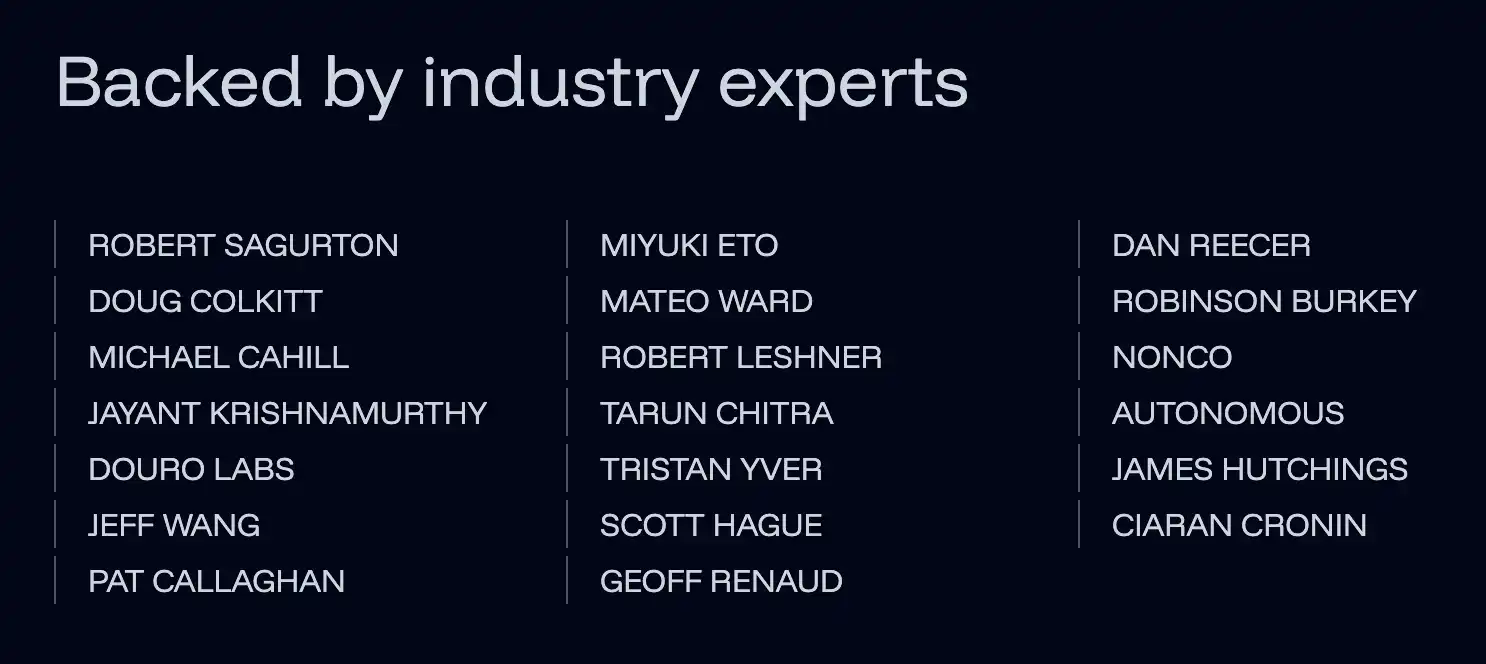
At the same time, Fogo's founding team has strong connections to Solana, cryptocurrency, and traditional finance.
According to Sagurton's LinkedIn profile, he has worked at Jump Crypto for over five years, serving as Global Head of Digital Asset Sales and Business Advisor. Prior to joining Jump Crypto, Sagurton held positions at enterprise blockchain company R3, J.P. Morgan, Deutsche Bank, and Morgan Stanley.
Fogo's other co-founder is Douglas Colkitt, also the founder of Crocodile Labs, who developed the decentralized exchange protocol Ambient Finance (formerly known as CrocSwap). It is also planned to deploy Ambient on Fogo.
You may also like

Morning Report | CoinEx becomes a key hub for Iran to evade sanctions, involving over $3.8 billion in funds; Kalshi seeks a new round of financing, with a valuation potentially rising to $40 billion

From the white-haired stock god to the billionaire fund mogul, the smart people shorting Nvidia are all getting rich using the same framework

Why do cryptocurrency projects always like to change their names?

Global Launch: As predictions become the most scarce asset in the AI era, Manadia is defining the next generation of the value internet

Who is footing the bill for the $64 billion accounting frenzy?
I never expected that the first application of AI x Crypto would be in security auditing

What is your view on Binance's competitive advantages?

ETH has entered a non-consensus phase, and the turning point is approaching!
The shift in the cloud of the air: from despising stablecoins a year ago to the high-profile entry of capital today
The survival dilemma of small and medium exchanges behind the withdrawal anomalies exposed by AscendEX

Why Is Bitcoin Falling Below $60K? 5 Key Market Drivers Explained
Bitcoin has dropped sharply amid ETF outflows, Strategy stock weakness, AI stock rallies, and changing Fed expectations. Explore the key forces driving BTC’s latest correction and what traders should watch next.

Bitcoin vs. Gold in 2026: Which Asset Performs Better in Different Markets?

Morning News | The draft amendment to the People's Bank of China Law aims to clarify the legal status of digital renminbi; South Korea will transfer about 40 unregistered virtual asset service providers to law enforcement agencies
The cryptocurrency industry has entered the "Show Me" era: merely relying on vision is no longer enough

Interpreting the Ethereum Foundation's new structure: Reaffirming self-sovereignty amid institutional trends
Former SpaceX engineer reconstructs the financial execution system using first principles
Standard Chartered Bank sings a 50x rhapsody again, aiming for AAVE to reach 3500 USD

Tidal Investment: We still have a positive outlook on the AI industry chain, but the reasons have changed
Morning Report | CoinEx becomes a key hub for Iran to evade sanctions, involving over $3.8 billion in funds; Kalshi seeks a new round of financing, with a valuation potentially rising to $40 billion
From the white-haired stock god to the billionaire fund mogul, the smart people shorting Nvidia are all getting rich using the same framework
Why do cryptocurrency projects always like to change their names?
Global Launch: As predictions become the most scarce asset in the AI era, Manadia is defining the next generation of the value internet
Who is footing the bill for the $64 billion accounting frenzy?
I never expected that the first application of AI x Crypto would be in security auditing


