
Coingecko: On-chain Gas Fees Surpass $6.9 Billion in 2024, Who Is the Biggest Winner?

Original Title: Blockchains Earned Over $6.9B Transaction Fees in 2024
Original Source: Lim Yu Qian, CoinGecko
Original Translation: Deng Tong, Golden Finance
Which Blockchains Earned the Most Fees?
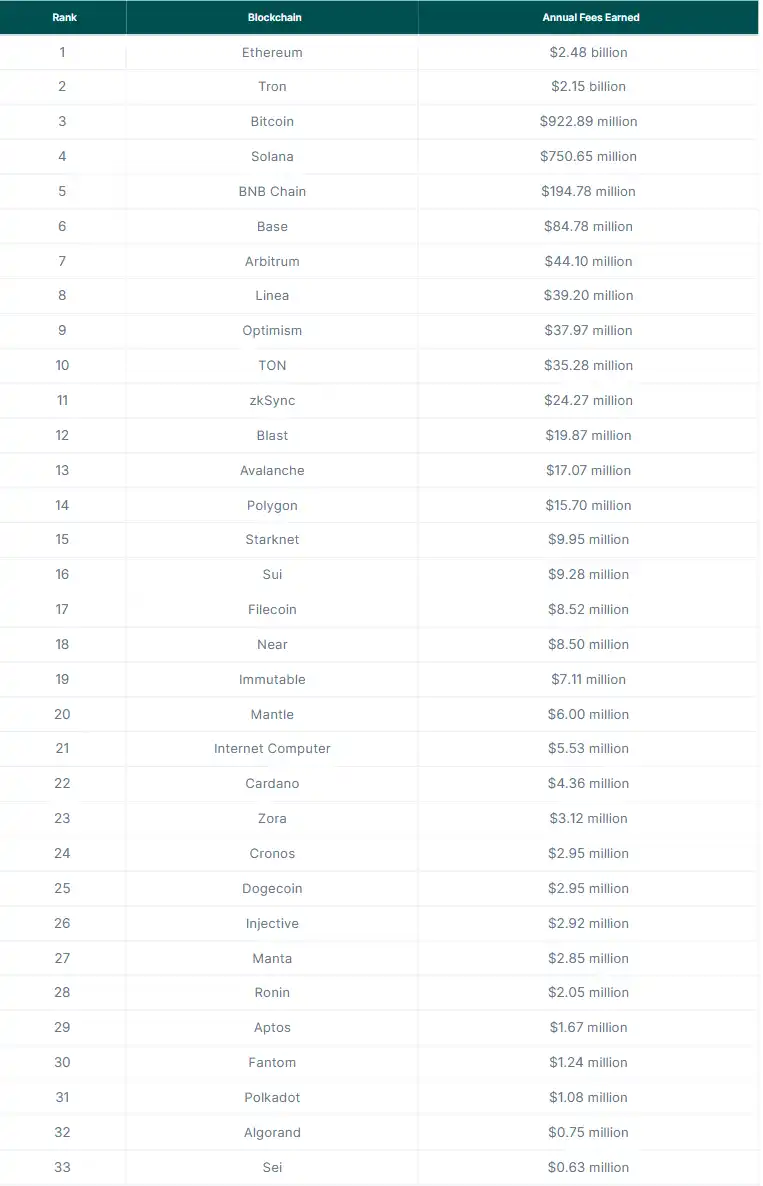
In 2024, Ethereum had the highest transaction fees of all blockchains, generating a total fee of $24.8 billion annually from gas fees. Tron became the second-highest-earning blockchain, with a total fee for the year of $21.5 billion. This means that on average, Ethereum earned $6.79 million in daily fee revenue last year, while Tron earned $5.89 million in daily fee revenue.
Bitcoin and Solana followed closely behind, with annual fees of $9.2289 billion and $7.5065 billion, respectively.
Overall, in 2024, Layer 1 (L1) and Layer 2 (L2) blockchains earned over $68.9 billion from transaction fees. Specifically, L1 accounted for $66 billion in fees across 21 blockchains, while L2 accounted for $2.9492 billion across 12 blockchains.
The top 10 highest-earning blockchains alone recorded a combined fee revenue of $67.4 billion. It is worth noting that among the top 10 highest-earning blockchains, 4 are Layer 2—namely Base, Arbitrum, Linea, and Optimism—which surpassed other Layer 1 chains, including TON, in annual fee revenue last year.
Ethereum Fee Revenue Over Time
Ethereum's $24.8 billion fee revenue in 2024 represented a 3.0% increase from the $24.1 billion in 2023. This indicates that despite the DenCun upgrade in March 2024 lowering L2 transaction costs and users migrating from L1 to its L2 scaling solutions, Ethereum maintained its leadership position in fee revenue. Ethereum's elastic fee revenue also contrasts sharply with ETH's price performance, which was lower than expected last year.
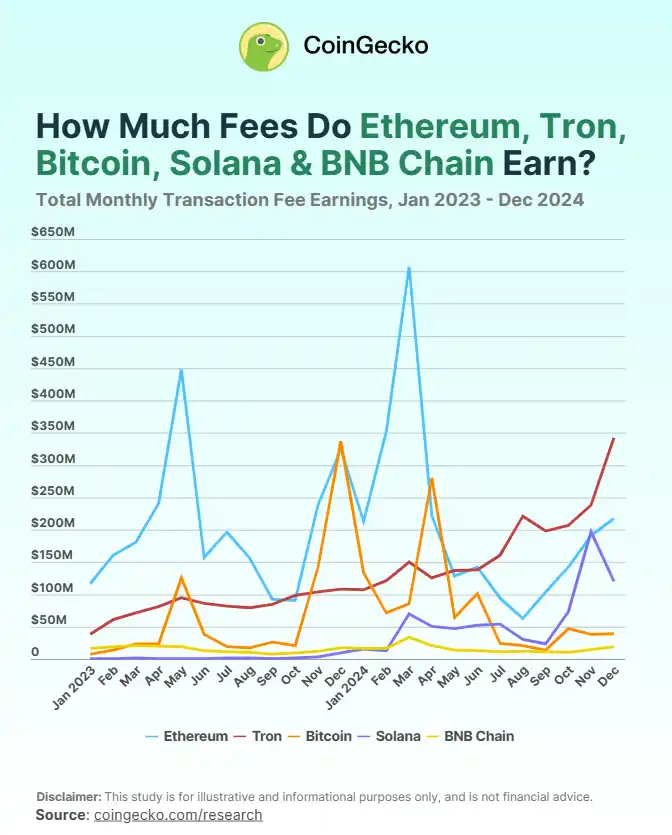
The amount of fees earned by Ethereum fluctuates monthly. In 2023, Ethereum's monthly revenue ranged from $91.22 million to $448.7 million, recording higher fee revenue during the meme frenzy in May and the market rebound at the year's end. In 2024, the range expanded, with Ethereum's monthly revenue ranging from $62.82 million to $606.77 million.
It is worth noting that in just the first quarter of 2024, Ethereum earned $1.17 billion, accounting for nearly half of its total annual fee revenue. This was also Ethereum's highest-earning quarter in the past two years, thanks to widespread airdrop initiatives and increased on-chain activities.
Tron, Solana Fee Revenue Shows Strong Growth
In the past year, Tron's fee revenue saw a significant increase of 116.7%, rising from $9.2208 billion in 2023 to $21.5 billion in 2024. As one of the largest blockchains for stablecoin transactions, the accelerated usage of stablecoins has steadily driven Tron's monthly fee revenue growth from $38.36 million in January 2023 to $342.54 million in December 2024.
Tron has outpaced Ethereum in fee revenue for the past six consecutive months. However, whether Tron can surpass Ethereum this year to become the blockchain with the highest fee revenue remains to be seen.
Solana saw an even larger increase in annual fee revenue, jumping from $25.55 million in 2023 to $750.65 million in 2024, a growth rate of 2,838.0%. As the most popular blockchain ecosystem last year, Solana's transaction volume surged to network congestion levels in April 2024. In contrast to Tron, Solana's monthly fee revenue remained stable throughout 2023 and experienced more volatile growth in 2024, increasing from $15.54 million in January to $197.5 million in November, then slowing to $120.95 million in December.
On the other hand, Bitcoin's annual fee revenue grew by 15.9%, BNB Chain grew by 8.7%, showing a much more modest increase but still surpassing Ethereum's 3.0% growth. In recent years, Bitcoin's fee-generating capacity has continued to strengthen, driven by the increased activity of Ordinal NFTs, BRC-20 tokens, and Rune tokens, as well as the rapid growth of interest in applications built on Bitcoin.
Meanwhile, TON ranks tenth as the highest-fee blockchain, with annual fee revenue of $35.28 million. Recently, the popular messaging app Telegram formally integrated TON, enabling more accessible on-chain interactions, such as blockchain games with earning incentives.
Which Layer 2 Solutions Earned the Most Fees?
Base was the top gas fee earner in L2, generating a total of $84.78 million in 2024. This represented a 548.2% increase from the $13.08 million earned in 2023, although it is worth noting that Base only launched its mainnet in August 2023.
Even accounting for the mainnet launch, Base's fee revenue doubled from an average of $6.38 million in the second half of 2023 to $21.20 million in 2024. Similar to Solana, Base has seen widespread adoption due to its retail-friendly nature, with its integration with Coinbase further amplifying this friendliness.
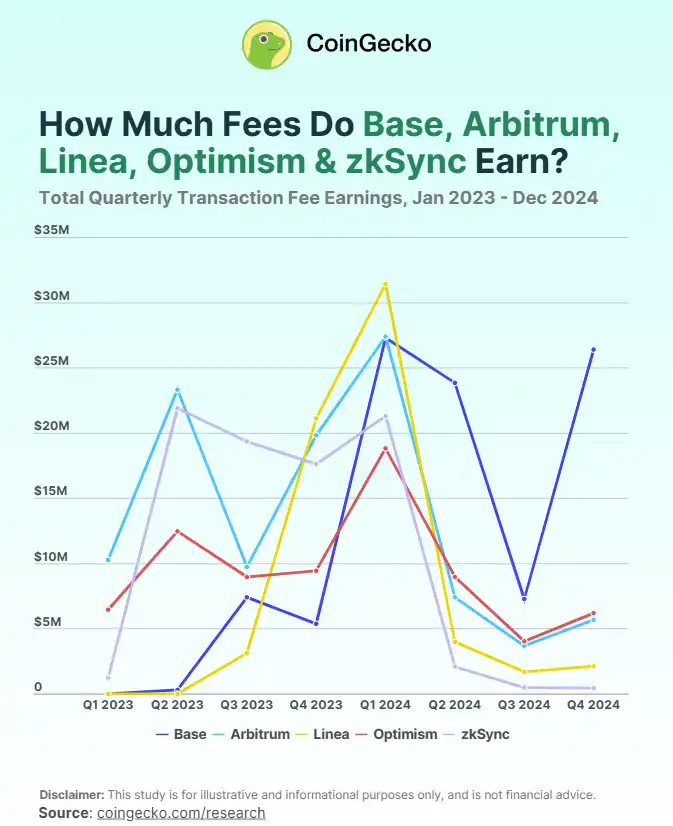
Likewise, Linea's mainnet was launched in August 2023, which partially explains the increase in annual fee revenue from $24.20 million in 2023 to $39.20 million last year, a growth of 62.0%. Most of Linea's 2024 annual fee was earned in the first quarter, when it set a quarterly record high of $31.40 million during the Linea Park airdrop event.
Meanwhile, Optimism saw a slight 1.9% increase in annual fee revenue, rising from $37.26 million in 2023 to $37.97 million in 2024.
Arbitrum, zkSync Fee Revenue Shrinks
Arbitrum was the second-highest fee earner in L2, bringing in $44.10 million in 2024. However, this represented a 30.1% decrease from the $63.12 million Arbitrum earned in 2023. Despite being a veteran player, both Arbitrum and Optimism are facing stiff competition in the increasingly crowded L2 space.
zkSync saw a larger decline, dropping from $60.04 million in annual fees in 2023 to $24.27 million in 2024, a 59.6% decrease. Specifically, during the L2 airdrop season, zkSync's quarterly fee revenue averaged $20.04 million from the second quarter of 2023 to the first quarter of 2024, but then plummeted to an average of $0.99 million per quarter from the second to fourth quarters of 2024.
Overall, the current fluctuations in L2 fee revenue seem to primarily reflect on-chain activity being primarily driven by token airdrops and incentive marketing programs. Therefore, it remains to be seen how much fees L2 chains can sustainably earn in the long run.
Blockchain Fee Revenue Ranking
The total fees earned by blockchains annually in 2024 are as follows:
You may also like

Global Launch: As predictions become the most scarce asset in the AI era, Manadia is defining the next generation of the value internet

Who is footing the bill for the $64 billion accounting frenzy?

Morning Report | CoinEx becomes a key hub for Iran to evade sanctions, involving over $3.8 billion in funds; Kalshi seeks a new round of financing, with a valuation potentially rising to $40 billion

Why do cryptocurrency projects always like to change their names?

From the white-haired stock god to the billionaire fund mogul, the smart people shorting Nvidia are all getting rich using the same framework

Morning News | The draft amendment to the People's Bank of China Law aims to clarify the legal status of digital renminbi; South Korea will transfer about 40 unregistered virtual asset service providers to law enforcement agencies

The cryptocurrency industry has entered the "Show Me" era: merely relying on vision is no longer enough
Interpreting the Ethereum Foundation's new structure: Reaffirming self-sovereignty amid institutional trends
Former SpaceX engineer reconstructs the financial execution system using first principles

Tidal Investment: We still have a positive outlook on the AI industry chain, but the reasons have changed

Standard Chartered Bank sings a 50x rhapsody again, aiming for AAVE to reach 3500 USD

The interim executive director of the Ethereum Foundation speaks out: What is our mission?
Why does OKX want to start a new company with the parent company of the New York Stock Exchange?

Why Is PAXG Price Different From Gold? 5 Reasons Crypto Traders Should Know

WEEX OpenAPI 101: 5 Powerful Modules, AI Trading Tools, and Grab Up to 70% Revenue Opportunities
Learn how WEEX OpenAPI connects traders, developers, AI agents, and trading platforms. Discover WEEX API features, Binance-compatible integration, automated trading workflows, revenue opportunities, and ecosystem possibilities.

Interview with NDV Founder Jason Huang: Popping the AI Bubble and the Myth of Microstrategy, Seeking the Ultimate Ace in the Crypto Market

Morning Report | Former Ethereum Foundation researcher establishes Ethlabs; EU Parliament Economic Committee passes digital euro regulatory proposal

Dragonfly partner Haseeb: The fastest-growing companies in the future may all be stuck at 149 people
Global Launch: As predictions become the most scarce asset in the AI era, Manadia is defining the next generation of the value internet
Who is footing the bill for the $64 billion accounting frenzy?
Morning Report | CoinEx becomes a key hub for Iran to evade sanctions, involving over $3.8 billion in funds; Kalshi seeks a new round of financing, with a valuation potentially rising to $40 billion
Why do cryptocurrency projects always like to change their names?
From the white-haired stock god to the billionaire fund mogul, the smart people shorting Nvidia are all getting rich using the same framework
Morning News | The draft amendment to the People's Bank of China Law aims to clarify the legal status of digital renminbi; South Korea will transfer about 40 unregistered virtual asset service providers to law enforcement agencies


