
Meme Fades, Pump.fun to the Rescue: Can PumpSwap Sustain Future Business?



Original Title: "Meme Recession, Pumping Fun Self-rescue: Can PumpSwap Support Future Business?"
Original Source: Deep Tide TechFlow
Liquidity depletion and declining user engagement have forced every project to look for new breakthroughs to attract more users and market share.
For example, yesterday Pump.fun also announced its new decentralized exchange platform — PumpSwap.
From the name itself, swap also points to the core operation of token exchange in DeFi; as a platform with memecoin culture at its core, Pump.fun's move seems to have expanded into the taste of a general DeFi platform.
So what exactly is PumpSwap? Why did Pump.fun choose to launch it at this time? Perhaps we can get a glimpse of it from its background and motivations.
From Growth to Control
With its unique "internal and external pool mechanism" and memecoin culture, Pump.fun attracted a large number of users and trading volume in a short period during the last cycle.
However, as the platform developed, the limitations of its existing model also gradually became apparent.
Pump.fun's internal and external pool mechanism brought it a large number of users but also exposed it to an undeniable problem — user experience is constrained by liquidity stability.
Limitations of the internal pool: The liquidity of the internal pool depends entirely on the platform's own resources. When liquidity is insufficient, users' trading experience is affected.
Dependence on the external pool: When the internal pool cannot meet user needs, trades are routed to the external pool, and the liquidity of the external pool depends on third-party platforms like Raydium. While this model solves short-term issues, in the long run, Pump.fun's reliance on external platforms has always been a hidden danger.
In the current model, Pump.fun needs to pay millions of dollars in transaction fees to external platforms like Raydium every year. These fees not only increase the platform's operating costs but also mean that part of Pump.fun's profits is taken by external liquidity providers.
In order to eliminate reliance on external platforms, Pump.fun had previously attempted to build its own AMM pool (amm.pump.fun). Although this was just a test version with very basic functionality and a simple interface, its significance lies in providing Pump.fun with a viable alternative.
Through this testing, Pump.fun has demonstrated its full capability to construct its own liquidity pool and have complete control over transaction fees.
From the current PumpSwap page, it is evident that this AMM pool is actually prepared for the Swap product, with the product page and functionality being very similar.
(Reference: Pump.fun Building Its Own AMM Pool? Revealing the Heart of Profits Grabbing from Raydium)

Product iteration is more of a surface phenomenon, with the deeper reason being the control of liquidity.
In the past, Pump.fun was a "liquidity provider" for Raydium, bringing a significant amount of trading volume to it; whereas now, Pump.fun seems more like it wants to become the "controller" of liquidity, completely freeing itself from reliance on external platforms.
Through the self-built liquidity pool, Pump.fun can not only retain more profits but also lay the foundation for launching more DeFi products in the future (such as perpetual contracts, lending protocols, etc.) and create more ecosystem gameplay.
PumpSwap Feature Highlights
In this context, Pump.fun's launch of PumpSwap can be seen as a feature-rich decentralized exchange platform (DEX).
Its core goal is to provide users with a more efficient trading experience while driving the ecosystem towards diversification and sustainable development. As a key strategic upgrade for Pump.fun, PumpSwap is no longer limited to memecoin trading but is expanding the breadth and depth of its ecosystem by supporting more high-quality projects and cross-chain assets.
From the official description, its features and advantages include:
Instant Migration with Zero Fees
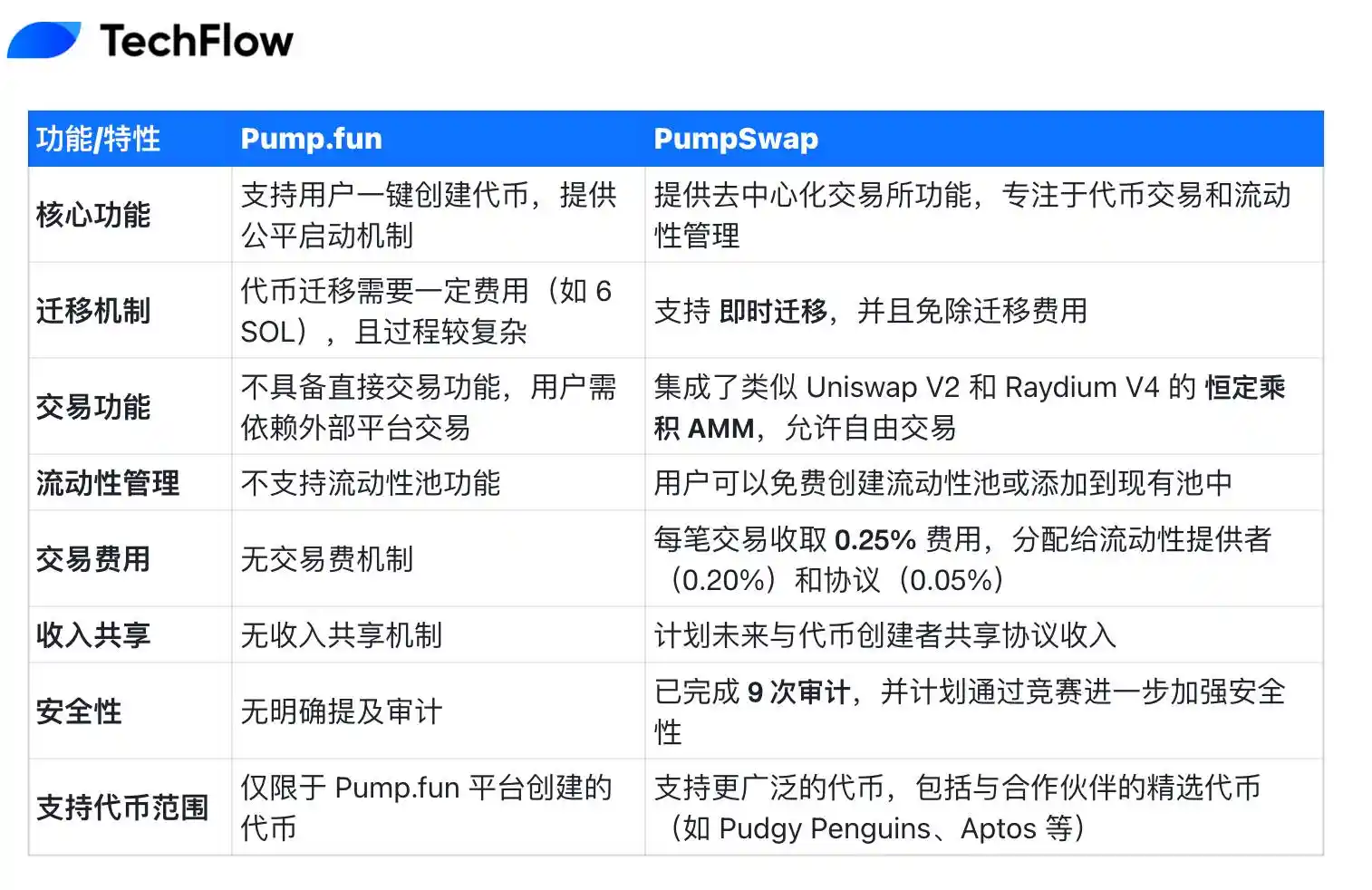
PumpSwap has thoroughly optimized the existing token migration process. All tokens that have completed the bonding curve will be directly migrated to PumpSwap without any migration fees.
This improvement significantly reduces the migration cost for users and projects compared to the previous 6 SOL migration fee.
Increased Liquidity and Creator Revenue Sharing
PumpSwap not only provides higher liquidity for tokens but also plans to introduce a Creator Revenue Sharing mechanism. This mechanism will allocate a portion of the protocol's revenue to token creators, incentivizing the launch of higher-quality projects on PumpSwap and strengthening the alignment of interests between creators and the community.
Permissionless Liquidity Pool Creation and Management
PumpSwap supports users in freely creating their own liquidity pools or adding funds to existing ones. This flexibility allows users to more conveniently manage their assets while injecting more liquidity into the ecosystem.
Support for Diverse Asset Trading
In addition to memecoins, PumpSwap also supports trading of high-quality tokens it collaborates with, with many tokens being bridged to Solana for the first time. This feature not only expands PumpSwap's asset range but also provides users with more trading options.

A Fee Structure Balancing Fairness and Incentives:
PumpSwap's transaction fee matches that of mainstream DEXs like Raydium, charging a 0.25% fee per trade. However, its fee distribution mechanism is more innovative:
0.20% allocated to liquidity providers: This reward mechanism aims to attract more users to stake in liquidity pools, thereby enhancing the platform's trading depth and stability.
0.05% allocated to the protocol: This revenue will be used for further platform development and ecosystem building.
In the future, when the Creator Revenue Sharing mechanism goes live, the above fee distribution rules will be further optimized to ensure creators can benefit from it.
Differences and Similarities Between Pump.fun and PumpSwap
Although PumpSwap is the native DEX of Pump.fun, the two have significant differences and complement each other in terms of functionality and positioning.
Pump.fun's core focus is as a tool platform for memecoin culture, helping users create, manage, and promote memecoin projects through user-friendly tools. Its goal is to lower the barrier to entry for memecoin issuance, allowing more users to participate in the creation and propagation of memecoins.
By contrast, PumpSwap is more focused on ecosystem infrastructure. As the native DEX of Pump.fun, PumpSwap's mission is to provide a more efficient trading and liquidity solution for memecoins, while driving the ecosystem's expansion into a broader DeFi space through creator revenue sharing mechanisms and support for diverse assets.
The relationship between Pump.fun and PumpSwap can be summarized as "Gateway and Core":
Pump.fun is the gateway for users to enter the ecosystem, attracting users to participate in memecoin creation and trading through tools and community.
PumpSwap is the core of the ecosystem, providing users with a more comprehensive service through liquidity aggregation and trading support, and driving the sustainable development of the ecosystem.
A more intuitive chart for comparison is as follows:
Is It Feasible?
However, would you now use PumpSwap exclusively for token swaps?
From the current market and user situation, the answer is mostly negative; this also means that Pump.fun needs more incentive activities, events, and partnerships for joint marketing to gradually drive users to use their own PumpSwap.
Meme coins are cooling off, so finding new revenue streams through DEX is a good thing.
However, the future success of PumpSwap depends not only on the functional design of the product itself, but also on whether the overall market environment is "cooperative". In plain terms, this project to a large extent still has to "play it by ear".
Timing is crucial.
If there is new liquidity inflow or a better bull market environment, PumpSwap's trading volume may experience explosive growth. After all, a bull market always increases people's interest in memecoins and new assets, and PumpSwap's positioning is well-suited to meet this demand.
Conversely, if the market continues to be sluggish and users' speculative enthusiasm cools down, PumpSwap's development may also face significant pressure.
In addition, Pump.fun also needs to find more differentiated competitive advantages, especially in the Solana ecosystem and even the broader DeFi space. After all, DEX competition is already very intense, and relying solely on the popularity of memecoins clearly cannot sustain user stickiness in the long run.
How to attract more users to stay on the platform in the long term through innovative incentive mechanisms, a unique product experience, and even collaboration with other top projects is the key challenge PumpSwap needs to address.
Overall, PumpSwap's future is a game of "time + environment": on the time front, it needs to continuously optimize its product and expand its ecosystem; on the environment front, it needs to wait for the market heat to return, ushering in new liquidity and user base.
In the end, whether this platform can truly stand out remains to be seen based on its ability to seize the opportunity when the market rebounds and carve out a unique development path.
You may also like

Circle CEO responds to OUSD's challenge: Stablecoins are a winner-takes-all business, and we will not slow down
Argentina vs Cape Verde: When a Record-Breaking Legend Meets an Unbreakable Underdog
WEEX exclusive pre-match analysis of Argentina vs Cape Verde, exploring Messi-led Argentina’s dominance and Cape Verde’s historic defensive breakout, with a breakdown of volatility, structure, and match dynamics.
How does Gate redo "buying and selling stocks" from the cryptocurrency world to the stock market?
Former ByteDance employee's account: How I started with two Pinduoduo hard drives and made six times the profit with Seagate to achieve financial freedom?
Visa and Mastercard join 140 giants to launch a new stablecoin, but the impact on the market landscape may still be limited
WEEX Launches Depth Chart for Spot Trading
MiCA reshuffle begins, Binance temporarily bids farewell to the EU
Raising interest rates to protect STRC and selling coins to maintain credit, this time the strategy has chosen the two most expensive paths
Morning Report | Samsung announces a 265.5 trillion won investment plan, focusing on semiconductor and AI computing power data centers; Vitalik publishes an article detailing the entire technology tree behind the confusion protocol (iO) mainline
In the era of AI, what is left of Bitcoin?
NeoSoul announced plans to integrate with the OKX Agentic Wallet, promoting AI agents' participation in the on-chain economy
Why Is Bitcoin Lagging Stocks in 2026? AI Stocks, ETF Outflows, and the Nasdaq Rally Explained
What you bought on CEX is really not US stocks: Analyzing the 94% liquidation monopoly and the evaporation of equity under a five-layer pipeline
In such a crowded cross-border payment arena, where is the next stop for the future?
Why Is Bitcoin Down in 2026? What We Can Learn From 2022
The large models in the United States are moving towards closure in the name of security
From the white-haired stock god to the billionaire fund mogul, the smart people shorting Nvidia are all getting rich using the same framework
Morning Report | CoinEx becomes a key hub for Iran to evade sanctions, involving over $3.8 billion in funds; Kalshi seeks a new round of financing, with a valuation potentially rising to $40 billion
Circle CEO responds to OUSD's challenge: Stablecoins are a winner-takes-all business, and we will not slow down
Argentina vs Cape Verde: When a Record-Breaking Legend Meets an Unbreakable Underdog
WEEX exclusive pre-match analysis of Argentina vs Cape Verde, exploring Messi-led Argentina’s dominance and Cape Verde’s historic defensive breakout, with a breakdown of volatility, structure, and match dynamics.
How does Gate redo "buying and selling stocks" from the cryptocurrency world to the stock market?
Former ByteDance employee's account: How I started with two Pinduoduo hard drives and made six times the profit with Seagate to achieve financial freedom?
Visa and Mastercard join 140 giants to launch a new stablecoin, but the impact on the market landscape may still be limited
WEEX Launches Depth Chart for Spot Trading