
RedStone "False Advertising"? Anger Erupts as Only 4,000 out of 230,000 Community Members Receive Airdrop


Original Title: "Only 4000 Qualified Addresses, Has RedStone's Airdrop Angered the Masses?"
Original Author: Alex Liu, Foresight News
On the evening of March 5th, RedStone initiated its airdrop query. Since its pre-market listing on Binance on February 28th, RED has hit Binance's latest circuit breaker for 3 consecutive days, breaking above $1.40 after the price limit was removed, and is now trading at $0.87 with a market cap of $34 million and a fully diluted market cap of $860 million.
As the latest Launchpad project on Binance, RedStone saw significant participation in its airdrop event, garnering attention in the community. Known for its low-cost reputation as a price oracle provider, the project has not experienced any major pricing errors since its launch and has received support from notable investment firms such as Coinbase Ventures and Blockchain Capital. However, this shining star's reputation took a nosedive in the community after the launch of the airdrop query page last night, with some netizens even labeling it a "scam project." But why?
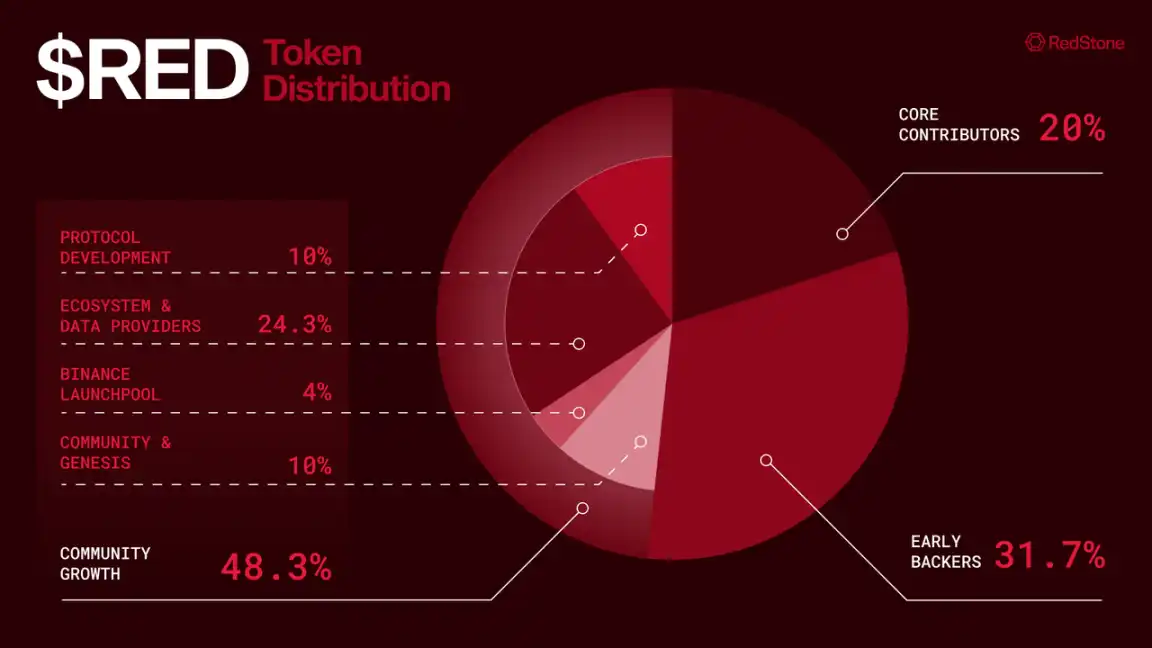
Looking at its tokenomics, a 10% community airdrop allocation is not considered low and does not seem to be the root of the issue. On social media platforms, community members have provided feedback that they participated in multi-year tasks (such as mining activities in Seasons 1-3, over a hundred tasks on Zealy, Lunar New Year events, etc.) but still did not receive the airdrop. In RedStone's official statement, the author found the answer.
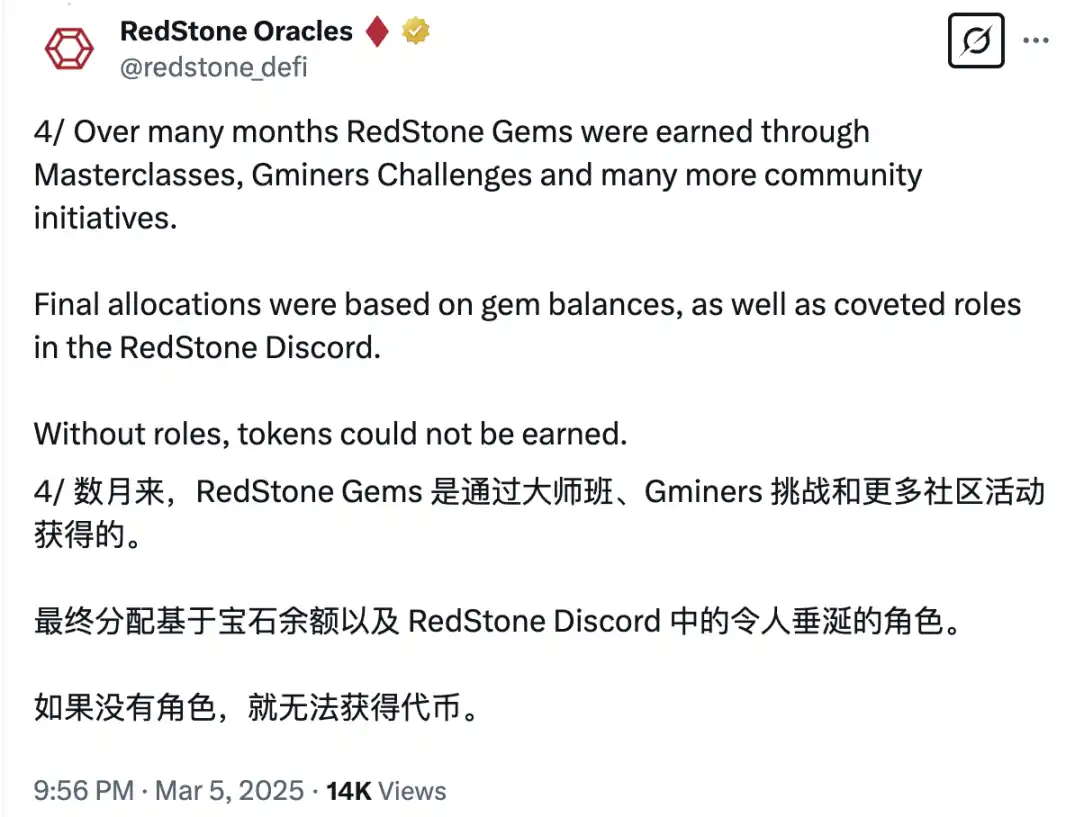
Only those with specific roles in the RedStone Discord are eligible to receive tokens! Qualified roles include Vein Master, Deep Miner, Professor, IRL (participated in offline events), etc., and the proportion of RedStone Discord's nearly 230,000 community members with any of these roles is less than 2%!
Merely offering a small amount of tokens may not have angered community users to this extent (RedStone DC has now activated "slow mode" due to excessive criticism), but the actual reward mechanism being inconsistent with the project's promotion has led many users to feel that their efforts were in vain, which is likely the crux of the issue.

In past promotions, the project team exclaimed, "Your points will be the key basis for future airdrops!" However, in reality, the top 10 holders in the RSG Points ranking, including the 5th and 7th places, were disqualified from receiving RED tokens because they did not have a Discord role. Out of more than 170,000 people on the leaderboard, only 2296 addresses were eligible. With around 200,000 members in the entire community, only about four thousand people ultimately met the airdrop criteria, with many users receiving only a few hundred tokens. The distribution logic appeared to be very "selective" compared to other mainstream projects in the market.
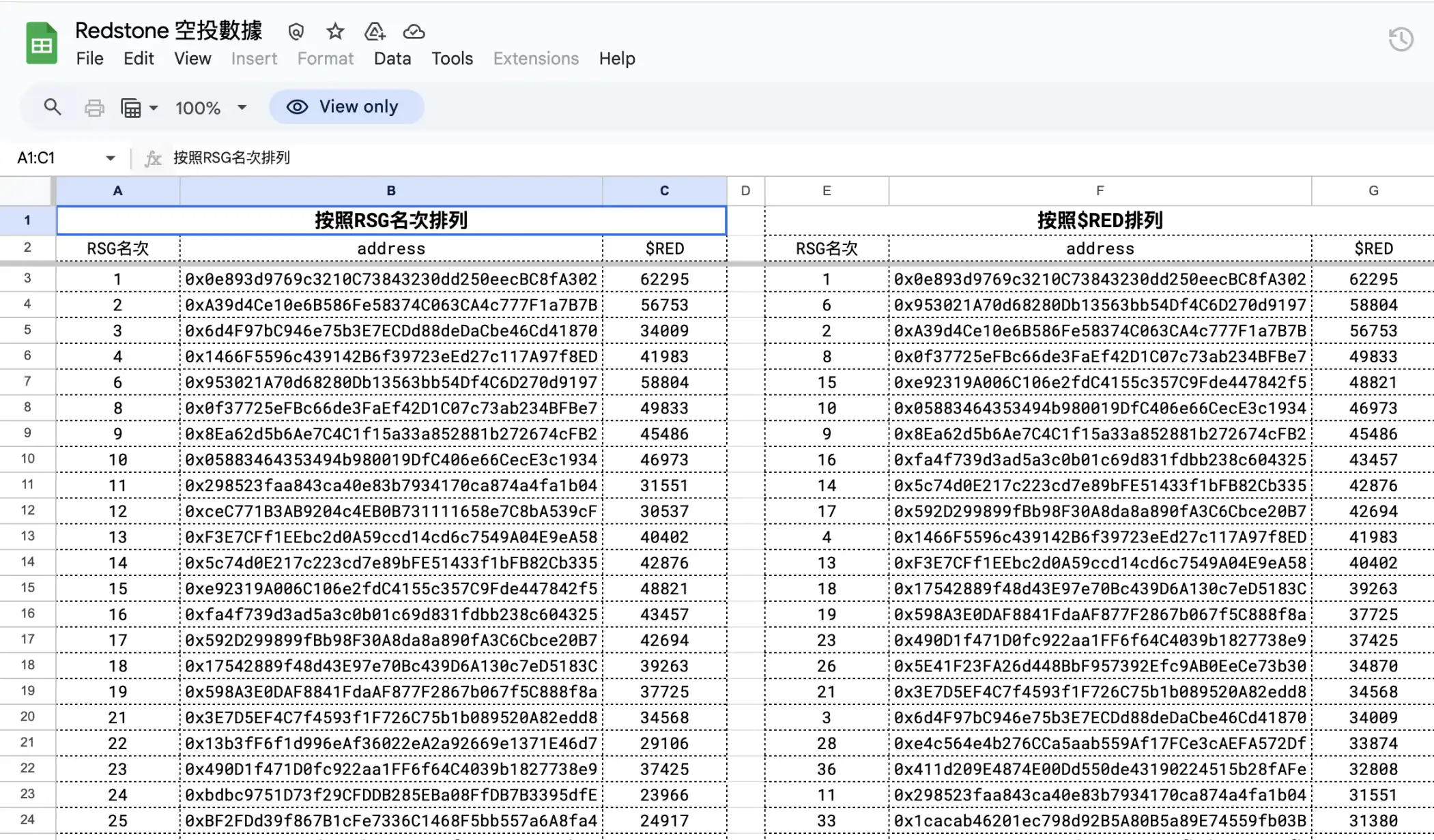
Data Source: @OshinoAJ_eth
So what truly sparked the anger of community members is that RedStone's event design was full of intense "PUA" style marketing: by continuously releasing tasks to attract user participation, it created an illusion of "as long as you are diligent enough, you can receive rewards." In reality, there were invisible barriers in the threshold setting, causing many ordinary users who invested a significant amount of time and resources to be excluded at the last moment.
This goes against industry norms. Other airdrop projects in the industry usually focus more on the broad participation of users in the distribution mechanism. In dYdX's airdrop event, tens of thousands of participating and eligible users generally receive a certain amount of governance tokens; and in projects like Optimism, their airdrop rules are clear, fair, and transparent, aiming to encompass a larger number of ecosystem users.
In contrast, RedStone's "special role" threshold appears too narrow, making it difficult to incentivize long-term community activity and trust.
Conclusion
The project team may have attempted to achieve a more sophisticated incentive mechanism in airdrop distribution, ensuring that core users receive a higher percentage of rewards. However, this approach undoubtedly overlooks the contributions and expectations of the broader participants.
In the long run, airdrops are not only a means to attract users as a promotional tool but also a crucial indicator of project governance transparency and ecosystem health. The current controversy undoubtedly sounds an alarm for the entire industry: only by establishing a fair, open, and reasonable incentive distribution mechanism can users truly feel the value of participation and thus drive the continuous prosperity of the entire ecosystem.
You may also like

Morning Report | Samsung announces a 265.5 trillion won investment plan, focusing on semiconductor and AI computing power data centers; Vitalik publishes an article detailing the entire technology tree behind the confusion protocol (iO) mainline
What you bought on CEX is really not US stocks: Analyzing the 94% liquidation monopoly and the evaporation of equity under a five-layer pipeline
In such a crowded cross-border payment arena, where is the next stop for the future?
Why Is Bitcoin Down in 2026? What We Can Learn From 2022
The large models in the United States are moving towards closure in the name of security
From the white-haired stock god to the billionaire fund mogul, the smart people shorting Nvidia are all getting rich using the same framework
Morning Report | CoinEx becomes a key hub for Iran to evade sanctions, involving over $3.8 billion in funds; Kalshi seeks a new round of financing, with a valuation potentially rising to $40 billion
Global Launch: As predictions become the most scarce asset in the AI era, Manadia is defining the next generation of the value internet
Why do cryptocurrency projects always like to change their names?
Who is footing the bill for the $64 billion accounting frenzy?
I never expected that the first application of AI x Crypto would be in security auditing
What is your view on Binance's competitive advantages?
ETH has entered a non-consensus phase, and the turning point is approaching!
The shift in the cloud of the air: from despising stablecoins a year ago to the high-profile entry of capital today
The survival dilemma of small and medium exchanges behind the withdrawal anomalies exposed by AscendEX
Why Is Bitcoin Falling Below $60K? 5 Key Market Drivers Explained
Bitcoin has dropped sharply amid ETF outflows, Strategy stock weakness, AI stock rallies, and changing Fed expectations. Explore the key forces driving BTC’s latest correction and what traders should watch next.
Bitcoin vs. Gold in 2026: Which Asset Performs Better in Different Markets?
The cryptocurrency industry has entered the "Show Me" era: merely relying on vision is no longer enough
Morning Report | Samsung announces a 265.5 trillion won investment plan, focusing on semiconductor and AI computing power data centers; Vitalik publishes an article detailing the entire technology tree behind the confusion protocol (iO) mainline
What you bought on CEX is really not US stocks: Analyzing the 94% liquidation monopoly and the evaporation of equity under a five-layer pipeline
In such a crowded cross-border payment arena, where is the next stop for the future?
Why Is Bitcoin Down in 2026? What We Can Learn From 2022
The large models in the United States are moving towards closure in the name of security
From the white-haired stock god to the billionaire fund mogul, the smart people shorting Nvidia are all getting rich using the same framework