
RWA, TVL Hit All-Time Highs: A Huge Opportunity for the Next Decade of Traditional Finance?


Original Article Title: RWA TVL Hit a New ATH—Don't Get Left Behind
Original Article Author: Moomsxxx
Original Article Translation: Plain Talk on Blockchain
The RWA sector is growing at an astounding pace. Just a few days ago, the total value of RWA hit a new all-time high, and today it has once again surpassed this new record.
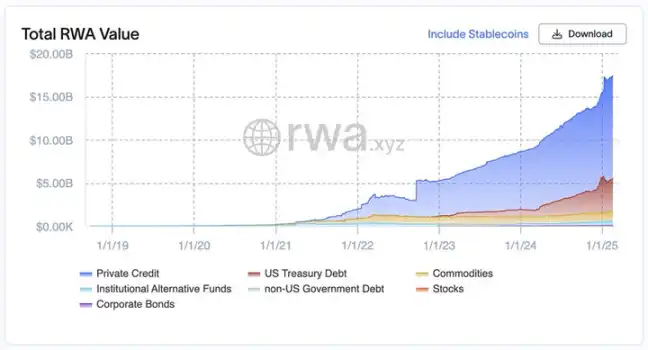
1. RWA TVL
Despite many ongoing operational frictions related to privacy solutions, digital identity solutions, interoperability, and being a bottleneck for faster adoption, the on-chain funds raised of 20-30 billion USD and around 200 billion USD in stablecoins demonstrate the increasing interest and adoption in this area of the Web3 industry.
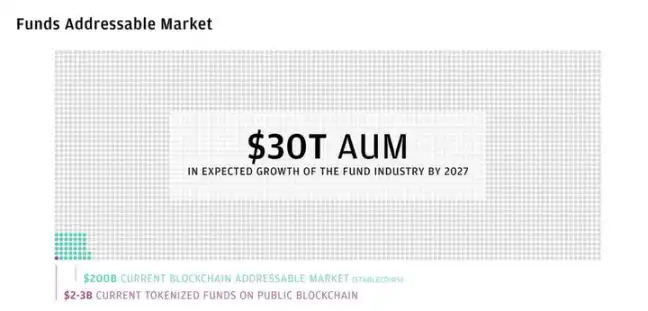
The current tokenized funds represent only a small portion of the expected growth in the fund industry in the coming years.
Likewise, the growth in private credit also reflects market participants' growing interest in opportunities beyond Bitcoin, DeFi native yields, alternative coins, and meme coins.
According to @Preqin, the global private credit market's investment size is close to $17 trillion, while according to @RWA_xyz, the size of tokenized private credit is only about $11.9 billion.
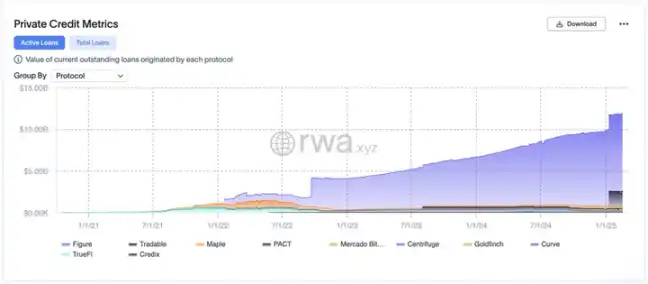
Active Loan Value - Private Credit Market (Source: RWA.xyz)
A deeper analysis of this area, I believe it is necessary to mention that since the market crash of 2022, the reliability of these loans has undergone a significant change, with teams of different platforms becoming more cautious and investing more resources to ensure higher credit quality issuance.
From July 2021 to the end of 2022, borrowing was mainly dominated by crypto trading and market-making companies. Therefore, the borrowing sector in this area collapsed in the 2022 bear market.
Subsequently, the growth mainly came from funds pool of various RWA transactions, such as consumer asset-backed securities (such as auto loans, credit card debt, student loans, small business loans, etc.), real estate bridge loans, trade finance, and other less volatile asset classes.
The proof of this point is resilient protocols like @maplefinance, as demonstrated in the liquidation event on February 3, 2025—a historic event in crypto. For more details, please see the following link: https://x.com/maplefinance/status/1886332880411832514 Additionally, over the past three years, the industry has matured significantly, with continuous emergence of technical solutions aimed at addressing regulatory and privacy obligations, further enhancing this critical area.
2. Opportunity Scale
According to @BCG data, tokenizing all global mutual funds could unlock an additional $100 billion in annual returns for investors. At the same time, "sophisticated investors" (sorry, not referring to you) could earn $400 billion by "capturing intraday value changes" (basically, day trading). Based on the historical adoption pattern of ETFs, it is reasonable to estimate that tokenized funds will represent 1% of global mutual fund and ETF assets under management in the next seven years.
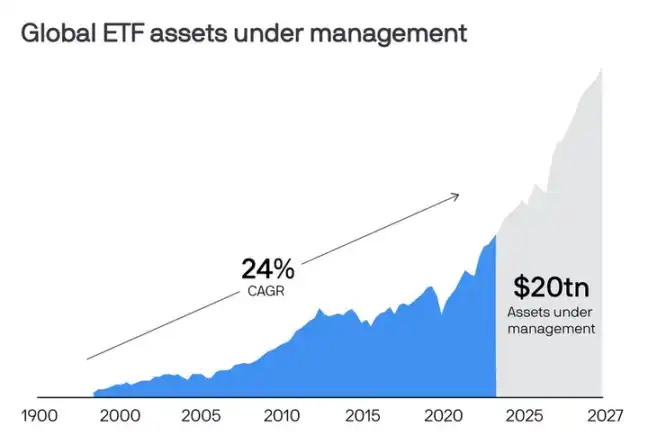
Global ETF Assets Under Management (Source - J.P. Morgan Asset Management)
This implies that by 2030, tokenized assets will exceed $600 billion.
Furthermore, if regulators allow existing mutual funds and ETFs to convert into tokenized funds (which is simpler than launching a new tokenized fund), we might see trillions of dollars in asset under management.
Given the similar growth expectations prior to the introduction of BTC ETFs, I believe we cannot dismiss the possibility that these figures may be overly conservative, and the actual growth might be astonishingly high.
However, even based on these expectations, we are still talking about at least a 200x growth.
Let me say that again, at least a 200x growth from now.
Are you still sitting there lamenting over not making money temporarily?
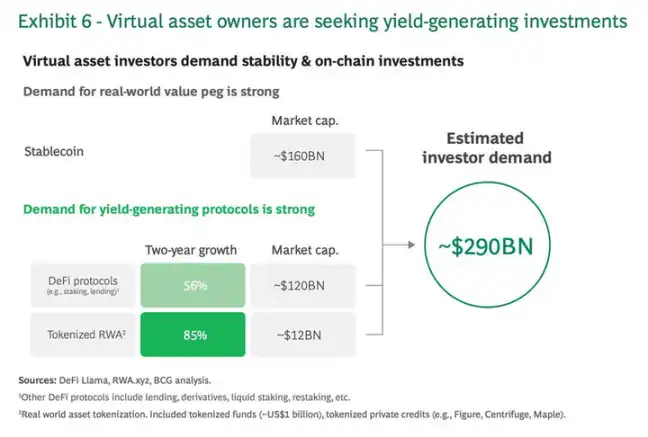
Give me that yield, please!
According to this @BCG study, our industry's investment demand for tokenized funds is approximately $290 billion. This figure includes stablecoin holders, tokenized RWAs, and DeFi protocol demand.
I believe this number may be high because it takes into account the growth of the DeFi protocol market cap, and this growth comes from a user base with a higher risk appetite, whose investment preferences may differ from those willing to invest in tokenized assets.
A more reasonable approach would be to consider the growth of DeFi Total Value Locked (TVL) over the past two years; nonetheless, it would still be a significant number: $580.6 billion (Source - @DefiLlama).
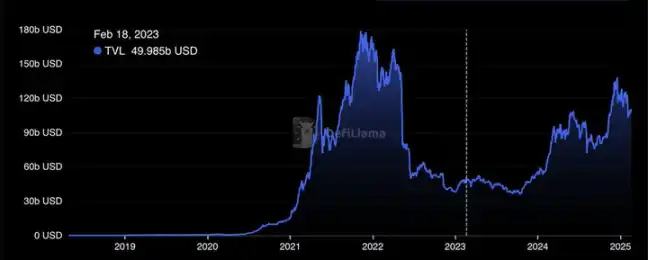
DeFi Total Value Locked (TVL)
Nevertheless, the value propositions of tokenized funds and RWAs are undeniable. They provide a channel to access real-world investment opportunities, allowing investors to better diversify their portfolios amidst market dynamics.
Imagine if, in the past few months, through @Rabby_io, you could have converted your on-chain tokens into stocks, commodities, and real estate without needing to cash out—wouldn't that be convenient?
But why must all this happen? What are the benefits for traditional finance? Lately, on Crypto Twitter (CT), I haven't seen much discussion on this topic, especially amidst the memecoin craze and controversy. We always talk about how Traditional Finance (TradFi) is stepping into the Web3 industry and adopting the technology we are building. But why are they doing this? While I plan to write an article specifically addressing this topic, below are some key points explaining why traditional finance needs and must embrace the crypto rails:
Instant settlement as shown in the following figure could potentially add around $500 billion annually to investors' portfolios. Lowering commissions saves another $330 billion, which will ultimately flow into investors' portfolios. Composability tokenized funds will be easier to lend out. Accessible trading tokenization will make it easier for investors to trade assets.
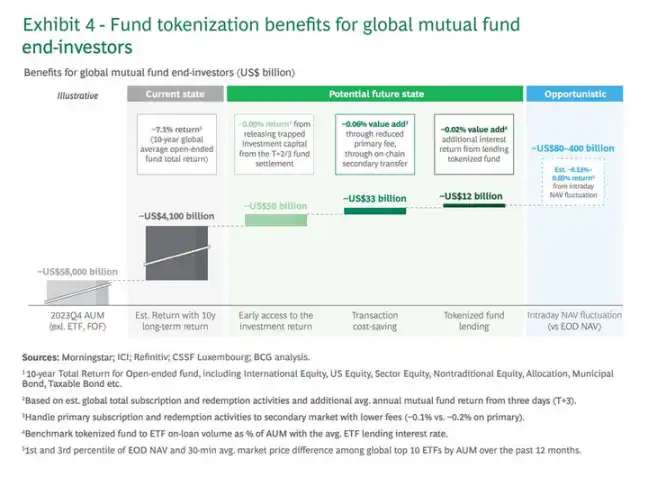
How Tokenization Enhances Returns (Source: Boston Consulting Group)
3. Sentiment Comes Second, Momentum Comes First
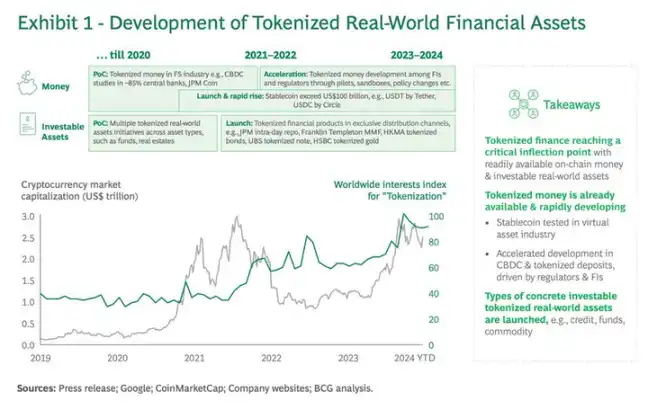
Traditional finance bids farewell, while Crypto Twitter (CT) gets rug pulled.
The chart above shows that regardless of the market conditions, especially Crypto Twitter (CT) sentiment (
You may also like

The large models in the United States are moving towards closure in the name of security

Morning Report | CoinEx becomes a key hub for Iran to evade sanctions, involving over $3.8 billion in funds; Kalshi seeks a new round of financing, with a valuation potentially rising to $40 billion

From the white-haired stock god to the billionaire fund mogul, the smart people shorting Nvidia are all getting rich using the same framework

Why do cryptocurrency projects always like to change their names?

Global Launch: As predictions become the most scarce asset in the AI era, Manadia is defining the next generation of the value internet

Who is footing the bill for the $64 billion accounting frenzy?
I never expected that the first application of AI x Crypto would be in security auditing

What is your view on Binance's competitive advantages?

ETH has entered a non-consensus phase, and the turning point is approaching!
The shift in the cloud of the air: from despising stablecoins a year ago to the high-profile entry of capital today
The survival dilemma of small and medium exchanges behind the withdrawal anomalies exposed by AscendEX
Why Is Bitcoin Falling Below $60K? 5 Key Market Drivers Explained
Bitcoin has dropped sharply amid ETF outflows, Strategy stock weakness, AI stock rallies, and changing Fed expectations. Explore the key forces driving BTC’s latest correction and what traders should watch next.

Bitcoin vs. Gold in 2026: Which Asset Performs Better in Different Markets?

Morning News | The draft amendment to the People's Bank of China Law aims to clarify the legal status of digital renminbi; South Korea will transfer about 40 unregistered virtual asset service providers to law enforcement agencies
The cryptocurrency industry has entered the "Show Me" era: merely relying on vision is no longer enough

Interpreting the Ethereum Foundation's new structure: Reaffirming self-sovereignty amid institutional trends
Former SpaceX engineer reconstructs the financial execution system using first principles
Standard Chartered Bank sings a 50x rhapsody again, aiming for AAVE to reach 3500 USD
The large models in the United States are moving towards closure in the name of security
Morning Report | CoinEx becomes a key hub for Iran to evade sanctions, involving over $3.8 billion in funds; Kalshi seeks a new round of financing, with a valuation potentially rising to $40 billion
From the white-haired stock god to the billionaire fund mogul, the smart people shorting Nvidia are all getting rich using the same framework
Why do cryptocurrency projects always like to change their names?
Global Launch: As predictions become the most scarce asset in the AI era, Manadia is defining the next generation of the value internet
Who is footing the bill for the $64 billion accounting frenzy?


