
Solana's Inflation Model Amendment Proposal, Can it Further Boost SOL Price?

Yesterday, SOL surpassed BNB in market cap, once again becoming the fifth largest cryptocurrency by market cap. Meanwhile, Solana's early investor Multicoin Capital has released a Solana governance proposal aimed at modifying the network's current inflation model and reducing the inflation rate of its native token SOL. The proposal, numbered SIMD-0228, aims to adjust SOL's issuance rate to a dynamic and variable model to make it more market-driven.
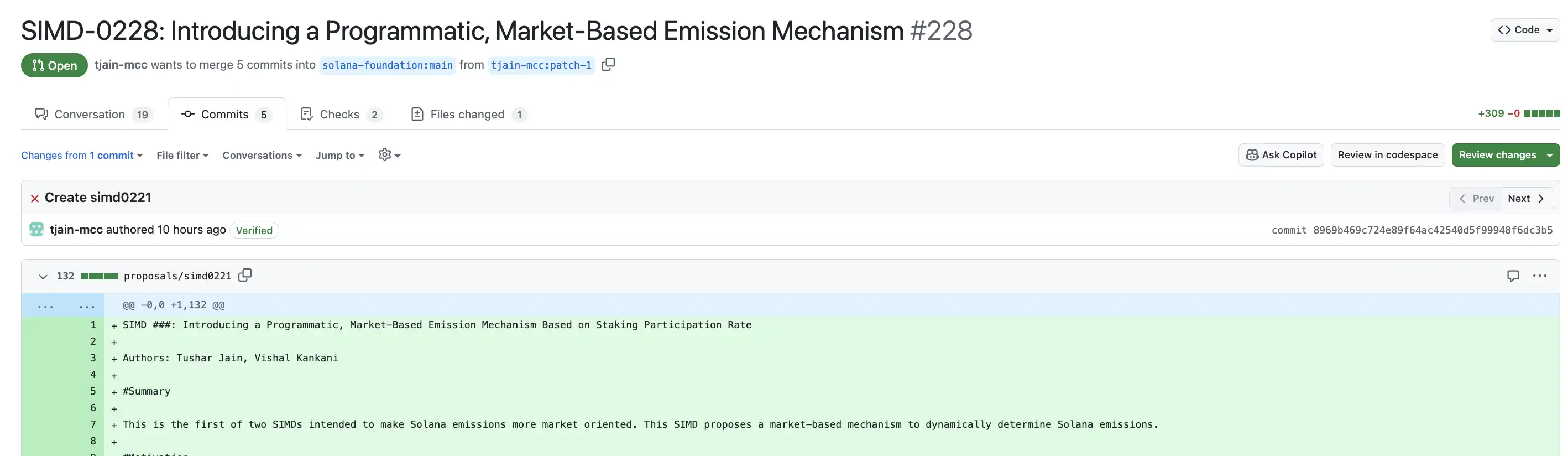
The proposal sets a target staking rate of 50% to enhance the network's security and decentralization. If more than 50% of SOL is staked, the supply will decrease, thereby suppressing further staking by lowering the yield; if less than 50% of SOL is staked, the supply will increase to raise the yield and incentivize staking. The minimum inflation rate will be 0%, while the maximum inflation rate will be determined based on Solana's current issuance curve.
In Solana's mechanism, inflation refers to the issuance of SOL to the validator nodes running the Solana software and assisting in building the blockchain, with the validator nodes subsequently distributing these issuance rewards and some MEV rewards to users delegating their staked SOL.
Currently, Solana's inflation mechanism is fixed, meaning the rate at which SOL is issued as a staking reward is static and does not adjust based on market conditions. However, if this proposal is approved, the network's inflation rate will become variable and be adjusted according to market dynamics.
Reason for Proposal and Its Impact
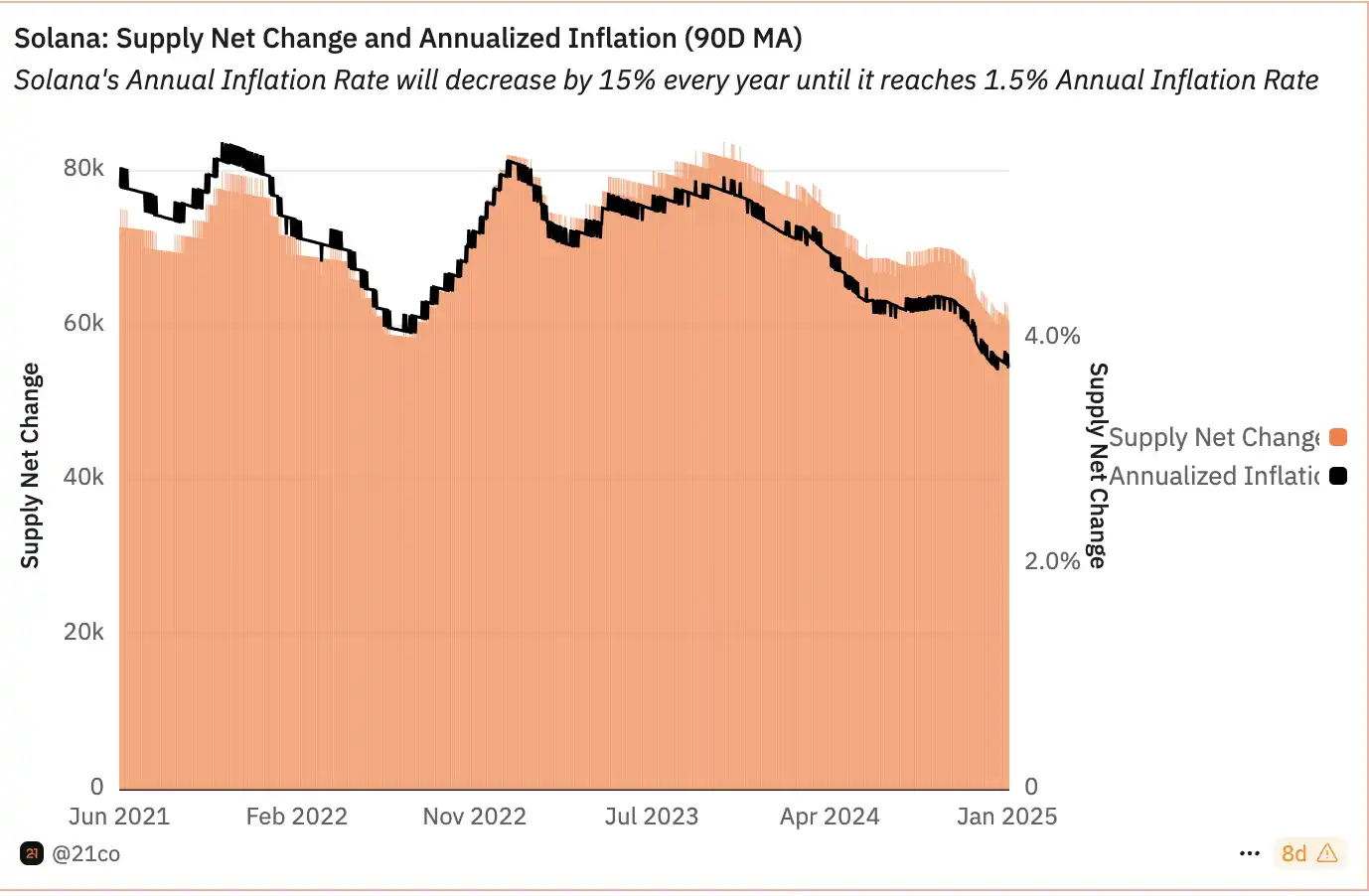
Solana's inflation rate was initially set at 8% and planned to decrease by 15% annually until it reaches 1.5%. Data from Dune Analytics shows that the current inflation rate of SOL is around 3.7%.
Solana co-founder Anatoly Yakovenko stated on the Lightspeed podcast that the idea of a fixed inflation rate was borrowed from the design of the Cosmos blockchain, where inflation is merely a "bookkeeping mechanism." Yakovenko is not particularly concerned about inflation because the issuance of SOL does not create or destroy value but only redistributes value. Newly minted SOL is allocated to stakers, causing a relative devaluation of holdings for non-stakers.
Nevertheless, Multicoin believes that reducing SOL inflation is necessary for the following reasons:
Newly issued SOL is only allocated to stakers, which may lead to network centralization; a high inflation rate reduces the utility of SOL in DeFi and other scenarios, as the opportunity cost of non-staked SOL is too high; additionally, only 9% of staked SOL is liquid, reducing staking rewards may also reduce selling pressure in certain jurisdictions where staking rewards are considered income.
Although technically issuance does not directly cost the network as a whole, the negative perception of non-staked SOL being diluted by inflation is, in Multicoin's view, enough reason to restrict inflation.
「Given the current network activity and fees, Solana's current inflation schedule is suboptimal because it mints more SOL than necessary to secure the network,」 said proposal authors Tushar Jain and Vishal Kankani. 「This mechanism does not account for network activity and does not embed it in the inflation rate calculation.」
If the proposal is implemented and runs as expected, the authors believe that this will 「systemically reduce selling pressure while maintaining a healthy staking participation rate.」 and that 「by aligning inflation adjustments with actual deviations, the network issuance more accurately mirrors the real-time economic and security status of the network.」
This proposal also has an obvious impact — the staking yield of SOL may decrease. Currently, the SOL staking yield has historically remained above 7%; if the issuance decreases, this yield will decrease accordingly. While the growth of MEV rewards may partially offset the impact of decreased inflation, overall, the yield of staking SOL may decrease.
Community Sentiment
This proposal involves multiple stakeholders in the Solana ecosystem, and the community's views on it have inevitably varied.
Messari analyst Patryk suggested that this proposal should be adopted because Solana will evolve from 「blind issuance」 to 「smart issuance,」 which would be a positive development. He believes that the SIMD-0224 proposal is unfavorable to validators, has a neutral impact on stakers, and is favorable to SOL holders.
「Currently, the total staking reward amount of Solana far exceeds the minimum necessary amount to ensure network security. The network is mature enough and no longer requires such a high inflation rate. The SIMD-0224 proposal will change Solana's inflation rate from a fixed schedule model to a programmatic, market-driven model. This change will dynamically incentivize staking participation, similar to the model adopted by networks like @Polkadot. This will minimize inflation to the maximum extent and bring the network staking ratio closer to MNA.」
Patryk believes that this move could reduce selling pressure on SOL and decrease the current "tax burden" imposed on non-staking SOL holders.
On the other hand, Solana forum member Bji does not support this proposal. He believes that the primary purpose of inflation is to incentivize more validators to participate and maintain the network's security, and the inflation reward is meant to gradually decrease. Since Solana's plan is to gradually shift more responsibility to transaction fees to incentivize validators, the inflation reward can be reduced as a supplement.
Currently, most validators already earn significantly more from transaction fees, priority fees, and MEV than from the inflation reward. Therefore, even if the inflation reward is reduced, validators' income will not be greatly affected, but stakers' rewards may decrease.
Bji argues that if, as proposed, the inflation rate were to drop by 50%, leading to a 50% reduction in staked SOL, it is not significant because everyone would reduce their stake in the same proportion; after the proportional reduction in stake by all holders, the relative stake ratio held by validators would remain the same, so their voting power would not substantially change. Since the voting power remains unchanged, the network's security properties would also remain unchanged. Therefore, there is no reason to set a specific inflation rate target for security purposes.
Some community members also argue that yield-oriented stakers would lose motivation if the staking reward were reduced by 50%, and with a 50% decrease in total staked supply, the cost of attacking the network would also significantly decrease. "If only 20% of the total supply is staked, the distribution of stakes may remain the same, but this means that an attacker would only need to purchase and stake 10% of the total supply to halt the network."
Currently, the community is still in a wait-and-see mode regarding this proposal, with key figures in the Solana ecosystem such as Solana founder Anatoly and Helius founder Mert yet to express their views on the proposal. However, the transformation of Solana's economic mechanism is a concern for every SOL holder, with Blockworks data analyst Dan Smith stating that "Solana is officially entering an era of economic transformation."
You may also like

Morning News | The draft amendment to the People's Bank of China Law aims to clarify the legal status of digital renminbi; South Korea will transfer about 40 unregistered virtual asset service providers to law enforcement agencies

The cryptocurrency industry has entered the "Show Me" era: merely relying on vision is no longer enough

Interpreting the Ethereum Foundation's new structure: Reaffirming self-sovereignty amid institutional trends

Former SpaceX engineer reconstructs the financial execution system using first principles

Tidal Investment: We still have a positive outlook on the AI industry chain, but the reasons have changed

Standard Chartered Bank sings a 50x rhapsody again, aiming for AAVE to reach 3500 USD

The interim executive director of the Ethereum Foundation speaks out: What is our mission?
Why does OKX want to start a new company with the parent company of the New York Stock Exchange?

Why Is PAXG Price Different From Gold? 5 Reasons Crypto Traders Should Know

WEEX OpenAPI 101: 5 Powerful Modules, AI Trading Tools, and Grab Up to 70% Revenue Opportunities
Learn how WEEX OpenAPI connects traders, developers, AI agents, and trading platforms. Discover WEEX API features, Binance-compatible integration, automated trading workflows, revenue opportunities, and ecosystem possibilities.

Interview with NDV Founder Jason Huang: Popping the AI Bubble and the Myth of Microstrategy, Seeking the Ultimate Ace in the Crypto Market

Morning Report | Former Ethereum Foundation researcher establishes Ethlabs; EU Parliament Economic Committee passes digital euro regulatory proposal

Dragonfly partner Haseeb: The fastest-growing companies in the future may all be stuck at 149 people

How xBubble Breaks the Deadlock in VC's Heavy Investment in the OPC Economy

The encrypted unicorn Blockstream is deeply embroiled in a serious fraud case

Morning Report | The South Korean Financial Services Commission plans to expand the regulatory sandbox to include virtual assets; the parent company of the New York Stock Exchange, ICE, has reached a partnership with OKX to jointly establish a cryptocu...

Exclusive Interview with Strategy CEO: Putting Aside the Sale of 32 BTC, the 60 Trillion AI Intelligence is the Ultimate Fate of Bitcoin

TRON revitalizes the image of the bull, creating a more approachable brand character
Morning News | The draft amendment to the People's Bank of China Law aims to clarify the legal status of digital renminbi; South Korea will transfer about 40 unregistered virtual asset service providers to law enforcement agencies
The cryptocurrency industry has entered the "Show Me" era: merely relying on vision is no longer enough
Interpreting the Ethereum Foundation's new structure: Reaffirming self-sovereignty amid institutional trends
Former SpaceX engineer reconstructs the financial execution system using first principles
Tidal Investment: We still have a positive outlook on the AI industry chain, but the reasons have changed
Standard Chartered Bank sings a 50x rhapsody again, aiming for AAVE to reach 3500 USD


