
Can PAC Coin Reach $1 Soon? Analyzing Public Asset Control


Public Asset Control (PAC) has caught the eye of many in the crypto space as a Solana-based token with a unique government-themed twist, sparking questions about its potential to hit $1. This article dives into whether that's realistic, breaking down market cap requirements, growth factors, and risks based on current data as of May 13, 2026. We'll explore PAC's price outlook, drawing from its speculative nature and Solana ecosystem dynamics, while offering a balanced view to help you weigh opportunities. If you're looking to dive into such tokens, you might want to explore trending coins via WEEX, a crypto trading platform that lists various assets.
KEY TAKEAWAYS
PAC coin's path to $1 would demand a $1 billion market cap, far from its current valuation under $1 million, highlighting the massive influx of capital needed.
Growth hinges on community buzz, exchange listings, and broader market trends, but speculative risks like low liquidity could lead to sharp volatility.
Short-term gains toward $0.001 or $0.01 seem more feasible than $1, based on math and historical Solana token patterns.
Investors should balance optimism with caution, verifying contract addresses and using verified platforms to mitigate scams in meme-driven tokens.
Long-term success for PAC depends on sustained adoption amid fierce competition in the Solana ecosystem.
Understanding Public Asset Control (PAC) Coin Basics
Public Asset Control, or PAC, emerged as a Solana-based token that plays on a classified government brief aesthetic, referencing assets and institutions in a bold, entertaining way. Launched with a total supply of 1 billion tokens, it's positioned as a speculative asset for entertainment, as per its own disclaimer. As of May 13, 2026, PAC trades at $0.0009023 USD, giving it a modest market cap around $902,300, according to data from the unidentified project materials extracted on that date.
What sets PAC apart in the crowded Solana meme token scene is its thematic flair, which has drawn social media chatter. Unlike utility-focused tokens in DeFi, PAC leans into speculation, where price movements often stem from hype rather than underlying tech. For beginners, think of it like a viral internet joke that gains value through shared excitement—much like how early meme coins rode waves of online communities. However, the project's limited public info on its team and security raises flags, urging users to verify claims independently.
This opacity isn't uncommon in emerging tokens, but it underscores the need for due diligence. Crypto analyst Alex Becker, in a recent YouTube breakdown of Solana projects, noted, "Tokens like PAC thrive on narrative, but without real adoption, they're just digital lottery tickets." That sentiment aligns with PAC's current setup, where entertainment value drives interest more than practical use cases.
Market Cap Breakdown: What $1 Means for PAC Coin
To grasp if PAC can reach $1, let's crunch the numbers on market capitalization. With a circulating supply of 1 billion tokens, hitting $1 per token would require a fully diluted valuation of $1 billion. That's a staggering leap from its current sub-$1 million cap. Breaking it down further reveals the scale:
| Price Level | Required Market Cap |
|---|---|
| $0.001 | ~$1 million |
| $0.01 | ~$10 million |
| $0.10 | ~$100 million |
| $1 | ~$1 billion |
These figures, derived from the project data as of May 13, 2026, show that smaller milestones like $0.001 are within reach if trading volume sustains. For context, Solana's ecosystem has seen tokens like BONK surge on community momentum, but scaling to $1 billion often takes years and significant capital inflow. It's not impossible—Bitcoin started small—but PAC would need exponential growth, perhaps mirroring how Dogecoin ballooned during bull runs.
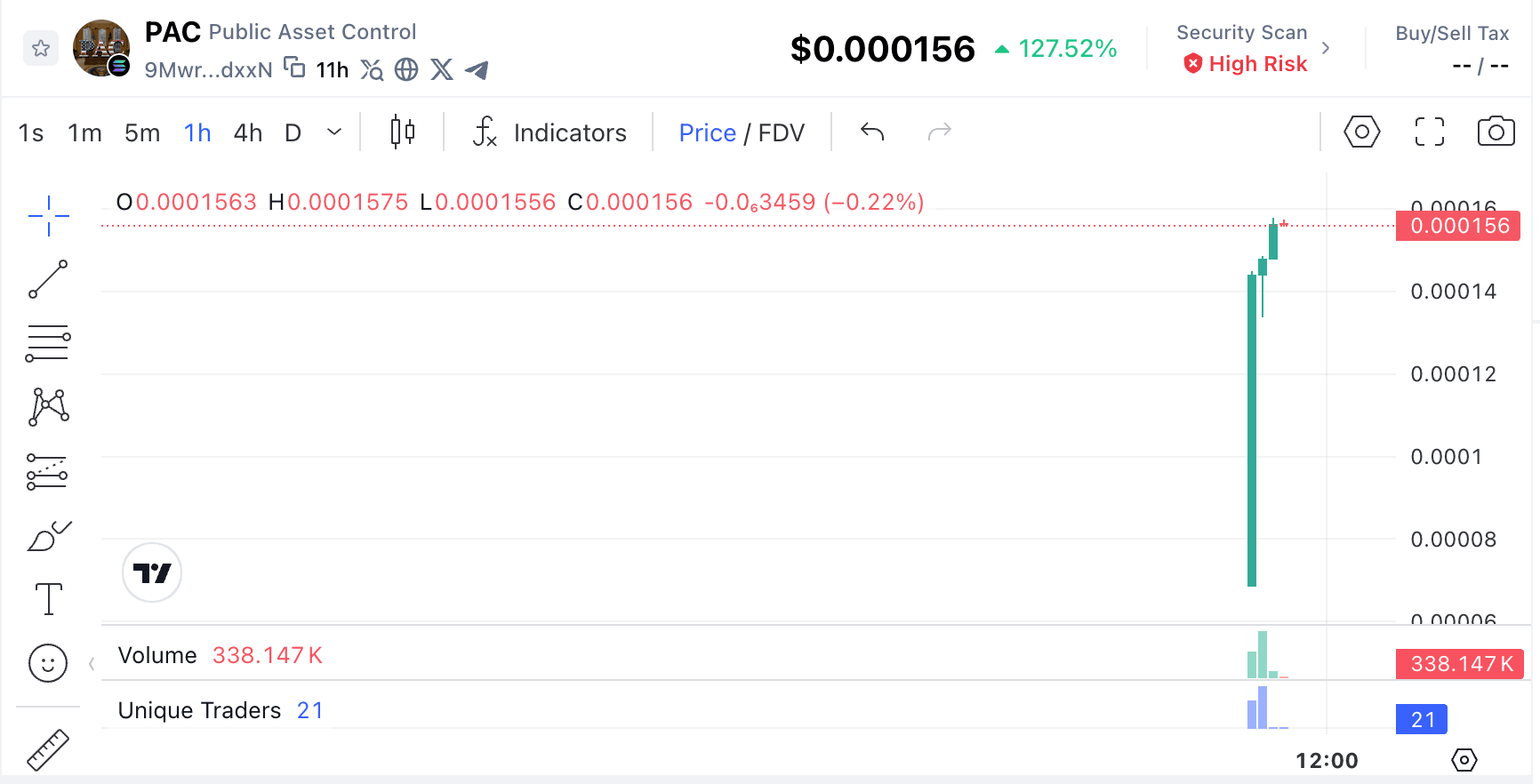
Experts like those from Messari's recent Solana report emphasize that market cap isn't just about price; it's tied to investor inflows. "Speculative tokens need liquidity pools to grow without crashing," states the report, highlighting how PAC's current $59,200 liquidity could amplify volatility if demand spikes unevenly.
Factors Driving PAC Coin Growth Potential
Several elements could propel PAC forward in the competitive Solana landscape. Strong community activity stands out, as many Solana meme tokens depend on social engagement for visibility. With daily trading volume hovering near $1.1 million as of May 13, 2026, there's evident interest, which could snowball if online discussions amplify.
Exchange listings play a pivotal role too. Securing spots on major platforms boosts accessibility and liquidity, potentially attracting more traders. For instance, when tokens like Jito got listed on bigger exchanges, their volumes exploded. PAC's path might follow suit if it gains such traction.
Broader crypto market momentum can't be ignored. Bull markets heighten risk appetite for low-cap tokens, as seen in the 2024-2025 rally where Solana projects averaged 5x gains, per CoinGecko data. If Bitcoin and Ethereum push higher, spillover effects could lift PAC.
Yet, growth isn't guaranteed. Sustained volume and community efforts are key, but as crypto researcher Lark Davis pointed out in a recent podcast, "Meme tokens rise on hype, but they need sticking power to avoid fading." For PAC, building beyond its thematic novelty—perhaps through partnerships or real-world tie-ins—could make a difference.
Risks and Challenges for PAC Coin Reaching $1
While optimism surrounds PAC, risks loom large in this volatile niche. Limited liquidity at $59,200 means prices can swing wildly; a big sell-off could drop values sharply, as happened with many small-cap Solana tokens during the 2025 correction.
Speculative trading dominates here, with much activity focused on short-term flips rather than long-term holding. The Solana ecosystem teems with thousands of competitors, making it tough for PAC to stand out. Uncertain adoption adds another layer—without expanding its user base or utility, growth stalls.
Market competition is fierce; tokens like Raydium and Orca have carved niches through DeFi functions, leaving pure spec assets like PAC vulnerable. Regulatory shifts, such as potential SEC scrutiny on meme coins, could also dampen enthusiasm, as noted in a Bloomberg article from early 2026 warning of increased oversight.
Balancing this, short-term outlooks favor incremental gains. PAC might climb to $0.001 on momentum, but $1 feels distant without major catalysts. Long-term? It's speculative—investor sentiment and market conditions will dictate.
Short-Term vs. Long-Term Outlook for PAC Token Price
In the near term, PAC could see upsides from current momentum, with price swings driven by trading activity. Data shows tokens under $1 million cap often double on viral pushes, but crashes follow if interest wanes. Aiming for $0.01 seems plausible with sustained $1.1 million volume, requiring about 10x current cap.
Long-term projections are trickier in crypto's fast pace. If PAC secures listings and community support, it might mirror successes like Shiba Inu, which hit lofty vals through ecosystem builds. However, years of growth are likely needed for $1, per the market cap math.
Crypto expert Raoul Pal, in a Real Vision interview, advised, "Low-cap plays are high-reward but high-risk; focus on trends like Solana's speed for edge." For PAC, monitoring Solana's overall health—strong with $200 billion TVL as of May 2026—offers clues.
Strategies for Traders Eyeing Public Asset Control (PAC)
Approaching PAC requires a framework: Assess your risk tolerance first. If speculative, allocate small portions—say, 5% of your portfolio—to avoid major losses. Track metrics like volume and liquidity via tools like DexScreener.
Diversify within Solana; pair PAC with established tokens for balance. Set price targets based on caps: Exit at $0.001 if it hits, locking gains. Always verify the contract address to dodge scams, a common pitfall in meme spaces.
Platforms like WEEX, as a crypto trading platform, can help access such assets, but remember, no strategy guarantees profits. Use stop-losses to manage volatility.
In wrapping up, PAC's journey to $1 hinges on massive scaling, but realistic paths point to gradual gains amid risks. As an investor, I've seen similar tokens surprise, yet most fizzle without substance. Keep expectations grounded, and view PAC as a fun, high-stakes bet in the evolving Solana world.
For those interested, the WEEX Token (WXT) serves as an ecosystem asset on the platform. New users can also check out the WEEX welcome bonus, which offers rewards like trading bonuses for tasks such as account setup or deposits.
FAQ
Q1: Can PAC reach $1?
Very unlikely due to the massive $1B market cap requirement.
Q2: What is more realistic for PAC?
Short-term targets like $0.001–$0.01 during hype cycles.
Q3: Why is PAC so volatile?
Low liquidity and strong meme-driven speculation.
Q4: Is PAC a safe investment?
No, it is high-risk and driven mainly by market sentiment.
DISCLAIMER: WEEX and affiliates provide digital asset exchange services, including derivatives and margin trading, only where legal and for eligible users. All content is general information, not financial advice-seek independent advice before trading. Cryptocurrency trading is high risk and may result in total loss. By using WEEX services you accept all related risks and terms. Never invest more than you can afford to lose. See our Terms of Use and Risk Disclosure for details.
You may also like

What Is SAOS? Strategic American Oil Supply Token Explained
SAOS is a meme token on Solana with a 75,000 USD market cap and 22,000 USD locked liquidity, positioned around oil supply themes but lacking real asset backing
It thrives on pure narrative speculation, with no utility, website, or doxxed team, making it highly volatile and attention-dependent
Traders should distinguish SAOS from legitimate real-world asset projects, as its branding is speculative rather than substantive
Positive aspects include locked liquidity reducing rug pull risks, but low trading activity signals high uncertainty
How to Buy Public Asset Control (PAC) Token in 2026: Latest Solana Buying Guide
How to buy Public Asset Control (PAC) token in 2026, PAC contract address, Solana wallet setup, Jupiter swap guide, latest price, liquidity, and risks.

What Is Public Asset Control (PAC) Token and How Does It Work? Latest Solana PAC Token Guide
Public Asset Control (PAC) token explained. Learn what PAC is, how it works on Solana, current price snapshot, risks, and buying basics.

United Nations Oil Reserve (UNOS) Crypto: Solana Token, UN Links, and Risks
United Nations Oil Reserve (UNOS) Crypto explained: Solana token basics, UN links, oil-backing claims, market risks, contract checks, and buying cautions.

What Is Public Asset Control (PAC) Coin? Explained for Beginners
Public Asset Control (PAC) is a Solana-based token that uses a “government asset control” narrative involving oil and gold themes, but it has no verified ties to any real institutions or governments. It is mainly an entertainment-focused, speculative meme coin.
The project’s claims about links to entities like BlackRock or Palantir are unverified, and its own disclaimer states it is not a real financial or institutional asset. Like many new Solana tokens, PAC is highly volatile, with low liquidity and limited transparency, including no fully verified audit.
Overall, PAC is a high-risk speculative token driven by hype and storytelling rather than real utility. Beginners are advised to be cautious, verify contract details, and prioritize risk control before considering any trading.
What Is Official Saudi Oil Reserve (OSOR) Coin?
Learn what OSOR coin is, why its Saudi oil narrative matters, how to verify the contract, and what risks to check before trading.

Global Digital Oil Reserve (GDOR): What It Is, Risks, and How to Check It
Global Digital Oil Reserve (GDOR) is an oil-themed Solana token with unclear backing. Learn its risks, market data, and verification checklist.

Is OBC Crypto a Good Investment?
Is OBC crypto a good investment? We analyze the latest market data, holder concentration, liquidity risks, and short-term momentum. Read this before you invest in OBC token.

Can OSOR Reach $1? Full Price Analysis 2026
OSOR crypto price prediction 2026: Can Saudi Oil Reserve token reach 1? Read before buying.

What is International Oil Supply (IOS) Coin?
Wondering what is IOS crypto? Here’s a straight look at International Oil Supply (IOS) coin—the Solana token tied to oil reserve data. Contract address, risks, and what’s still unverified.

What Is the Unified International Token (UNIT)? Is UNIT Crypto Legit or Scam?
what is UNIT crypto? Here’s a breakdown of the Unified International Token ($UNIT), how it ties to BRICS+ data, where to buy it, and why it’s a conceptual project—not an official currency.
What Is Stablecoin Business OS (SBOS) Coin?
What is SBOS crypto? We break down Stablecoin Business OS, its USDC invoicing tools, AI finance assistant, token contract address, and real utility for online businesses.

World Collective Oil Reserve ($WCOR) Price Prediction: May 2026 Rally Analysis and Future Outlook
Is $WCOR a good investment? Read our comprehensive World Collective Oil Reserve price prediction and market analysis for 2026-2030. Learn about the energy narrative on Solana and start your trading journey with WEEX rewards.

Is $PAC Token a Good Investment in 2026? Price, Risks, and Market Analysis
A data-driven analysis of Public Asset Control (PAC) token: current price, market cap, liquidity, $1 target feasibility, and risk factors. Is it a legitimate investment or a high-risk meme coin?
OPG Airdrop: Share 50,000 USDT and Enjoy 0-Fee Trading on WEEX
Join the OPG airdrop on WEEX to share a 50,000 USDT prize pool. New users earn rewards through spot trade and deposits. Trade OPG with zero fees now.
Is OSOR Token Next 10X Like WCOR or Just Market Hype?
Is OSOR the next 10X crypto like WCOR or just market hype? Compare OSOR vs WCOR on-chain data, price discrepancies, and holder risks in this deep dive into Saudi oil-backed tokens.
NEAR Airdrop: Join WEEX to Share 50,000 USDT in Crypto Rewards
Join the NEAR airdrop on WEEX from May 7 to May 14 to share a 50,000 USDT prize pool. New users can earn rewards through deposits and spot trades with zero-fee trading advantages.
What Is $PAC Token? Legitimate Crypto or Just A High-Risk Meme Coin?
Is Public Asset Control ($PAC) a real asset-backed token or just another meme coin narrative? We analyze its official website, market data, and risks.
What Is SAOS? Strategic American Oil Supply Token Explained
SAOS is a meme token on Solana with a 75,000 USD market cap and 22,000 USD locked liquidity, positioned around oil supply themes but lacking real asset backing
It thrives on pure narrative speculation, with no utility, website, or doxxed team, making it highly volatile and attention-dependent
Traders should distinguish SAOS from legitimate real-world asset projects, as its branding is speculative rather than substantive
Positive aspects include locked liquidity reducing rug pull risks, but low trading activity signals high uncertainty
How to Buy Public Asset Control (PAC) Token in 2026: Latest Solana Buying Guide
How to buy Public Asset Control (PAC) token in 2026, PAC contract address, Solana wallet setup, Jupiter swap guide, latest price, liquidity, and risks.
What Is Public Asset Control (PAC) Token and How Does It Work? Latest Solana PAC Token Guide
Public Asset Control (PAC) token explained. Learn what PAC is, how it works on Solana, current price snapshot, risks, and buying basics.
United Nations Oil Reserve (UNOS) Crypto: Solana Token, UN Links, and Risks
United Nations Oil Reserve (UNOS) Crypto explained: Solana token basics, UN links, oil-backing claims, market risks, contract checks, and buying cautions.
What Is Public Asset Control (PAC) Coin? Explained for Beginners
Public Asset Control (PAC) is a Solana-based token that uses a “government asset control” narrative involving oil and gold themes, but it has no verified ties to any real institutions or governments. It is mainly an entertainment-focused, speculative meme coin.
The project’s claims about links to entities like BlackRock or Palantir are unverified, and its own disclaimer states it is not a real financial or institutional asset. Like many new Solana tokens, PAC is highly volatile, with low liquidity and limited transparency, including no fully verified audit.
Overall, PAC is a high-risk speculative token driven by hype and storytelling rather than real utility. Beginners are advised to be cautious, verify contract details, and prioritize risk control before considering any trading.
What Is Official Saudi Oil Reserve (OSOR) Coin?
Learn what OSOR coin is, why its Saudi oil narrative matters, how to verify the contract, and what risks to check before trading.


