DeFi 2026: What is DeFi? A beginner's guide to DeFi

 Prefer us on Google
DeFi (decentralized finance) is an "open" financial system running on blockchain: you use a wallet to swap, lend/borrow, save, etc., without needing a bank as an intermediary. (Ethereum.org; CoinMarketCap).
During the 2024–2025 period, DeFi accelerated into a multi-chain environment: CoinGecko recorded that in Q4/2024, Solana led DEX transactions (over 30% of transactions), and in 2025, perps on DEXs surged (+346%) to reach 6.7 trillion USD. (CoinGecko).
In the context of DeFi 2026, the market is simultaneously expanding its products and volume while facing security risks and an increasingly clear regulatory framework—beginners should prioritize "understanding mechanisms + risk management" before optimizing for profit. This article by WEEX Crypto Wiki will analyze this.
What is DeFi and why should beginners care about DeFi
Ethereum.org describes DeFi as an open financial system that operates 24/7; services are automated via smart contracts, and there is no central authority that can arbitrarily block payments or close the market. (Ethereum.org).
CoinMarketCap adds a pragmatic perspective: DeFi is a "movement/ecosystem" that creates alternatives to centralized financial services; popular applications include stablecoin, DEX, and lending. (CoinMarketCap).
Why should beginners care about DeFi? Because DeFi turns "financial services" into software: with just a wallet and an Internet connection, you can access bank-like functions (earning interest, collateralized borrowing, trading). However, the BIS warns that DeFi also introduces new systemic risks (e.g., information asymmetry, market inefficiencies, etc.), so oversight and regulation tend to increase as adoption spreads. (BIS).
How does DeFi work
A DeFi session typically goes through: wallet → dApp interface → smart contract → blockchain.
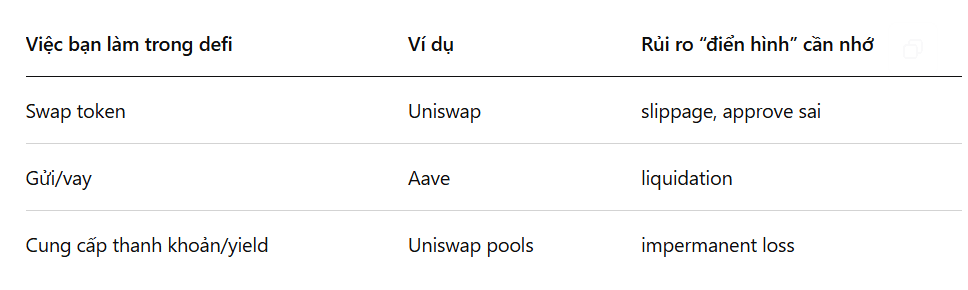
With AMM-style DEXs (like Uniswap), swaps occur via a "liquidity pool"; swap fees are paid to liquidity providers (LP), and swaps are permissionless. (Uniswap Docs).
Two concepts beginners need to understand before executing a trade:
Slippage/price impact: Uniswap explains that slippage is the difference that can occur when a transaction is "pending"; setting a "slippage tolerance" helps limit poor execution prices (though setting it too low can easily cause transactions to fail). (Uniswap Docs).
Approve: the first time you swap or provide liquidity with a token, you may need to perform an approval transaction to grant the smart contract permission to use the tokens in your wallet. Uniswap describes this as a necessary step before swapping/providing liquidity with that token. (Uniswap Support).
With lending protocols like Aave, borrowing positions are typically over-collateralized and risks are monitored via a Health Factor; Aave clearly states that when the Health Factor < 1, the position may be liquidated. (Aave Docs; Aave Help).
TVL is a metric you will encounter very frequently. DeFi Pulse defines TVL as the total value of assets deposited into a protocol to generate economic activity (lending, borrowing, providing liquidity, etc.), and emphasizes that TVL has specific exclusion criteria. (DeFi Pulse).
Security risk is a "hot spot" as we enter DeFi 2026. Chainalysis estimates that scam & fraud in 2025 could exceed 17 billion USD, with impersonation scams increasing by approximately 1400% YoY—beginners are often targeted by "fake support" tactics, tricking them into signing malicious transactions or granting incorrect permissions. (Chainalysis).
Beyond scams, Chainalysis also recorded more than 3.4 billion USD stolen in 2025 (from January to early December 2025), showing that DeFi becoming more mature does not mean risks have disappeared. (Chainalysis).
Trends and outlook for DeFi 2026
Some key quantitative signals from 2024–2026:
Multi-chain DeFi and on-chain trading continue to grow. CoinGecko recorded that in Q4/2024, Solana led DEXs (>30% of transactions), and in 2025, perps on DEXs reached 6.7 trillion USD (+346%). (CoinGecko).
As early as 2024, DEXs had explosive months: Axios cited DefiLlama data indicating that DEX volume in March 2024 reached a record 268 billion USD. (Axios).
Stablecoins are the core liquidity foundation, while RWA expands "real yield." CoinGecko reported the market cap of fiat-pegged stablecoins was ~161.2 billion USD (August 1, 2024) with USDT accounting for approximately ~71% of the market cap. (CoinGecko).
By 2025, CoinGecko reported that the stablecoin market cap increased significantly to reach 311 billion USD. (CoinGecko).
Regarding real-world asset tokenization, CoinGecko recorded that tokenized treasuries reached 5.6 billion USD (April 2025, +544.8% from the beginning of 2024) and BUIDL held a 44% market share—a foundation for the DeFi 2026 scenario shifting from "endogenous yield" to "traditional asset-backed yield." (CoinGecko RWA 2025).
Regulatory frameworks are clearer but fragmented. European Commission documents state that MiCA began applying to stablecoins (Titles III & IV) from June 30, 2024, and will be fully applied from December 30, 2024; ESMA is implementing a registry and expects to complete integration into the system by mid-2026. (European Commission; ESMA).
In the US, the Wall Street Journal and Axios reported that the Senate voted to repeal an IRS regulation that would have expanded the definition of "broker" to include certain DeFi activities—reflecting the policy tug-of-war between tax compliance and fostering innovation. (WSJ; Axios).
DeFi 2026 TVL forecasts based on "a standard figure": within the scope of the reports prioritized in this article, there is no unified quantitative TVL projection; TVL itself depends on the measurement methodology and exclusion criteria. (DeFi Pulse).
FAQ for beginners
Is DeFi legal?
It depends on the location. The EU has applied MiCA since 2024; the US is still debating, for example, regarding "DeFi broker" tax regulations. (European Commission; WSJ).
Why do swaps require "approval"?
Because the smart contract needs permission to use the tokens in your wallet to execute the swap/provide liquidity; that is the "approval transaction." (Uniswap Support).
Is high yield "safe"?
No. Chainalysis data shows that scams and various forms of fraud are increasing sharply; high yield often comes with high risk. (Chainalysis).
Related articles from WEEX
- Advantages and disadvantages of investing in crypto for beginners | WEEX Crypto Wiki
- Crypto tax policies in selected countries: US, EU, Japan, South Korea, and Vietnam
- What is USOR Crypto? Exploring the U.S. Oil (USOR) project for beginners | WEEX Crypto Wiki
Open a crypto trading account on WEEX
WEEX offers:
- A simple interface that is easy to use even for those who have never invested before.
- 24/7 customer support in Vietnamese to quickly answer all your questions.
- A multi-layered security system to ensure your assets are always safe.
- An in-depth investment knowledge base to help you track market trends and make accurate decisions.
WEEX is the ideal choice if you are looking for a reputable platform to start your investment journey and explore potential AI projects.
Disclaimer:
WEEX and its affiliates provide digital asset exchange services, including derivatives and margin trading, only where legal and for eligible users. All content is general information, not financial advice—please seek independent advice before trading. Trading cryptocurrency carries high risk and can lead to total loss. By using WEEX services, you accept all related risks and terms. Never invest more than you can afford to lose. See our Terms of Use and Risk Disclosure for details.
Disclaimer: This content is provided for general branding and informational purposes only and doesn't constitute financial, investment, legal, or tax advice. Any events, rewards, online events, or related information mentioned herein should not be considered a recommendation, solicitation, or invitation to purchase, sell, trade, or otherwise deal in any crypto assets or to use any services. Crypto assets are highly volatile and may result in loss. WEEX services and online events may not be available in all regions and are subject to applicable laws, regulations, and eligibility requirements. You are responsible for ensuring that your use of WEEX services complies with local laws and for carefully assessing the risks before participating in any crypto-related activities.
You may also like
How to Set Up a DCA Strategy for Crypto
Dollar-cost averaging (DCA) helps crypto investors spread buys over time to reduce timing risk. This guide shows how…
Does DCA Actually Work? What the Data Shows
DCA (dollar-cost averaging) means investing a fixed amount on a set schedule, regardless of price. This article looks…
What is Astera Labs Tokenized Stock (Ondo)(ALABON) Coin? Everything You Need to Know Before Trading ALABON/USDT
This article explains what Astera Labs Tokenized Stock (Ondo) (ticker: ALABON) is, how tokenized stocks work, where to…
What Is Copy Trading? A Beginner’s Guide
Copy trading lets you automatically mirror another trader’s positions in real time. You choose a trader to follow,…
What is Credo Technology Group Holding Tokenized Stock (Ondo)(CRDOON) Coin? Everything You Need to Know Before Trading CRDOON/USDT
This article explains what Credo Technology Group Holding Tokenized Stock (Ondo) (CRDOON) is, how it works, who stands…
Is DCA a Good Strategy for Beginners?
Short answer: for most beginners, DCA (dollar-cost averaging) is a sensible starting point—simple, steady, and less stressful—though it…
USA Rare Earth Stock (USAR): Bull Case, Risks, and the 2028 Bet
USA Rare Earth stock (USAR) explained — what the company does, why shares slumped in 2026, the Round Top bull case, the MP Materials lawsuit, and key risks.
USAR Stock Price Prediction: Can USA Rare Earth Reclaim $40?
USAR stock price prediction: USA Rare Earth trades near $19 vs a $36–$39 analyst target. Bull case, bear case, and 2026–2030 scenarios.
Meta Stock in 2026: Price, Forecast, and How to Trade It
Meta stock near $630 in July 2026, down YTD on AI capex fears. See the price, analyst forecast, bull vs bear case, and how to trade META exposure.
Costco Stock (COST): Price, Forecast, and Is It a Buy in 2026
Costco stock (COST) trades near $915–950 in July 2026 at ~48x earnings. See the latest price, analyst forecast, dividend, and how to buy.
SK Hynix Stock: Inside the AI Memory Giant's Nasdaq Debut
SK Hynix stock lists on Nasdaq July 10 as SKHY in the biggest ADR debut ever. Price, 2026 forecast, HBM bull/bear case, and how to buy.
Risks of Shorting Bitcoin You Should Know Before You Trade
Shorting can look simple: you profit when price falls. But the bitcoin short is different from buying because…
Shorting Bitcoin vs Buying Put Options: What’s the Difference
This guide breaks down two ways to express a bearish view on BTC: opening a bitcoin short with…
Prismevm (PP) Airdrop on WEEX: How to Unlock New User Rewards
This guide explains what Prismevm (PP) is, how the Prismevm (PP) airdrop on WEEX works, and a simple,…
How to Short Bitcoin: Methods and Platforms Compared
A bitcoin short lets you profit if BTC falls. This guide explains how to short bitcoin using futures,…
What Is Dollar-Cost Averaging (DCA)? A Beginner’s Guide
Dollar-cost averaging (DCA) is a simple strategy: invest a fixed amount on a fixed schedule, no matter the…
What Does It Mean to Short Bitcoin? A Beginner’s Guide
Shorting is the opposite of buying. Instead of hoping Bitcoin goes up, you take a bitcoin short to…
How to Join GROVE Airdrop and Unlock 50,000 USDT Rewards
The GROVE airdrop marks Grove Finance’s token debut on WEEX with a clear, rules-based campaign that rewards deposits,…
What is Cash Cat (CASHCAT) Coin? Everything You Need to Know Before Trading CASHCAT/USDT
This article explains what Cash Cat (CASHCAT) is, how it works on Robinhood Chain, what drives demand, how…
Bitcoin Price Prediction 2026: Is the BTC Bottom Finally In?
This article maps a clear path to Bitcoin Price Prediction 2026 and weighs the question: Is the BTC…
Aptos (APT) Token Unlock July 12: Will APT Price Crash?
Aptos (APT) faces a scheduled token unlock on July 12, and traders are asking if the added supply…
What is Bitmine BMNR and Why Does It Own 5.7 Million ETH?
This article explains the claim that “Bitmine BMNR” controls 5.7 million ETH, what Bitmine BMNR might be, how…
Why is XRP Price Pumping Today After Ripple MiCA License Approval?
XRP price momentum accelerated after reports that Ripple secured a MiCA-compliant authorization in the EU, a milestone that…
Why Did Bitcoin Drop 33% While Semiconductor Stocks Pumped 102%?
Bitcoin’s 33% drawdown alongside a 102% surge in semiconductor stocks looks contradictory, but the gap is explainable. This…
Is Bitmine Immersion Technologies Safe? BMNR Crypto Holdings Explained
This guide breaks down what Bitmine BMNR and BMNR Crypto could represent, how to judge safety for Bitmine…
Why is Bitcoin Crashing Below 64K After the Weekend Rally?
Bitcoin’s slide below 64K after a strong weekend bounce looks jarring, but the mechanics are familiar: thin weekend…
Crypto Kidnapping and Torture Case: 5 Crucial Rules to Protect Your Cold Wallet Private Keys
Crypto kidnapping is a blunt, offline attack that targets you—not your code. This guide explains how kidnappers force…
What is Trump Crypto Coin and Why Did It Lose 3.8 Billion Dollars?
This article explains what people mean by “Trump Crypto” coin, why multiple Trump-themed tokens surged and then rapidly…
What is Ripple MiCA Crypto Authorization and How Does It Work?
Ripple MiCA Crypto Authorization refers to the process a Ripple-affiliated entity would follow to operate legally under the…
Is Trump Crypto Coin a Scam? The $3.8 Billion Loss Report Explained
“Trump Crypto” has become a catch-all label for tokens, NFTs, and memecoins that reference the former U.S. president.…
How to Set Up a DCA Strategy for Crypto
Dollar-cost averaging (DCA) helps crypto investors spread buys over time to reduce timing risk. This guide shows how…
Does DCA Actually Work? What the Data Shows
DCA (dollar-cost averaging) means investing a fixed amount on a set schedule, regardless of price. This article looks…
What is Astera Labs Tokenized Stock (Ondo)(ALABON) Coin? Everything You Need to Know Before Trading ALABON/USDT
This article explains what Astera Labs Tokenized Stock (Ondo) (ticker: ALABON) is, how tokenized stocks work, where to…
What Is Copy Trading? A Beginner’s Guide
Copy trading lets you automatically mirror another trader’s positions in real time. You choose a trader to follow,…
What is Credo Technology Group Holding Tokenized Stock (Ondo)(CRDOON) Coin? Everything You Need to Know Before Trading CRDOON/USDT
This article explains what Credo Technology Group Holding Tokenized Stock (Ondo) (CRDOON) is, how it works, who stands…
Is DCA a Good Strategy for Beginners?
Short answer: for most beginners, DCA (dollar-cost averaging) is a sensible starting point—simple, steady, and less stressful—though it…