What is AVAX (Avalanche)? Subnet Mechanisms, 2026 Trends, and How to Trade on WEEX

With BlackRock's tokenization fund, partnerships with Sumitomo Mitsui Financial Group, and over $200 billion in real estate tokenization in New Jersey, AVAX is currently recognized as one of the most prominent blockchains among institutional investors.
AVAX (Avalanche) is a Layer 1 blockchain known for its high speed, low costs, and custom enterprise-grade chains (subnets). This article provides an easy-to-understand guide to the mechanisms of AVAX, the latest 2026 trends, and how to trade it on WEEX.
What is AVAX? Basic Information
Official Name: Avalanche
Developer: Ava Labs (Founded by Cornell University professor Emin Gün Sirer)
Mainnet Launch: September 2020
Processing Speed: Over 4,500 TPS, with finality in approximately 2 seconds
Market Cap Ranking: Approximately 28th on CoinGecko (approx. $3.9 billion as of April 2026)
Current Price: Around the $9 range (ATH: $144.96)
Three Key Features of Avalanche
① Subnets (L1): Building Custom Enterprise Chains
Avalanche's primary differentiator is its "subnets." Companies and developers can build their own blockchains on top of Avalanche, setting custom rules, fees, and validator requirements. The Avalanche 9000 upgrade at the end of 2024 reduced construction costs by 99.9% compared to previous levels. Its design, which allows financial institutions to meet compliance requirements while connecting to public DeFi, has driven adoption by banks and asset management firms.
As a specific example, South Korean payment giant NHN KCP partnered with Ava Labs in 2026 to begin building a chain specialized for KRW-denominated payments using subnets. With features like sub-second transaction finality, on-chain data encryption, and tokenized deposits, it is attracting attention as a practical example of connecting existing financial infrastructure with blockchain.
② EVM Compatibility, High Speed, and Low Cost
The C-Chain is compatible with the EVM (Ethereum Virtual Machine), allowing Ethereum DApps to be ported with minimal changes. Processing speeds are dozens of times faster than Ethereum, and fees remain consistently low.
③ Leader in RWA (Real-World Asset) Tokenization
BlackRock's tokenized fund, BUILD, supports Avalanche, and development of a fiat-collateralized stablecoin with Sumitomo Mitsui Financial Group is underway. The TVL in the RWA sector has exceeded $1.3 billion (a 949% increase year-over-year), highlighting its track record in institutional adoption.
Latest Trends in 2026
Three-ETF Lineup (January–April 2026)
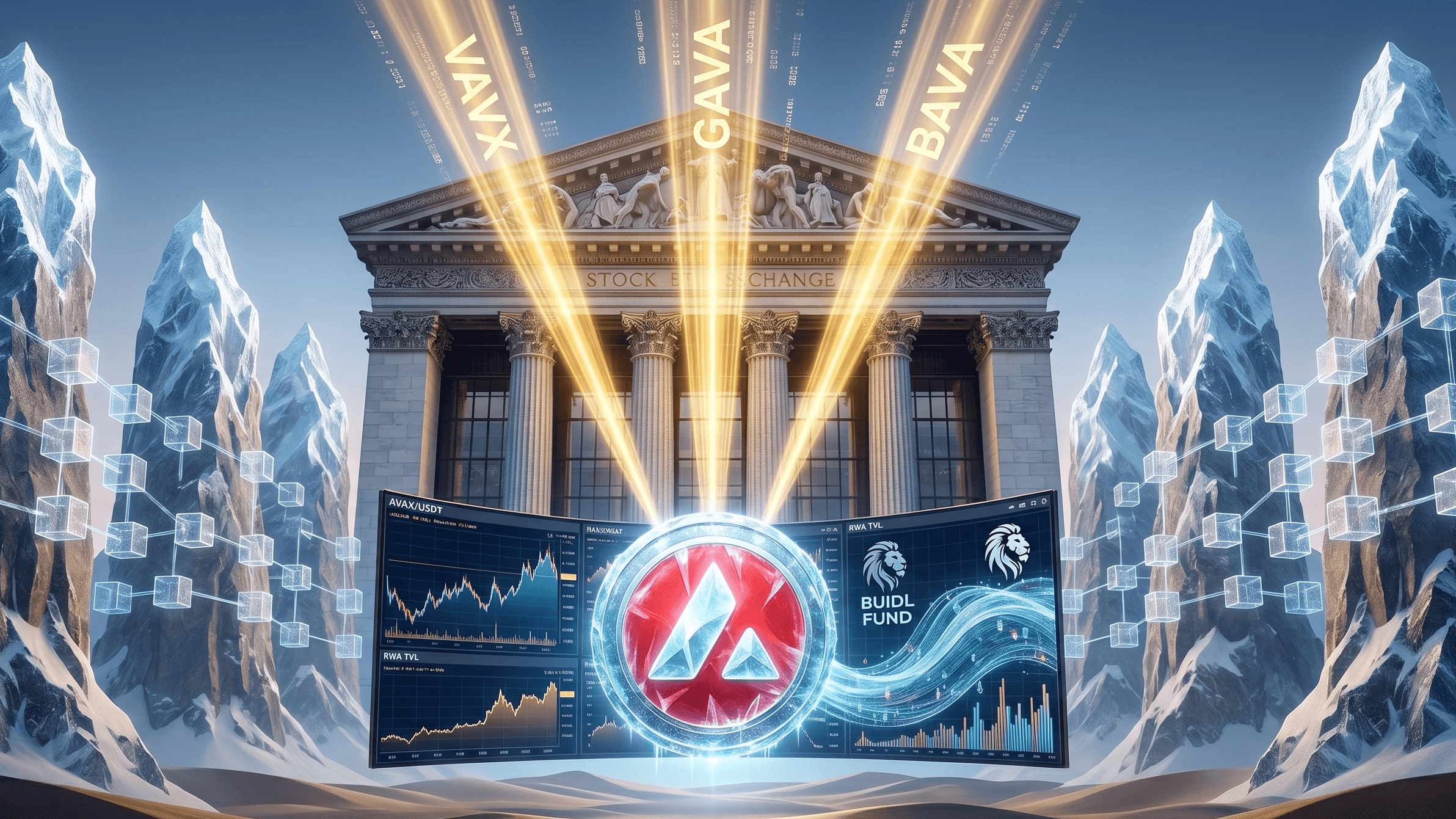
Three spot ETFs were listed in quick succession over approximately four months: VanEck's "VAVX" (January), Grayscale's staking-enabled "GAVA" (March, Nasdaq), and Bitwise's "BAVA" (April 15, NYSE). BAVA features a unique design that includes staking capabilities, with 0% fees for the first month up to $500 million.
SEC and CFTC Commodity Classification (March 2026)
Following the joint interpretive rule by the SEC and CFTC on March 17, 2026, AVAX was officially classified as one of 16 digital commodities. This has resolved securities-related risks, creating an environment where institutional investors can hold and manage AVAX more freely.
Daily Transaction Volume Hits 2026 High
Daily transaction volume surpassed 3.5 million in March–April 2026, and the number of active addresses has expanded 5 to 7 times compared to 2025. This growth is driven by real-world usage rather than speculation.
AVAX Risks and Considerations
Price Stagnation: As of April 2026, the price remains in the $9 range, down approximately 94% from its ATH. The $10 resistance level has suppressed multiple rallies, and market attention is focused on whether the ETF listings will act as a catalyst to break this threshold.
High Competition: AVAX is constantly compared to Solana and various Ethereum L2 networks. Since Ethereum is also strong in the RWA sector, maintaining its unique position remains a challenge for AVAX.
Accumulating Subnet Demand: While construction costs have decreased, further adoption cases are needed to translate actual transaction volume on subnets into direct demand for AVAX.
Trading AVAX on WEEX
WEEX supports both AVAX/USDT spot trading and AVAXUSDT futures trading.
Spot Trading: Suitable for holding strategies linked to mid-to-long-term fundamentals, such as ETF listings and expanding RWA adoption.
Futures Trading: With abundant catalysts like ETF listings and commodity classification, traders can respond to news-driven price movements with long or short positions. Always ensure you set TP/SL (Take Profit/Stop Loss) orders.
Summary
AVAX is a Layer 1 blockchain with three core strengths: subnets (enterprise-dedicated chains), high-speed processing, and RWA tokenization. In 2026, the environment for institutional entry has rapidly matured through commodity classification, a three-ETF lineup, BlackRock adoption, and record-breaking daily transaction volumes. While the price continues to consolidate in the $9 range, the strength of its fundamentals exceeds what current levels suggest. You can trade both AVAX/USDT spot and AVAXUSDT futures on WEEX.
Frequently Asked Questions
Q. What is an AVAX subnet?
An Avalanche subnet is a mechanism that allows companies and developers to build their own independent blockchain (L1) while leveraging the security of Avalanche. It enables custom fee structures, validator requirements, and access control, and is increasingly being adopted by financial and public institutions. The Avalanche 9000 upgrade at the end of 2024 significantly lowered construction costs, removing barriers to entry.
Q. What is the difference between AVAX and SOL (Solana)?
While both are high-speed, low-cost L1s, their design philosophies differ. Solana pursues high throughput on a single chain as a monolithic L1, whereas AVAX excels in enterprise-grade custom chains via subnets and interoperability. AVAX is currently leading in compliance-ready solutions for institutions and enterprises, as well as in the RWA sector.
Q. How can I trade AVAX on WEEX?
WEEX offers both AVAX/USDT spot trading and futures trading. Futures allow for up to 400x leverage, but beginners should start with low leverage (1–3x) and always set TP/SL (Take Profit/Stop Loss). We recommend using the demo trading feature first to get a feel for the platform.
Disclaimer
WEEX and its affiliates provide digital asset exchange services, including derivatives and margin trading, only to eligible users in legally permitted regions. This content is for general information purposes only and does not constitute investment advice. Please consult with a professional before trading. Cryptocurrency trading involves high risk, and you may lose all of your invested capital. By using WEEX services, you acknowledge that you agree to all relevant risks, Terms of Service, and Risk Disclosure. Please trade at your own discretion and within your means.