What is Metaverse 2026? Which metaverses are suitable for crypto beginners?

 Prefer us on Google
Metaverse is an "immersive" 3D virtual network where users interact via avatars and can generate a digital economy.
The 2026 metaverse landscape leans toward practicality: games/UGC retain mass users, while enterprise/industrial metaverse focuses on digital twins and simulations to generate ROI.
For new crypto investors, the priority is to identify which metaverses are actually functional and understand the risks of digital asset "hype" (especially "virtual land").
What is the Metaverse?
Major sources often describe the metaverse using several common attributes: persistent, immersive, social, and potentially featuring a "virtual economy".
Three definitions worth following when you read news:
Britannica: The metaverse is a network of immersive online worlds (usually via VR/AR) with interactions and the buying/selling of goods/services (even those that exist only online).
Gartner: The metaverse is a shared, persistent 3D virtual space; ideally device-independent and not owned by a single provider; the virtual economy can be "enabled" by crypto & NFT.
Meta: The metaverse is the "next evolution of social technology" and the "successor to the mobile internet," consisting of linked immersive 3D spaces.
From an academic perspective, Dionisio et al. describe the "Metaverse" as a shift from many disconnected virtual worlds to an interconnected 3D network, requiring specific standards for interoperability and scalability.
A practical perspective for crypto beginners: the metaverse does not require the use of blockchain; blockchain is merely a "layer" for recording ownership and transactions in certain Web3 metaverses.
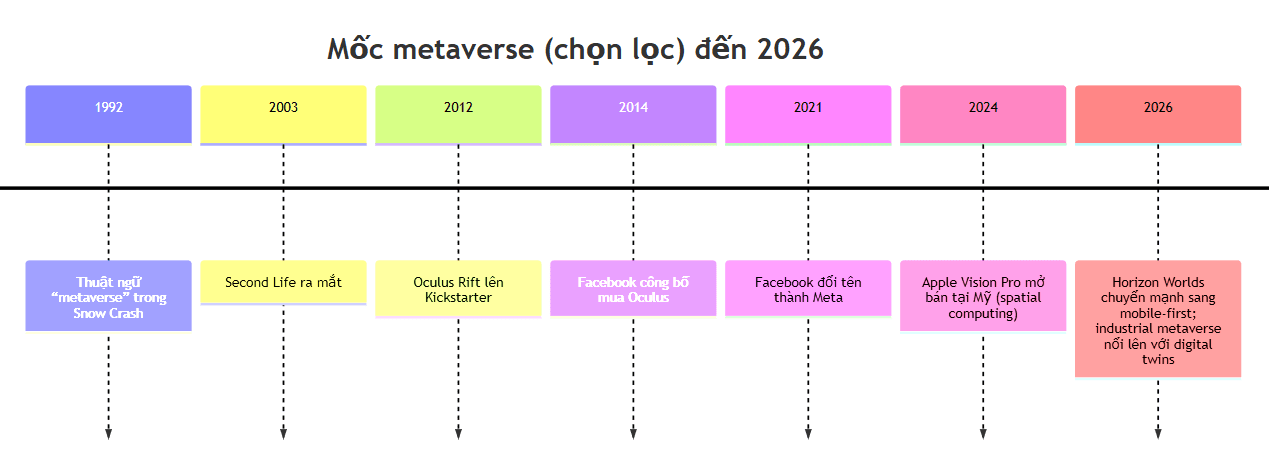
Reference milestones: Britannica (Snow Crash/Second Life), Linden Lab (Second Life), Kickstarter + Meta (Oculus), Apple (Vision Pro), The Verge (Horizon Worlds 2026), Siemens/NVIDIA (industrial metaverse).
Metaverse 2026
Regarding the market, many organizations are moving away from the "one virtual world for everything" narrative to focus on measurable problems: digital twins, simulations, training, and design. McKinsey calls this the "enterprise metaverse" and emphasizes digital twins as the foundation for reaching that stage.
For example, Siemens describes the "industrial metaverse" as a convergence of cloud/edge, industrial AI, and Digital Twins to optimize processes; NVIDIA Omniverse is positioned as a library and microservices suite for developing digital twin and industrial simulation applications.
In the consumer space, multi-device access is prioritized to increase user numbers. Meta stated it is shifting Horizon Worlds "almost entirely" to mobile and moving away from a Quest VR-only focus—indicating that VR-only remains difficult to scale.
Opportunities for new investors usually lie in choosing the right "product with users" or "infrastructure with demand." A common risk is buying into the narrative that "metaverse land is as scarce as real estate"; WIRED warns that a "land rush" easily creates an illusion of value when products are still nascent/have few users/lack interoperability, leading to high volatility in NFTs/tokens and difficulty in exiting positions.
Two examples for new investors
Conservative example: experience a platform that does not require buying tokens (Roblox/Fortnite/Spatial) to understand real demand; if you still want "metaverse 2026 exposure," use only a very small budget and prioritize tokens with clear documentation (MANA/SAND) rather than buying "land".
Risk: tokens remain highly volatile; there is no guarantee of adoption.
Speculative example: buying LAND/NFTs in Web3 metaverses and expecting price appreciation. Risk: low liquidity + valuations easily driven by "hype"; WIRED emphasizes that a "land rush" can be an illusion when products are still nascent/have little interaction.
Conclusion
Metaverse 2026 is "many metaverses": the entertainment/UGC segment leads user adoption, while the enterprise/industrial metaverse leads with practical value through digital twins.
Call-to-action: choose 1 platform from the list, experience it for 30 minutes, then answer 3 questions for yourself: what is the value for the user, where does the money come from, and are you buying "utility" or buying a "story"?
Related articles from WEEX
- What is War Coin Crypto? Explaining the War Coin concept for beginners
- Crypto tax policies in selected countries: the US, the EU, Japan, South Korea, and Vietnam
- Why did the price of bitcoin drop sharply at the beginning of 2026? What will bitcoin's price be like in 2026 for beginners | WEEX Crypto Wiki
Open a crypto trading account on WEEX
WEEX provides:
- A simple, user-friendly interface, even for those who have never invested.
- 24/7 customer support in Vietnamese, quickly answering all inquiries.
- A multi-layer security system, ensuring your assets are always safe.
- An in-depth investment knowledge base, helping you track market trends and make accurate decisions.
WEEX is the ideal choice if you are looking for a reputable platform to start your crypto investment journey and explore potential AI projects.
Disclaimer:
WEEX and its affiliates provide digital asset exchange services, including derivatives and margin trading, only where legal and for eligible users. All content is general information, not financial advice—seek independent advice before trading. Trading cryptocurrency carries high risk and can lead to total loss. By using WEEX services, you accept all risks and related terms. Never invest more than you can afford to lose. See our Terms of Use and Risk Disclosure for details.
Disclaimer: This content is provided for general branding and informational purposes only and doesn't constitute financial, investment, legal, or tax advice. Any events, rewards, online events, or related information mentioned herein should not be considered a recommendation, solicitation, or invitation to purchase, sell, trade, or otherwise deal in any crypto assets or to use any services. Crypto assets are highly volatile and may result in loss. WEEX services and online events may not be available in all regions and are subject to applicable laws, regulations, and eligibility requirements. You are responsible for ensuring that your use of WEEX services complies with local laws and for carefully assessing the risks before participating in any crypto-related activities.
You may also like
How to Bridge Assets to the Sui Network
Moving funds to the Sui network shouldn’t feel risky or confusing. This guide shows beginners how to bridge…
How to Set Up a Sui Wallet?
This guide shows how to choose a Sui wallet, install it on browser or mobile, create or import…
What Is Sui? A Complete Guide to the Sui Blockchain
Sui is an independent Layer-1 blockchain built for high throughput and low latency using an object-based data model.…
Top 5 DApps to Try on Base in 2026
Base has matured into a low-fee, consumer-friendly Layer 2 that’s ideal for trying DeFi, NFTs, and social apps…
How to Bridge Assets to Base Network?
Bridging assets to Base lets you tap low fees and fast settlement on an Ethereum Layer-2 built with…
Base vs Arbitrum vs Optimism: Which Layer 2 Should You Use?
Choosing between Base, Arbitrum, and Optimism comes down to fees, app depth, and how tightly each network is…
How to Add Base Network to MetaMask?
You’ll learn exactly how to add Base to MetaMask—manually or with one click—plus the official RPC, Chain ID,…
What Is Base? A Complete Guide to Coinbase’s Layer 2 Network
Base is a Layer 2 (L2) blockchain built on Ethereum that makes transactions faster and cheaper by moving…
Top 5 Wallets for Storing SUI in 2026
Choosing a Sui wallet in 2026 comes down to custody model, staking access, and how you interact with…
How to Set the Right Trailing Stop Percentage
A trailing stop helps you ride a crypto trend while automatically locking in gains as price moves in…
Trailing Stop vs Stop Loss: What’s the Difference
This guide breaks down the trailing stop and the classic stop-loss so you can choose the right order…
What Is a Trailing Stop Order? A Beginner’s Guide
A trailing stop is a dynamic exit tool that moves up with the market to protect gains and…
Copy Trading Platforms Compared: Which One Is Right for You?
The right copy trading platform depends on your experience, the markets you want to mirror (spot, futures, DeFi),…
Copy Trading Risks You Should Know Before You Start
Copy trading makes it easy to mirror the moves of experienced traders, but convenience can hide real risk.…
How to Choose the Right Trader to Copy
Copy trading lets you mirror another trader’s positions automatically, but the right choice hinges on more than a…
What is Roundhill Memory ETF Tokenized ETF (Ondo)(DRAMON) Coin? Everything You Need to Know Before Trading DRAMON/USDT
This guide explains what DRAMON is, how Ondo tokenizes the Roundhill Memory ETF exposure, how it works on-chain,…
Oil Trading Rewards: Share $100,000 Bonus on WEEX
WEEX is running a limited-time oil and energy trading campaign with a $100,000 reward pool. This guide explains…
Is Tangem Safe? Security Features Explained
Tangem is a card-based hardware wallet that stores your private keys inside a certified secure chip and signs…
SafePal vs Ledger: Which Wallet Should You Choose
Hardware wallets protect private keys off the internet, reducing the chance of remote hacks. This guide compares SafePal…
How to Set Up and Use SafePal Wallet? A Complete Beginner’s Guide
This beginner-friendly guide explains how to set up the SafePal app and S1 hardware wallet, create or import…
What Is SafePal Wallet? A Complete Beginner’s Guide
SafePal is a beginner-friendly crypto wallet brand that offers both a hardware wallet and a mobile software wallet…
Is Your Trailing Stop Costing You Money? Common Mistakes to Avoid
Have you noticed that after setting a trailing stop, you often get shaken out just before the real…
What Is Copy Trading? A Beginner’s Guide
Copy trading lets you automatically mirror another trader’s positions in real time. You choose a trader to follow,…
What is Credo Technology Group Holding Tokenized Stock (Ondo)(CRDOON) Coin? Everything You Need to Know Before Trading CRDOON/USDT
This article explains what Credo Technology Group Holding Tokenized Stock (Ondo) (CRDOON) is, how it works, who stands…
Is DCA a Good Strategy for Beginners?
Short answer: for most beginners, DCA (dollar-cost averaging) is a sensible starting point—simple, steady, and less stressful—though it…
Does DCA Actually Work? What the Data Shows
DCA (dollar-cost averaging) means investing a fixed amount on a set schedule, regardless of price. This article looks…
What is Astera Labs Tokenized Stock (Ondo)(ALABON) Coin? Everything You Need to Know Before Trading ALABON/USDT
This article explains what Astera Labs Tokenized Stock (Ondo) (ticker: ALABON) is, how tokenized stocks work, where to…
How to Set Up a DCA Strategy for Crypto
Dollar-cost averaging (DCA) helps crypto investors spread buys over time to reduce timing risk. This guide shows how…
USA Rare Earth Stock (USAR): Bull Case, Risks, and the 2028 Bet
USA Rare Earth stock (USAR) explained — what the company does, why shares slumped in 2026, the Round Top bull case, the MP Materials lawsuit, and key risks.
Costco Stock (COST): Price, Forecast, and Is It a Buy in 2026
Costco stock (COST) trades near $915–950 in July 2026 at ~48x earnings. See the latest price, analyst forecast, dividend, and how to buy.
How to Bridge Assets to the Sui Network
Moving funds to the Sui network shouldn’t feel risky or confusing. This guide shows beginners how to bridge…
How to Set Up a Sui Wallet?
This guide shows how to choose a Sui wallet, install it on browser or mobile, create or import…
What Is Sui? A Complete Guide to the Sui Blockchain
Sui is an independent Layer-1 blockchain built for high throughput and low latency using an object-based data model.…
Top 5 DApps to Try on Base in 2026
Base has matured into a low-fee, consumer-friendly Layer 2 that’s ideal for trying DeFi, NFTs, and social apps…
How to Bridge Assets to Base Network?
Bridging assets to Base lets you tap low fees and fast settlement on an Ethereum Layer-2 built with…
Base vs Arbitrum vs Optimism: Which Layer 2 Should You Use?
Choosing between Base, Arbitrum, and Optimism comes down to fees, app depth, and how tightly each network is…